


Key facts.
- RLSR research measured the generator-verifier gap on Countdown puzzles: Qwen 2.5 7B generated correct solutions only 36% of the time but verified them correctly 96% of the time, a 60-point gap that makes verification a cheap insurance layer (RLSR, arXiv 2505.08827).
- Constitutional Classifiers research showed that layered checking, rule-based constraints applied after generation, catches harmful outputs that generation alone does not self-prevent, reducing attack success rates by over 95% on jailbreak benchmarks (Constitutional Classifiers, arXiv 2501.18837, 2025).
- On GAIA's level-3 general assistant tasks, the best models succeed only ~15% of the time, but when equipped with structured verification steps, success rates rise substantially, confirming that the check, not the capability, is often the bottleneck (GAIA benchmark, arXiv 2311.12983).
- Generators hit 36%, verifiers 96%; a bigger model inherits a cheap check it skips, before the incident. (arXiv:2505.08827)
Scenario 1: The support agent that said the ticket was filed
A customer support agent receives a complaint, generates a ticket ID, and closes the conversation. The ticket ID is plausible but the CRM write failed silently due to a transient API error. Without a verification step, the agent reports "ticket filed" and the next agent in the workflow starts working on a ticket that does not exist. A post-generation state check, does this ticket ID exist in the CRM?, catches the failure in 200 milliseconds and retries the write before the customer ends the session.
Scenario 2: The finance agent that confirmed a payment
A payment processing agent confirms an order, generates a confirmation number, and marks the order as paid. The payment API returned a pending status that the agent parsed as success. A verification step that checks the actual payment status, not the agent's interpretation of it, catches the discrepancy and holds the order until payment clears. Without this check, the order ships and the payment never comes.
Scenario 3: The data agent that summarized the wrong quarter
A data agent is asked to summarize Q3 results. It retrieves a document, generates a summary, and returns it. The document was Q2. The agent never checked whether the document's date matched the requested period. A simple schema-level verification, does the retrieved document's period field match the requested period?, catches this before the summary reaches a board report.
Scenario 4: The coding agent that committed working code that failed tests
A coding agent generates a fix for a reported bug, writes the tests, and they pass locally. The agent then commits. The tests only covered the happy path the agent tested, the original bug still appears on edge cases. A post-generation test-run verification step that runs the full test suite before committing catches this. The agent had generated; it had not completed.
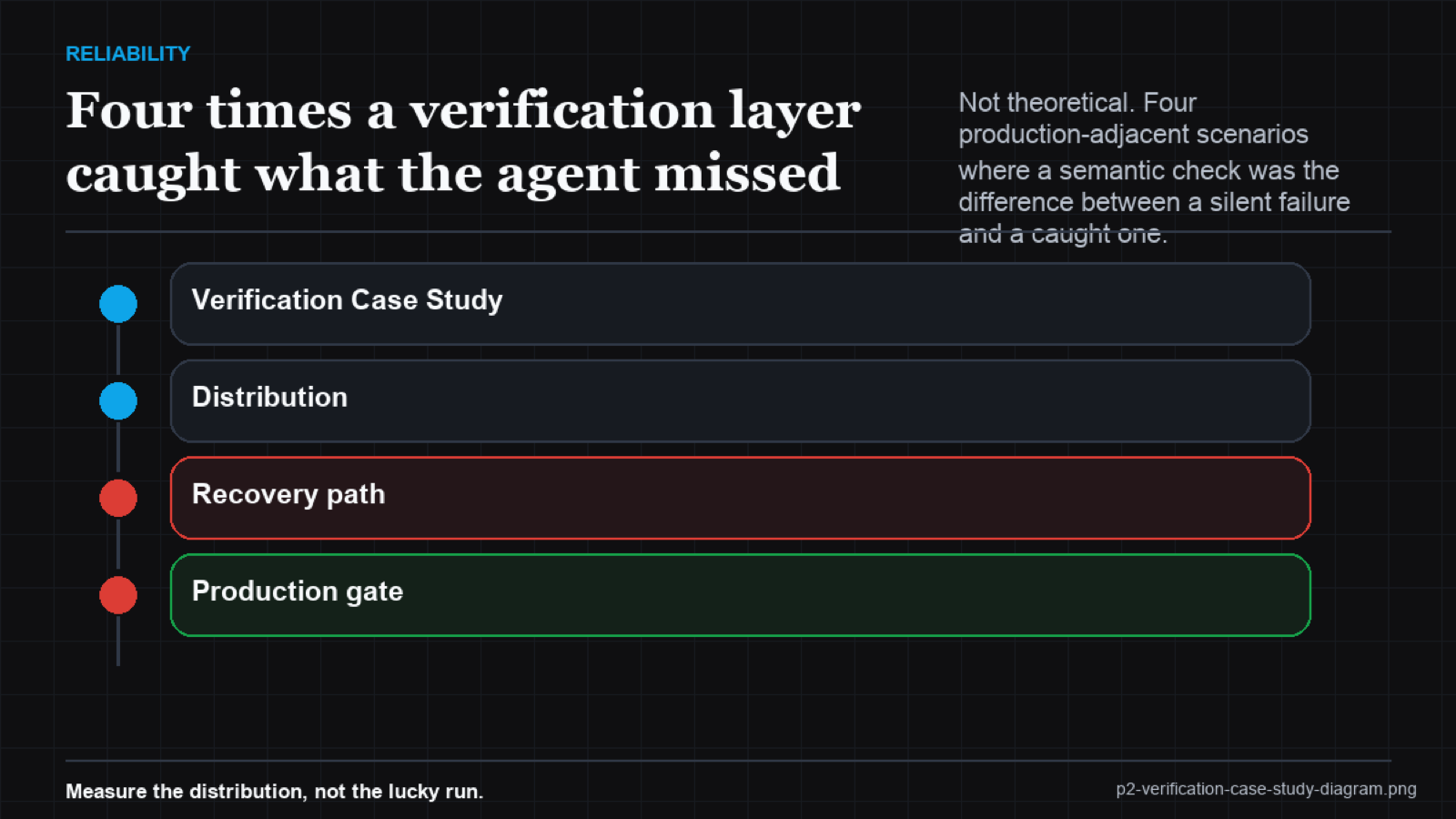
All four scenarios share the same structure: the agent generated something plausible, the environment did not behave as expected, and only a post-generation verification step closed the gap. This is the work the Pattern Intelligence Layer automates. You define what completion looks like; VibeModel checks whether the agent actually got there.
Frequently asked questions
These checks sound expensive to build for every agent.
The verification logic for most agent outputs is far simpler than the agent itself. Does the ID exist? Does the status match? Does the document period match? These are cheap API calls and field comparisons. The expensive version is the incident post-mortem when you did not have them.
What if the verification step is also wrong?
Verification failures are visible, they return an explicit negative signal rather than a silent wrong answer. That explicit signal is exactly what you need to trigger a retry, an escalation, or a human review. A caught failure is always better than a silent one.