

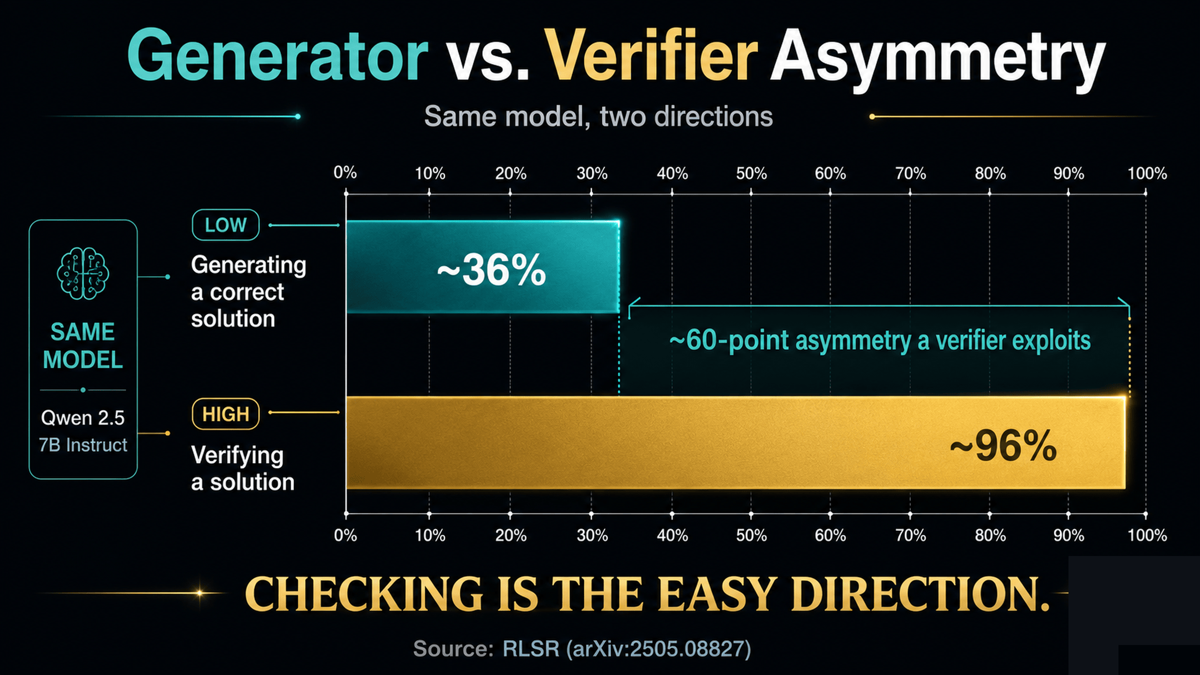
Even a strong frontier model gets only about a third of hard problems right on the first try, and left to check its own work it ships the rest. On the same model, generation accuracy sat near 36% while verification accuracy reached about 96%, a 60-point asymmetry you only capture with an independent verifier (RLSR, arXiv:2505.08827, 2025).
Key facts.
- The generator-verifier gap is large and exploitable: one model scored about 36% generating correct solutions but about 96% verifying them, a roughly 60-point asymmetry, because checking a solution is computationally easier than producing it (RLSR, arXiv:2505.08827, 2025).
- The generator cannot reliably fix its own reasoning without outside feedback: a controlled study found LLMs often fail to self-correct and can even degrade a correct answer when left to grade themselves (LLMs Cannot Self-Correct Reasoning Yet, arXiv:2310.01798, 2024).
- The verifier itself must be watched: an LLM judge carries position, length, and self-preference biases, so it is a calibrated instrument, not an oracle (Position bias in LLM-as-a-Judge, arXiv:2406.07791, 2024).
Why is a separate verifier worth it?
Because verifying is the easy direction of a hard problem. Across many tasks, confirming that a solution is correct is computationally simpler than producing it, the same way checking a proof is easier than finding one, and that shows up concretely: a model that solved a task correctly only about a third of the time could judge solutions correctly almost all of the time, a roughly 60-point gap (RLSR). An independent verifier exploits that asymmetry: it spends a fraction of the generator's effort to catch errors the generator, optimizing for a fluent answer, cannot detect in its own output. Since a model left to grade its own reasoning often fails to catch its mistakes (LLMs Cannot Self-Correct Reasoning Yet), adding an independent layer is the highest-return reliability move available.
Why do teams skip it anyway?
Cost, latency, and demo metrics. Every extra model call adds money and milliseconds, so under pressure to look fast and cheap, teams ship the generator alone and let it grade itself, which it does generously. The economics feel like they favor skipping verification, until the uncaught errors arrive as tickets, rework, and incidents. The other reason is that the obvious verifier, a frontier LLM judging another frontier model, has real limits: it carries position, length, and self-preference biases, and at the top of the capability curve a judge no stronger than the model it grades cannot reliably separate right from wrong (position bias). So teams conclude verification is expensive and weak. The fix is not to skip it; it is to verify the cheap, reliable way.
# An independent verifier grades the output before it becomes an action
draft = generator(task)
ok = verifier(draft, task) # smaller/specialized model OR deterministic check
if not ok.passes:
 draft = generator(task, feedback=ok.reason) # correct, re-plan, or escalate
commit(draft) # only verified output acts
How do you build a verification layer that pays off?
Verify cheaply and deterministically first, then add a model critic only where semantics demand it. Use schema and business-rule checks, the cheapest verifiers, to catch malformed and out-of-policy outputs for almost nothing. Add a smaller, specialized, or fine-tuned verifier model rather than a second frontier call, so you exploit the asymmetry instead of paying generator prices to check. Prefer process verification, checking each step, over grading only the final output, because per-step checking is what turns compounding error into reliability. Treat any LLM judge as a calibrated instrument: ground it against human labels, debias for position and length, and use a different model than the one being judged (position bias). Make the verifier a first-class, budgeted layer with escalation to a human on low confidence.
Generator-only versus a verification layer
| Concern | Generator alone | With an independent verifier |
|---|---|---|
| Self-blind errors | Graded generously by itself | Caught by an outside check |
| Malformed / out-of-policy | Propagates | Deterministic check rejects it |
| Cost of reliability | Bigger generator | Small verifier, asymmetry pays |
| Judge bias | Self-preference unchecked | Different model, calibrated |
| Compounding error | Final-only check, too late | Per-step process verification |
The pattern is that verification is the cheap direction of a hard problem, so an agent that runs on the generator alone is paying full price for reliability it could buy at a discount. Add a layered verifier, deterministic checks plus a small calibrated critic, verify per step, and keep a human on the low-confidence cases, and you catch the errors the generator cannot see in itself. Making independent verification a first-class layer rather than an optional cost is exactly what VibeModel builds as the Pattern Intelligence Layer.
Frequently asked questions
Why can't the generator just check its own work?
Because it grades the output with the same biases it generated it with, so it rates its own fluent-but-wrong answers highly. An independent verifier, ideally a different model plus deterministic checks, sees what the generator cannot.
Doesn't a verifier double my cost?
Not if you use the asymmetry: verifying is far easier than generating, so a smaller or specialized verifier, plus near-free schema and rule checks, buys most of the reliability without a second frontier call.
Is an LLM judge reliable enough?
Only as a calibrated instrument. It has position, length, and self-preference biases, so debias it, use a different model than the one judged, anchor on human labels, and prefer deterministic checks where you can.