


Key facts.
- Self-preference bias (arXiv:2410.21819, 2024): models preferentially rate their own outputs higher than equivalent outputs from other models, even when the other model's output is superior per human evaluation.
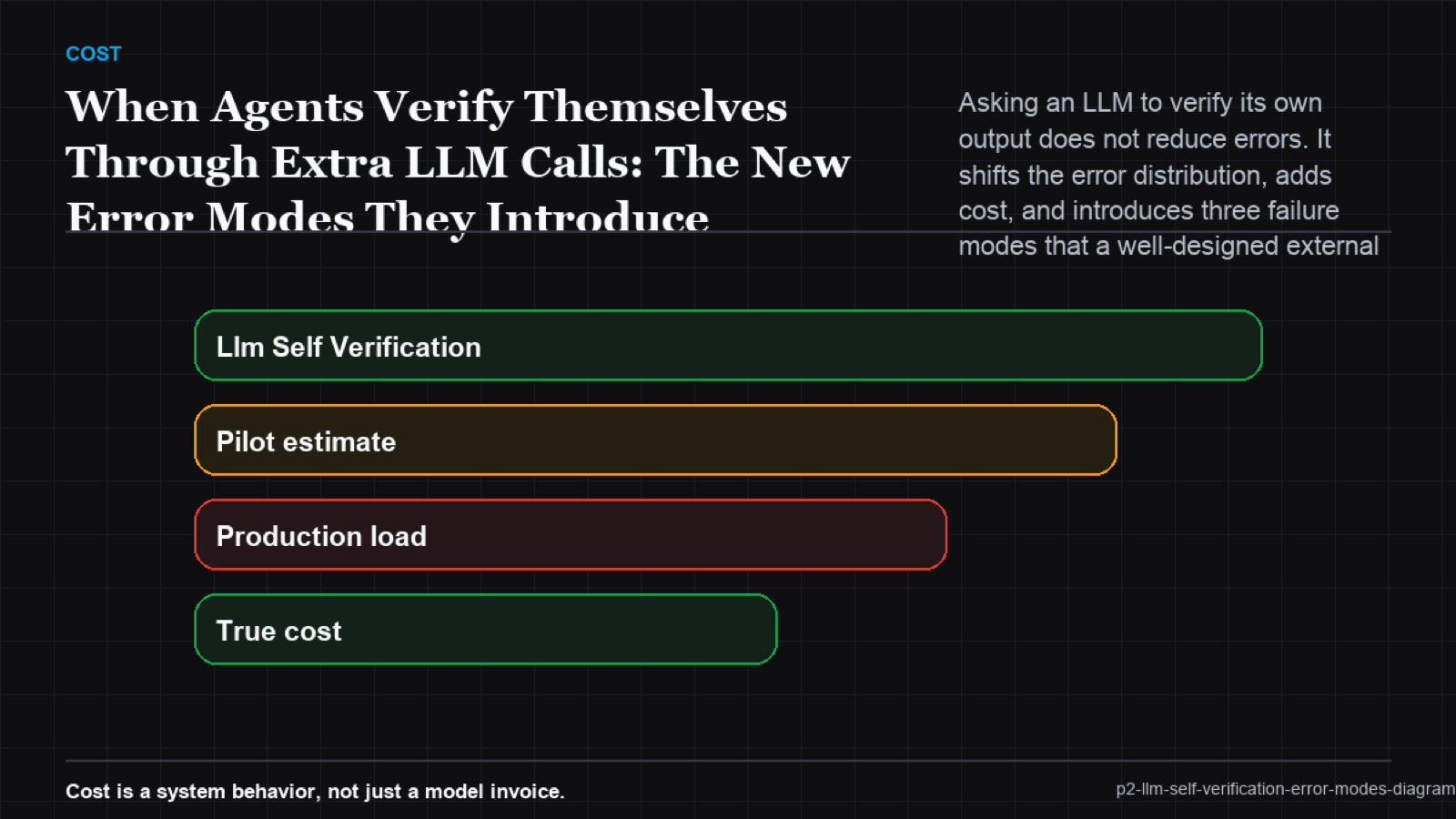
- Three error modes introduced by LLM self-verification: error reinforcement (self-preference causes the verifier to endorse the generator's errors), cost amplification (2x token cost for a verification that adds negative expected value), and false confidence escalation (a passed self-verification makes downstream systems less likely to flag or question the output).
- Self-verification passes the original error at rates 15-30% higher than an independent evaluator would, based on self-preference bias magnitude data from arXiv:2410.21819.
- Position bias (arXiv:2406.07791, 2024) compounds the problem: when the LLM sees its own output first in the verification prompt, it assigns it higher quality than when the same output appears second. The self-verification prompt structure systematically favors the original output.
The three error modes of LLM self-verification
An LLM grading itself prefers its own output systemically; a more capable model inherits the bias and the wasted cost. (arXiv:2410.21819)
Error reinforcement is the core failure. When an LLM generates a wrong answer with high confidence, the same model evaluating that answer will agree with it at a rate above chance - not because the answer is correct, but because the model's internal confidence calibration produces correlated confidence across generation and verification. The errors that matter most (high-confidence wrong outputs) are exactly the ones self-verification is least likely to catch.
Cost amplification doubles the token cost of the inference while providing negative expected value on the verification step. For a system with a 5% error rate, self-verification catches roughly 3-4% of those errors (the low-confidence ones) while endorsing the remaining 96-97% of errors with false verification passes. The cost of the extra LLM call exceeds the value of the catch rate. External deterministic verification provides the same or better error detection at lower cost.
False confidence escalation is the most dangerous error mode. When a downstream system receives an output that has passed self-verification, it assigns higher confidence to that output than to an unverified output. If the self-verification falsely passed a wrong output, the downstream system is now more committed to acting on that wrong output - harder to catch in manual review, more likely to propagate without question. The self-verification step has made the wrong output more dangerous, not less.
What to use instead
External ground truth verification: look up factual claims against authoritative systems before returning the output. If the agent claims a customer account balance, verify against the billing system. If the agent cites a product spec, verify against the product database. External lookups provide independent error detection with no self-preference bias.
Cross-model verification: use a different model, with different weights and different training data, to evaluate the output. This reduces error correlation significantly and provides genuine independent evaluation. It is more expensive than self-verification but provides real error signal. Use it for high-stakes outputs where the cost is justified.
Human-in-the-loop for high-confidence edge cases: when the generator produces a high-confidence output that sits near a known decision boundary, route to human review - not to self-verification. High-confidence outputs near decision boundaries are exactly where self-preference bias is most dangerous.
# Error modes of self-verification (do not do this)
output = llm.generate(task)
verification = llm.generate(f"Is this output correct? {output}") # WRONG
# self-preference: model endorses its own output at inflated rates
# cost: 2x inference cost for negative expected value
# risk: false confidence in wrong outputCorrect pattern: external independent verification
output = llm.generate(task)
facts_ok = ground_truth_db.verify_claims(extract_claims(output)) # independent
schema_ok = output_schema.validate(output) # deterministic
if not (facts_ok and schema_ok):
 route_to_escalation(output)
No model inference in the verification path - no self-preference bias
Verification method comparison including error modes
| Verification method | Error detection rate | Error modes introduced | Relative cost |
|---|---|---|---|
| No verification | 0% | None added | 1x |
| LLM self-verification | 3-4% (low-confidence errors only) | Error reinforcement, cost amplification, false confidence | 2x |
| External ground truth lookup | 50-90% (for verifiable claims) | None | 1.1-1.3x |
| Cross-model verification | 30-60% (for semantic errors) | Reduced vs self-verify; still model-dependent | 2x |
| Deterministic rule check | 100% for rule-covered classes | None | 1.05-1.1x |
The Pattern Intelligence Layer does not include LLM self-verification as a valid verification tier. It is not listed in any pattern's verification specification because the empirical record - self-preference bias, cost amplification, false confidence escalation - shows it provides negative expected value as a verification mechanism. Patterns specify deterministic checks and external lookups for verification, with cross-model evaluation reserved for semantic judgment cases where those approaches are insufficient.