


Key facts.
- LLMs-can't-Self-Correct (arXiv:2310.01798, 2023): same-model self-verification adds cost without meaningful error detection - the wrong kind of verification is expensive and unreliable.
- Deterministic rule checks add 5-50ms of latency per action - invisible in the latency budget of any enterprise workflow.
- External ground truth lookups add 50-200ms - visible but acceptable in most asynchronous workflows and in synchronous workflows when cached.
- The autonomy-killing verification design is the synchronous, blocking manual review for every action. The autonomy-preserving design is fast deterministic checks with a narrow escalation path that activates only on confirmed risk signals.
Three tiers of verification by speed and consequence
Self-checks add cost, not catches, as a class; a better model inherits the gap. (arXiv:2310.01798)
Tier 1: Instant deterministic checks (5-50ms). These run synchronously on every action and never block. Schema validation, range checks, policy rule evaluation, format conformance. These checks don't require model inference, network calls, or human judgment. they're the first line of defense and catch the majority of well-defined failure classes in milliseconds. They don't slow the agent.
Tier 2: Fast external lookups (50-200ms). Synchronous for high-confidence verification, asynchronous for lower-priority checks. CRM lookup to confirm an account ID, pricing query to confirm a quoted price, permissions check to confirm an authorized action. Network calls, but cacheable. Perceptible but acceptable in synchronous flows; invisible in async.
Tier 3: Model-based or human review (seconds to minutes). These activate only when tier 1 and tier 2 checks pass a risk signal that requires judgment: a tier-1 check flags a boundary case, a tier-2 lookup returns an ambiguous result, or a confidence threshold isn't met. This tier is the escalation path, not the default path. When designed correctly, it activates for a small minority of actions - not for every action.
Parallelizing verification with execution
Verification latency disappears when it runs in parallel with the next execution step. In a multi-step pipeline, verification of step N often runs concurrently with preparation for step N+1. The pipeline keeps moving. Prior-step verification catches up, or triggers a correction, before step N+2 needs step N's output.
This requires a non-blocking verification architecture: verification results are delivered as events, not as synchronous return values. The pipeline subscribes to verification events and responds when they arrive. Clear signal: proceed. Risk signal: escalate. The architecture is similar to circuit breakers in distributed systems: fast-path execution with asynchronous health signals that can interrupt the path when needed.
# Non-blocking parallel verification architecture async def agent_pipeline(steps): verification_tasks = []for i, step in enumerate(steps):
Execute step without waiting for prior verification
result = await step.execute()
Launch verification of this step asynchronously
v_task = asyncio.create_task(verify_step(step, result)) verification_tasks.append((i, v_task))
Check if any prior verification has completed with a signal
for idx, task in verification_tasks: if task.done() and not task.result().ok: await handle_verification_failure(idx, task.result()) return # halt pipeline at failure
Await all remaining verifications after last step
await asyncio.gather(*[t for _, t in verification_tasks])
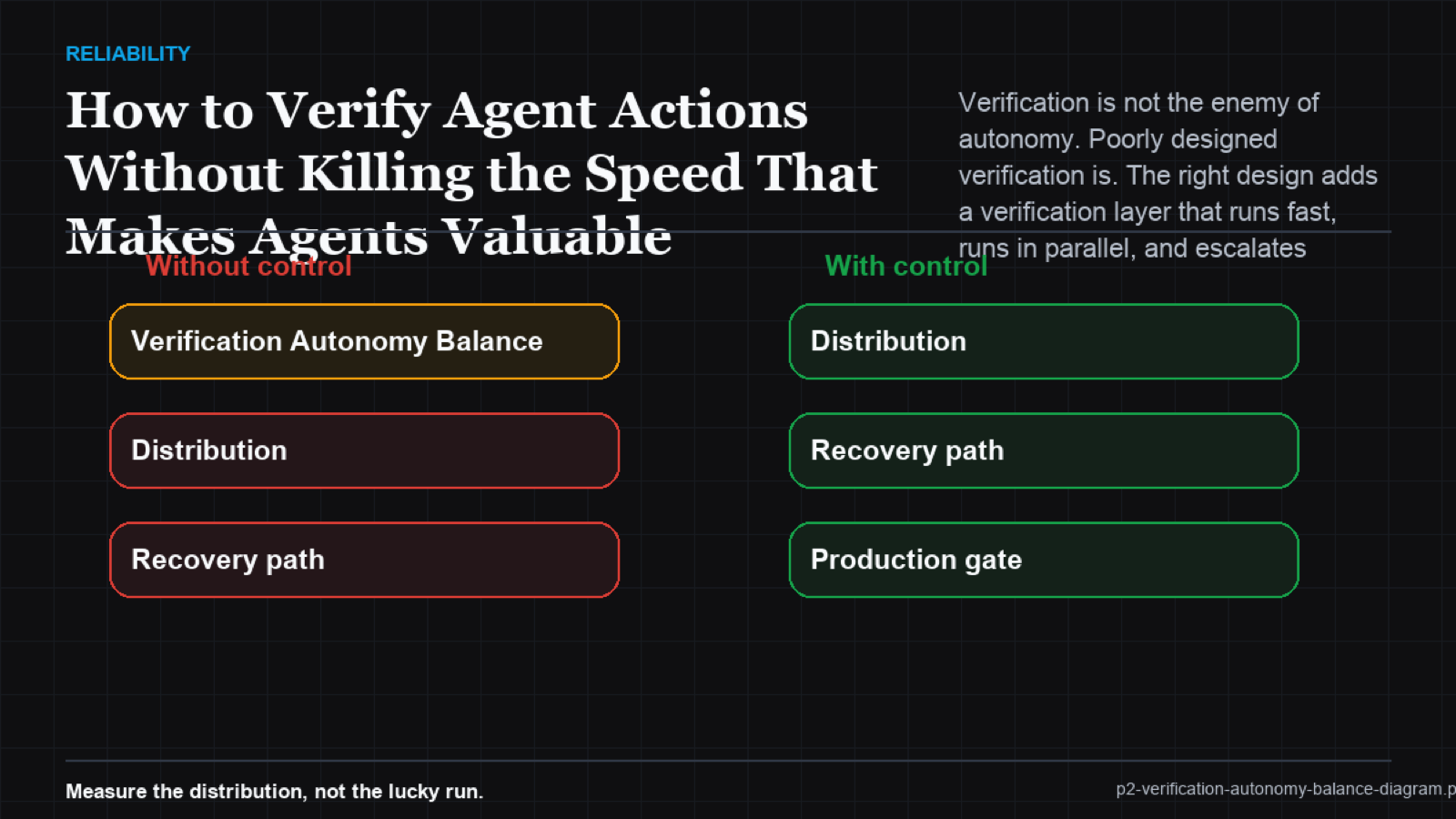
Verification design comparison
| Design | Latency | Autonomy impact | Error detection |
|---|---|---|---|
| No verification | 0ms | None | 0% |
| Synchronous blocking review | Minutes | Kills autonomy | High (human judgment) |
| Same-model self-check | 500ms-2s | Moderate slowdown | Low (correlated errors) |
| Tiered deterministic + async escalation | 5-50ms (sync), parallel async | Minimal | High (for rule-covered classes) |
The Pattern Intelligence Layer specifies which verification tier applies to each action class in a pattern. Low-consequence, high-frequency actions get Tier 1 checks only. High-consequence, low-frequency actions get all three tiers. Routine 90% of actions: autonomy at speed. The 10% that require it: precise, fast intervention. Both, from the same architecture. Autonomy and verification are complementary when the design is right.