

Key facts.
- Let's Verify Step by Step (arXiv:2305.20050, 2023): process verification at each step outperformed outcome-only verification by 8.4 points on multi-step reasoning tasks.
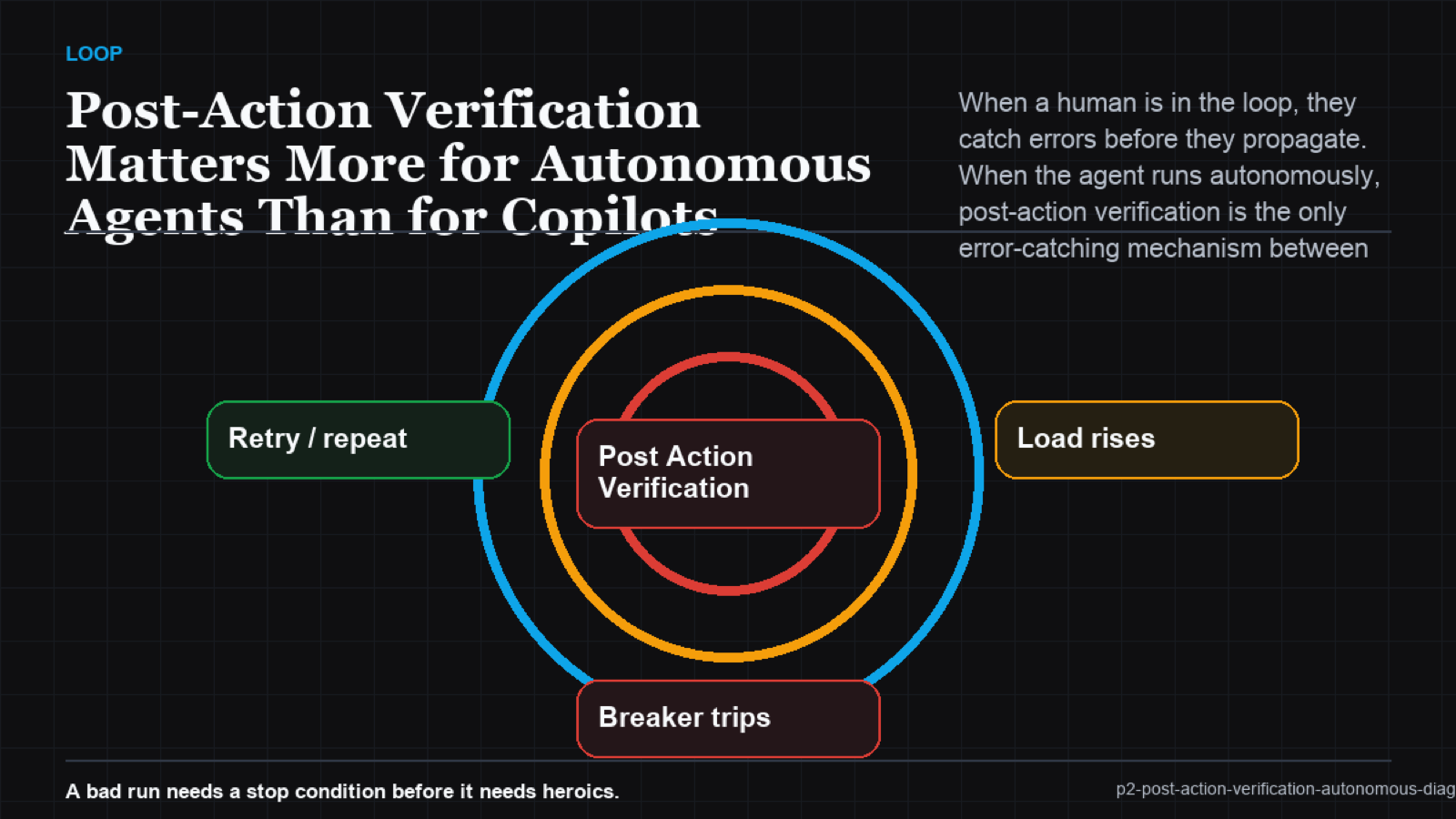
- Copilot deployments have an implicit verification layer in every human interaction - the user sees the output before it is actioned. Autonomous agents remove that layer entirely.
- The error propagation rate in autonomous agents vs copilots is approximately 3:1 per step - each unverified intermediate step in an autonomous agent is 3x more likely to carry an error into the next step than in a copilot workflow where humans can intervene.
- Post-action verification in autonomous agents must replace human judgment at three points: plausibility of the output (does it make sense?), compliance with policy (does it violate rules?), and consistency with prior context (does it contradict what the agent already knows or did?).
What human review provides that autonomous agents lack
Skip-step checks fail as a class; a frontier model inherits the late-rework gap. (arXiv:2305.20050)
In a copilot workflow, a human reads the agent's draft email before sending. They notice the wrong customer name. They fix it. Total impact: zero. In an autonomous email agent, the email sends immediately after generation. There is no human in the path. Total impact: wrong name sent to customer, brand and trust damage, potential compliance issue if the content is regulated.
The human in the copilot path provides three things: plausibility filtering (does this look right?), policy compliance (does this violate any rule I know?), and context consistency (does this match what I told the agent last week?). None of these are provided by the execution framework in most autonomous agent implementations. They must be explicitly designed as post-action verification steps.
The cost of adding these three checks as automated verification is significantly lower than the cost of a human review at scale - but the checks must be designed and implemented, not assumed to be provided by the model's own judgment. An autonomous agent that lacks post-action verification is an autonomous agent that makes the same errors as a copilot would, with no human to catch them.
Designing post-action verification for autonomous agents
Plausibility verification catches outputs that are technically valid but semantically wrong. The easiest implementation is an anomaly score: how different is this output from the distribution of previous outputs for this task type? Significant deviations are routed for human review. This does not require a model - statistical methods over output embeddings or structured fields are sufficient for most domains.
Policy compliance verification checks the output against the encoded policy set for the domain. Autonomous agents operating in regulated environments need this check to be comprehensive and auditable. For each action category, the compliance check should be able to produce a human-readable explanation of which rules were checked and which passed or failed.
Context consistency verification checks whether the current output is consistent with the agent's prior decisions and the task context. An agent that recommends Plan A in step 3 and then recommends Plan B in step 7 without acknowledging the change has a consistency failure. Autonomous agents need an explicit consistency check that humans provide implicitly.
# Post-action verification for autonomous agents
def post_action_verify(action_output, agent_context, policy_engine, anomaly_detector):
 checks = []1. Plausibility
 anomaly_score = anomaly_detector.score(action_output, agent_context.prior_outputs)
 checks.append(PlausibilityCheck(score=anomaly_score, threshold=0.8))
2. Policy compliance
 compliance_result = policy_engine.evaluate(action_output, agent_context.domain)
 checks.append(ComplianceCheck(result=compliance_result))
3. Context consistency
 consistency = agent_context.check_consistency(action_output)
 checks.append(ConsistencyCheck(result=consistency))
 if all(c.passed for c in checks):
 return VerificationResult.PASS
 return VerificationResult.ESCALATE(checks=[c for c in checks if not c.passed])
Autonomous vs copilot verification requirements
| Verification function | Copilot | Autonomous agent |
|---|---|---|
| Plausibility filtering | Human reads output | Anomaly detector on output distribution |
| Policy compliance | Human knows policy | Automated rule engine per action category |
| Context consistency | Human remembers context | Consistency check against session state |
| Final approval | Human clicks send/submit | HITL gate at irreversibility threshold |
The Pattern Intelligence Layer distinguishes between copilot patterns and autonomous patterns in its specification. Autonomous patterns ship with required post-action verification contracts across all three dimensions - plausibility, compliance, consistency - because the pattern definition knows that no human is in the path. Copilot patterns can reduce verification requirements where human review covers the gap. The architecture matches the oversight model.