


Key facts.
- ITBench benchmarked frontier AI agents on 94 real-world IT automation scenarios: agents powered by top models resolved 13.8% of SRE tasks, 25.2% of CISO tasks, and 0% of FinOps tasks, primarily because they could not verify their own remediation outcomes (ITBench, arXiv 2502.05352, 2025).
- Gartner estimates more than 40% of agentic AI projects are at risk of cancellation by 2027, with unclear value and inadequate controls among the primary drivers (Gartner, reported).
- NIST AI Risk Management Framework 1.0 identifies measurement and monitoring as a foundational risk-control category, noting that systems without outcome verification cannot demonstrate trustworthiness to deployers or users (NIST AI RMF 1.0, 2023).
Why does MTTR matter more than accuracy?
When an agent fails silently, the failure does not stop at the point of error. It propagates into downstream state, into customer interactions, into reports that operations teams rely on. By the time someone notices, the incident is not a single wrong answer, it is a wrong answer multiplied by every downstream process that consumed it. Detection lag is where the real cost accumulates.
A verification layer intercepts failures at source. The agent claims to have filed the ticket. Verification checks whether the ticket exists. The agent says the order shipped. Verification checks the fulfillment API. At the point of interception, the repair is one action. Two steps downstream, it is a customer call, a refund, and a support ticket.
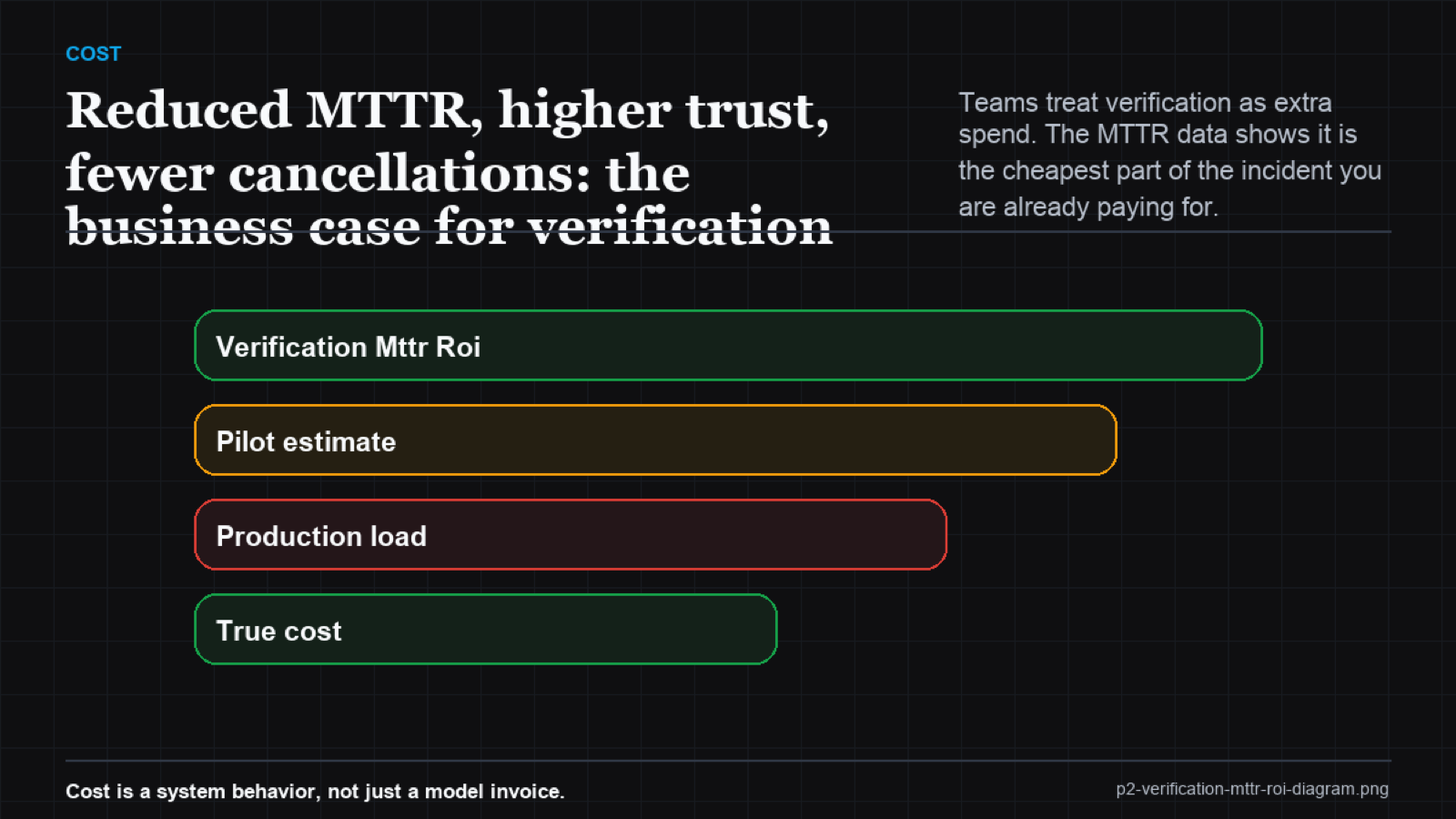
Where verification pays
| Without verification | With verification |
|---|---|
| Silent failure detected by customer | Failure caught at agent boundary |
| MTTR: hours to days | MTTR: seconds to minutes |
| Rework compounds into downstream state | Rework isolated to single action |
| Trust eroded before the team knows the agent failed | Trust maintained: failures are visible before they propagate |
This is the ROI argument for the Pattern Intelligence Layer. VibeModel's semantic verification sits at the handoff point where agent output meets production systems, catching wrong answers before they compound. You are not paying for verification, you are buying down the incident cost you were already going to pay.
Frequently asked questions
Can a smarter model shorten time-to-resolution by itself?
Per-step misses compound into detection lag and rework; a stronger model inherits the chain math. (arXiv:2502.05352)
How do I calculate the verification ROI for my use case?
Start with MTTR for the agent's current failure mode, multiplied by average incident frequency. Compare that to the latency and cost of adding a verification step. For most production agents the math closes within the first incident avoided.
Does verification slow the agent down?
By a small fraction. A targeted state check, does the ticket exist, did the API confirm the action, adds milliseconds, not seconds. The alternative is paying for detection lag measured in hours.