

Key facts.
- California Management Review's 2025 analysis of AI and agentic adoption frames durable success as a matter of sustainable operating pathways, not one-off heroics. source
- Anthropic's multi-agent research system delivered a 90.2% improvement over a single agent but consumed about 15 times the tokens, showing how brute-force reliability effort scales cost steeply. source
Why does heroic oversight fail?
Heroic oversight expires when the heroes do; a bigger model does not lower the bill, Anthropic's 15x tokens for a 90.2% gain. (source)
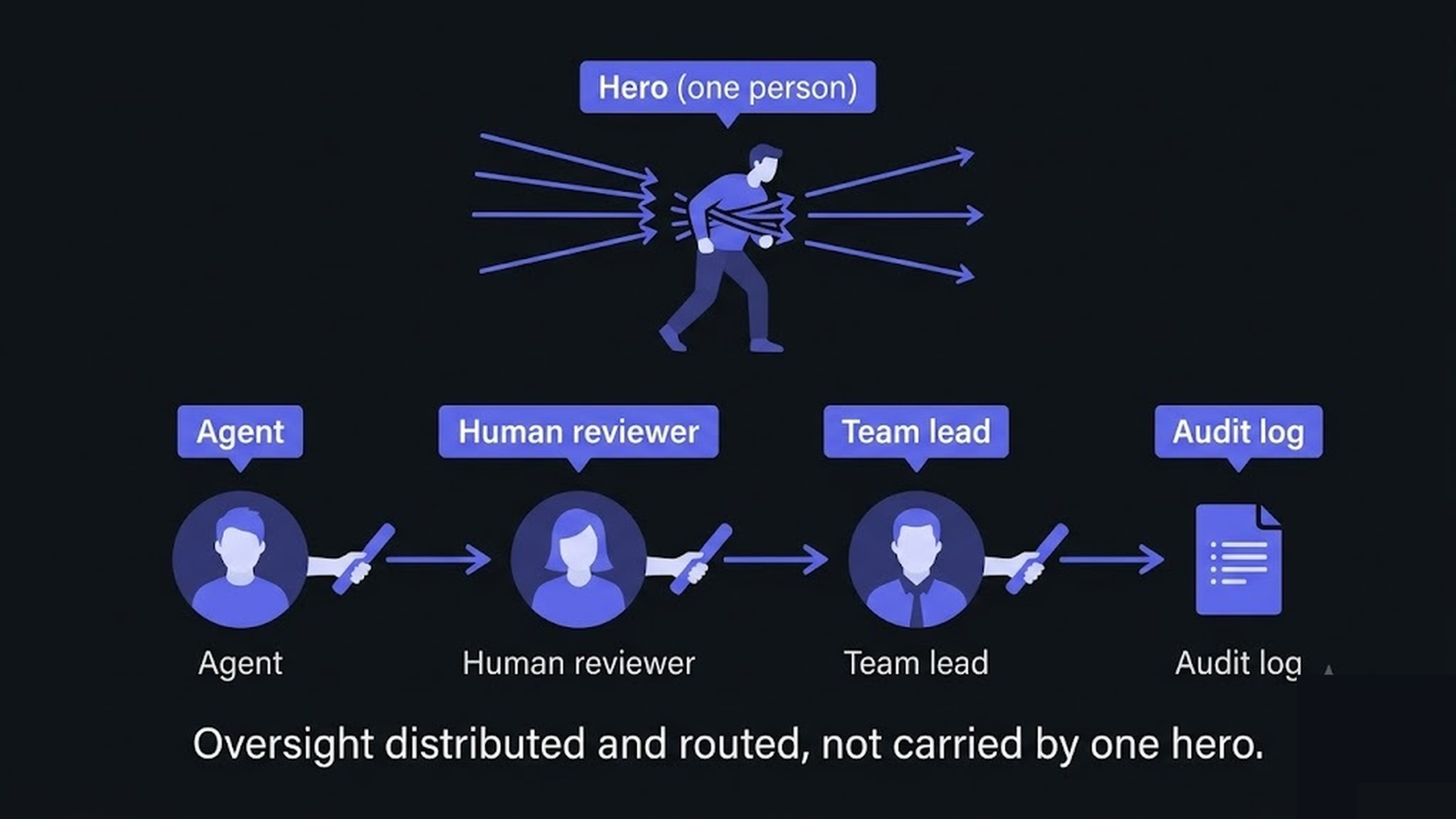
A common launch pattern is to assign a sharp engineer or analyst to watch the agent closely, catch its mistakes and patch issues as they arise. It works beautifully for a few weeks, which is exactly why it is dangerous. That coverage depends on one person paying heroic attention and attention is finite. They take a vacation, get pulled to another project or simply burn out and the oversight that looked solid evaporates with no system underneath it. The agent does not get safer over those weeks; it just borrows reliability from a person who cannot keep lending it.
The Anthropic figure reframes the economics of the brute-force instinct. Even at the model level, buying more reliability by spending more effort scaled the cost roughly fifteenfold. The human version is the same trap: you can hold an agent up with heroic effort, but the cost compounds and the supply runs out. Sustainable oversight does the opposite. It decides which actions are safe to run unsupervised, surfaces only the consequential decisions to a human and embeds the review in normal work so no one has to be a hero.
What makes oversight sustainable?
| Property | Heroic | Sustainable |
|---|---|---|
| Who holds it | One person's attention | A system and routing |
| What humans review | Everything | Consequential decisions only |
| Cost over time | Compounds, then collapses | Flat and predictable |
| When the hero leaves | Safety evaporates | Nothing changes |
Sustainable oversight depends on knowing which situations can run alone and which need a person, a judgment made at the pattern level. VibeModel is the Pattern Intelligence Layer because it handles the routine patterns the same correct way every time and surfaces the rest, so oversight scales with volume instead of with someone's stamina and the agent stays safe long after the launch-week hero has moved on.
Frequently asked questions
Isn't close human watching the safe choice?
Only until the watcher runs out. Heroic oversight borrows reliability from a person; a sustainable system owns it, so safety does not leave when they do.
How do you decide what runs unsupervised?
By consequence. Low-stakes, reliable patterns run alone; high-stakes or uncertain ones route to a human, which is what keeps the human's load survivable.
Why mention the token cost?
Because it shows brute force scales cost, not just effort. Buying reliability by spending more does not stay affordable, in tokens or in human attention.