


Key facts.
- McKinsey's 2025 global AI survey found inaccuracy the most cited risk, with nearly one-third of respondents reporting negative consequences from it. source
- Confidence in catching AI errors is low: surveys report only around 42% of support teams feel able to detect a hallucinated answer. source
- Because errors arrive in the same confident tone as correct answers, a customer cannot pre-filter them, so the first caught mistake recolors the rest. source
Why is trust so asymmetric?
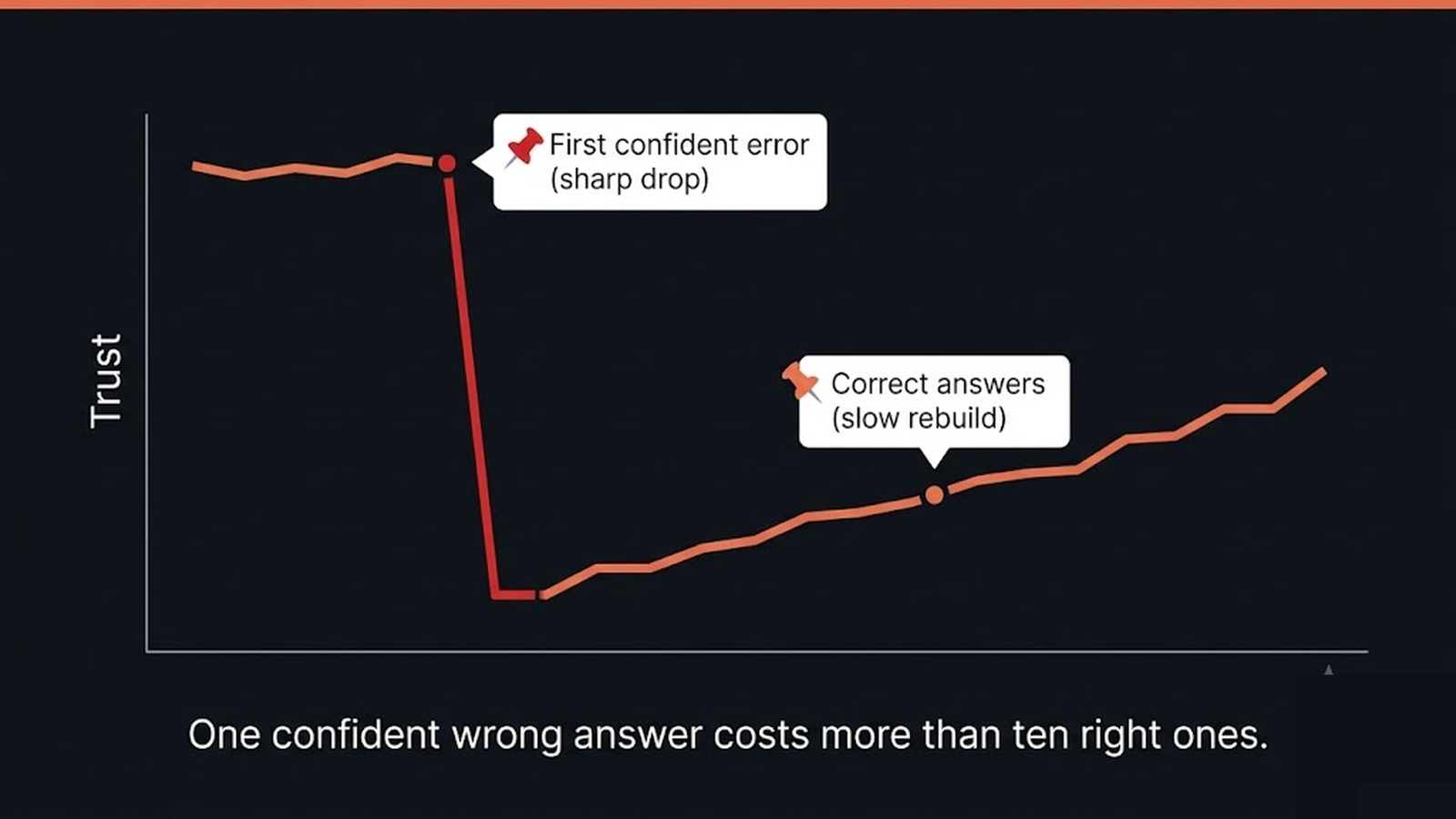
Because a confident wrong answer teaches the customer that the agent's confidence means nothing. Before the mistake, the customer takes the agent's answers at face value. After it, they know the agent will state a falsehood in exactly the same assured tone it uses for the truth, so they can no longer use confidence as a signal and they discount everything. This is why one early error costs more than its share. It does not just get one answer wrong, it devalues the currency the agent trades in, which is the customer's willingness to believe it. The McKinsey finding that inaccuracy is the top cited risk and the low confidence support teams have in catching errors, both point at the same thing: the cost of a wrong answer is not the wrong answer, it is the trust it takes with it.
Rebuilding is slow and incomplete. The customer who was burned reads later correct answers skeptically, double-checks what they would have accepted and is quicker to escalate or abandon. The agent is now doing accurate work that lands worse than it should, because the early error is still being paid for.
How do you protect early trust?
Make the agent reliably right where it speaks and honest where it does not know. Ground its answers so the early confident error does not happen and have it decline or escalate rather than guess, because a humble "let me check" never costs trust the way a confident falsehood does. The asymmetry means prevention dominates: it is far cheaper to avoid the first mistake than to rebuild from it. An agent that never spends its credibility on a confident wrong answer keeps the trust that makes all its later answers land.
| Early behavior | Effect on later answers |
|---|---|
| Confident wrong answer | Later correct answers discounted |
| Grounded, declines when unsure | Credibility preserved, answers believed |
Protecting that credibility is part of what VibeModel does as the Pattern Intelligence Layer. We model the patterns of an answer the agent can stand behind and the cases where it should decline, so your support agent keeps the early trust that determines how every later answer is received.
Frequently asked questions
Why does one error matter so much?
It removes confidence as a usable signal, so the customer discounts every answer after it. Trust falls in one step and rebuilds slowly.
Is declining really better than answering?
Yes, when the agent is unsure. A humble escalation preserves trust; a confident wrong answer spends it.
Can the agent recover lost trust?
Slowly and partially. Prevention is far cheaper, which is why grounding and honest declines matter most early.