


Key facts.
- Wavestone's 2025 global AI survey describes the paradox of adoption, where trust and explainability concerns gate uptake even as interest stays high. source
- Research on why language models hallucinate finds the confident wrong answer is incentivized by training and evaluation that reward guessing over admitting uncertainty, so opacity hides a real failure mode. source
Why does opacity drive more resistance than errors?
A usually-right black box still hides the confident wrong answer an upgrade rewards, so the cost stays invisible. (arXiv:2509.04664)
People can work with a tool that is sometimes wrong if they can see how it reached its answer and judge it. They struggle to trust one that hands down conclusions with no visible reasoning, even when it is usually right, because they have no way to tell a good answer from a confident wrong one. That is the black-box problem and it is a trust problem more than an accuracy problem. The hallucination research sharpens why the fear is rational: models are nudged by training toward confident answers over honest uncertainty, so an opaque agent will sometimes be sure and wrong with nothing on the surface to warn you.
The response that works is not a louder claim that the agent is accurate. It is making the reasoning legible: showing the sources it used, the steps it took and the confidence it should have. When people can see inside, they can extend the kind of bounded trust they give a competent colleague who shows their work. The opacity, not the occasional error, was the thing standing in the way.
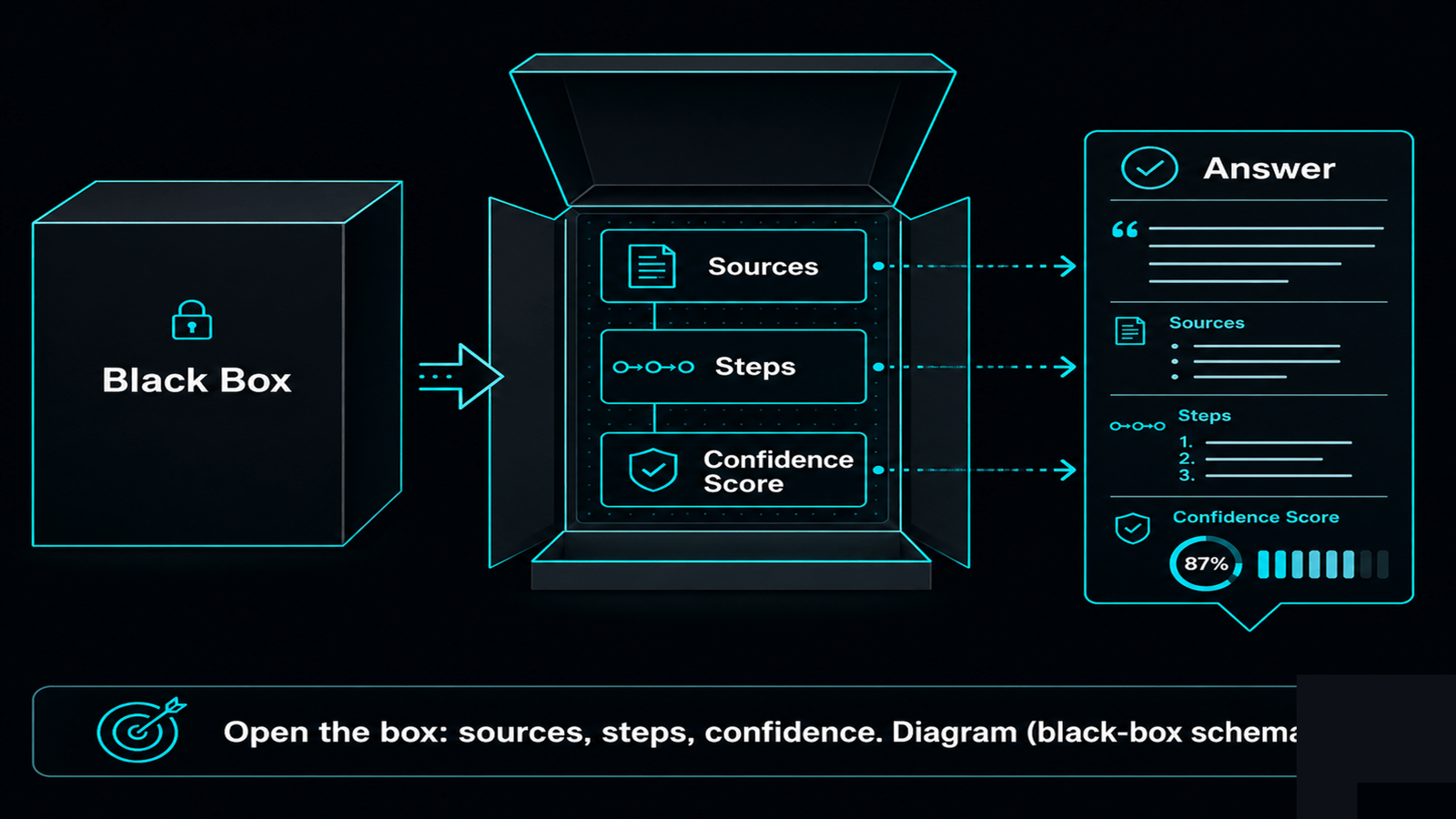
What makes an agent legible enough to trust?
| Dimension | Black box | Legible agent |
|---|---|---|
| Why it acted | Hidden | Shown: sources and steps |
| Confidence | Always certain-sounding | Expressed and bounded |
| How users respond | Resist regardless of accuracy | Extend bounded trust |
Legibility at the level people care about, the reasoning behind a decision, is what VibeModel surfaces as the Pattern Intelligence Layer. When the agent handles a situation through a visible, consistent pattern, a person can see why it did what it did and where to check it, so trust rests on something they can inspect rather than on faith in a box they cannot open.
Frequently asked questions
Won't a very accurate agent overcome the fear?
Not on its own. An opaque agent that is usually right still feels untrustworthy, because people cannot tell its good answers from its confident wrong ones.
Is explainability just a UI feature?
It is a trust mechanism. Showing sources, steps and confidence lets people calibrate reliance, which is what moves them from resistance to use.
Why are confident wrong answers so damaging?
Because in a black box they look identical to right ones. Research shows models are trained toward confident answers, so legibility is how you spot the difference.