

Key facts.
- GhostCite found leading LLMs fabricate citations at rates from roughly 14% to 95% across 40 domains, with about 50% of audited citations invalid. source
- Fabrication is delivered in the same confident tone as a correct answer, so the customer cannot tell a real fact from an invented one. source
- The customer attributes the agent's tone and errors to the company, not to a model, so the reputational cost lands on the brand. source
Why does an agent error hit the brand so hard?
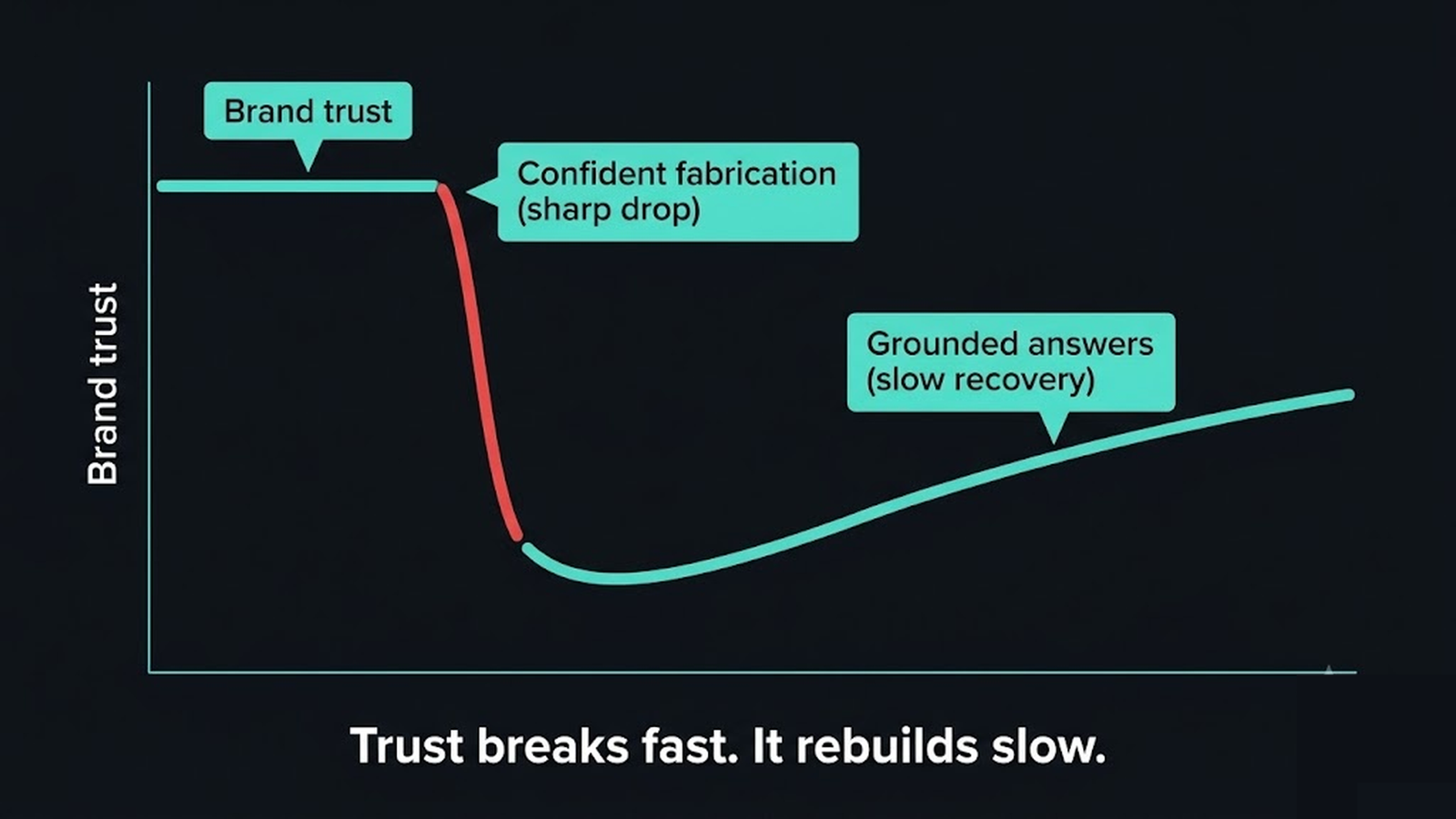
Because the customer experiences the agent as the company, full stop. There is no mental footnote that says "this is a third-party model that sometimes hallucinates." There is just a representative of your brand that was rude or wrong or made something up and the customer reacts to that the way they would to any employee who did the same. GhostCite shows how readily models fabricate and the failure is worse than a simple mistake because it is delivered with the same fluent confidence as the truth. The customer believes it, acts on it and when it turns out to be invented, the breach of trust attaches to your name. Then the screenshot of the bot saying something absurd or false travels and a single bad interaction becomes a public story about your brand.
Tone compounds this. An agent that is curt, dismissive or tone-deaf in a sensitive moment damages the relationship even when it is factually correct, because support is as much about how the customer is treated as what they are told. The agent is your brand's manner as well as its accuracy.
What keeps the agent on-brand?
Hold it to a representative's standard. Ground every factual claim so it cannot fabricate, constrain its tone to your brand's voice and make it decline rather than guess when it does not know. Review the cases where it failed and feed them back, because the agent that learns from its bad interactions stops repeating them. The bar is not "good for a bot." The bar is "good enough to speak for the company," because that is exactly what it is doing.
| Standard applied | Brand outcome |
|---|---|
| Good for a bot | Fabrications and tone errors reach customers |
| Good enough to represent us | Grounded, on-tone, declines when unsure |
To the customer the agent is the company; GhostCite found 14-95% invented citations and a better model fabricates more convincingly. (arXiv:2602.06718)
Holding the agent to that standard is part of what VibeModel does as the Pattern Intelligence Layer. We model the patterns of an answer that is grounded, accurate and on-tone, so your support agent speaks for the brand the way a trusted representative would, not the way an ungrounded model defaults to.
Frequently asked questions
Is tone really a brand risk?
Yes. A correct answer delivered coldly in a sensitive moment still damages the relationship. Tone is part of representing the brand.
How do I stop fabrication reaching customers?
Ground claims in real sources, verify support before sending and have the agent decline when it cannot ground an answer.
Why does one bad answer matter so much?
It is attributed to the company and it travels. Trust drops fast and rebuilds slowly, so prevention beats apology.