

Key facts.
- PwC's 2025 AI Agent Survey found 79% of companies adopting AI agents and 66% of adopters reporting measurable value, so agents are increasingly customer- and employee-facing. source
- On GhostCite, leading models fabricate citations 14 to 95% of the time depending on model and domain, the kind of confident error that erodes trust on contact. source
Why do customer-facing agents need a higher bar?
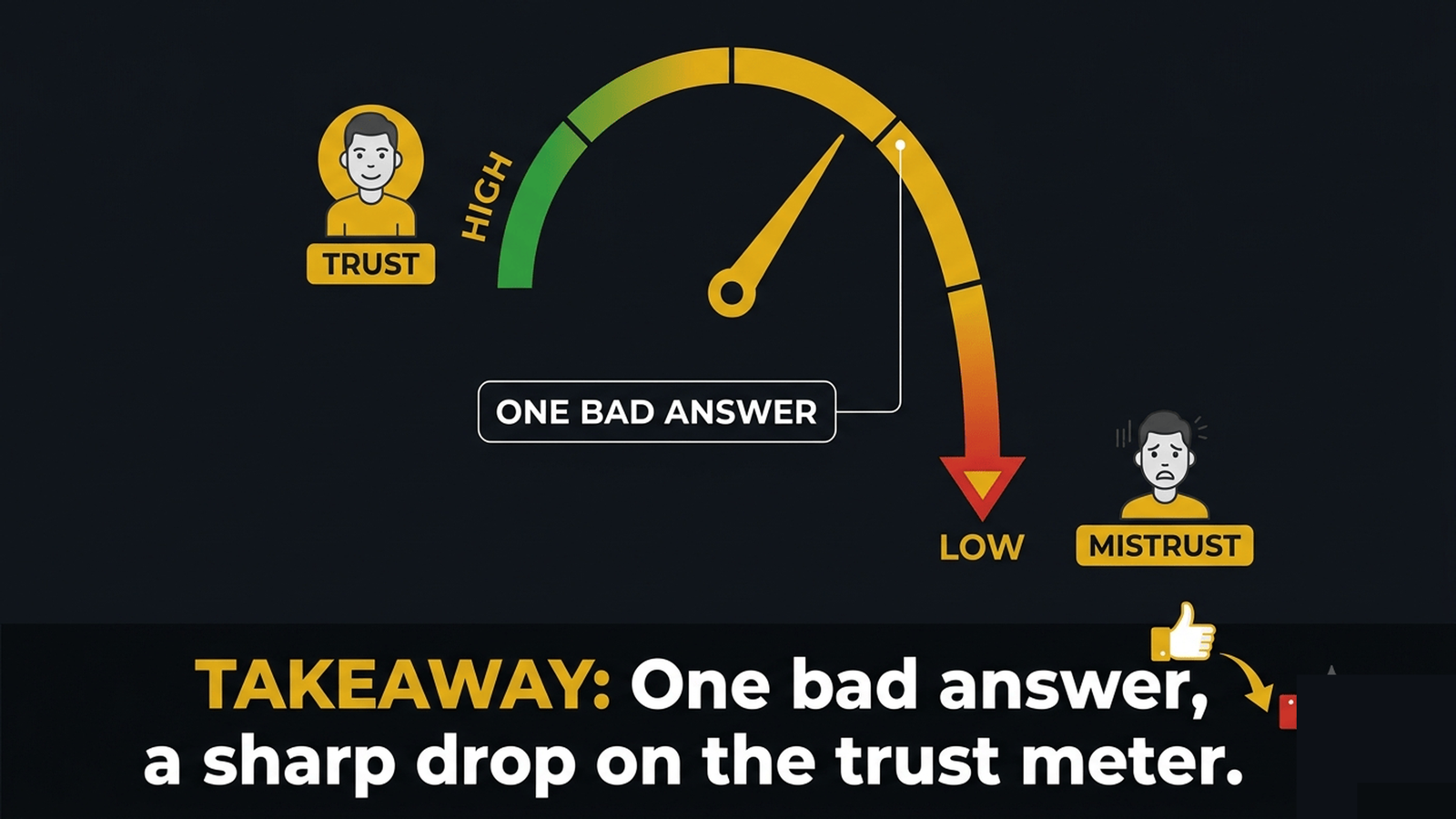
An internal agent that makes a mistake costs you a correction. A customer-facing one that makes the same mistake costs you trust and sometimes a legal position, because the customer experienced your company being wrong, confidently, to their face. The asymmetry is the whole point: the blast radius of a failure is far larger when it lands on a customer or an employee than when it stays inside the tool. The GhostCite range shows the failure is not hypothetical; models will produce confident, fabricated specifics and a support or advice agent that does this in a real interaction has converted a model limitation into a brand event.
So these agents earn a different standard. Tighter scope on what they can assert, verification before anything factual reaches the person, clear escalation when confidence is low and monitoring tuned to catch the plausible wrong answer, not just the crash. The PwC adoption numbers mean this is not an edge case to defer; agents are becoming the interface and the interface is where trust is won or lost. The higher bar is not caution for its own sake, it is matching the control to the consequence.
What does the higher bar include?
| Control | Internal tool | Customer-facing agent |
|---|---|---|
| Scope of assertions | Looser | Tight, verified before sending |
| Low-confidence cases | Best effort | Escalate to a human |
| Monitoring | Crashes | Plausible wrong answers too |
| A single failure | A correction | A brand and trust event |
A capability paradox: a more capable agent fabricates citations more convincingly to a customer, which becomes your company's position. (arXiv:2602.06718)
Matching control to consequence is exactly what the Pattern Intelligence Layer is for. VibeModel makes the agent handle a customer situation the same correct way every time and routes the uncertain ones to a person, so the patterns that reach a customer are the ones the agent is reliable on and the confident wrong answer that would have become your brand never leaves the building.
Frequently asked questions
Why treat customer-facing agents differently?
Because the cost of a failure is reputational and sometimes legal, not just a correction. The control bar should match the consequence, which is higher when a customer is on the other end.
What is the most dangerous failure here?
The confident wrong answer, like a fabricated fact or citation, because it looks authoritative to the customer and lands as your company's position.
Does this slow the agent down?
Only on the high-stakes path, where verification and escalation are worth it. Routine, reliable interactions still run fast.