

Key facts.
- Benchmarks like SupChain-Bench exist to evaluate LLMs on realistic supply chain tasks, because idealized performance does not predict real-world reliability. source
- Real supply chains feature delays, disruptions and demand shifts that an agent optimized for stability does not anticipate. source
- Demand forecasting and planning over volatile conditions is among the hardest parts of supply chain work for current models. source
Why does real variability break the agent?
SupChain-Bench exists because idealized scores miss real delays caught late; a more capable model handles the stable case, not disruption. (arXiv:2602.07342)
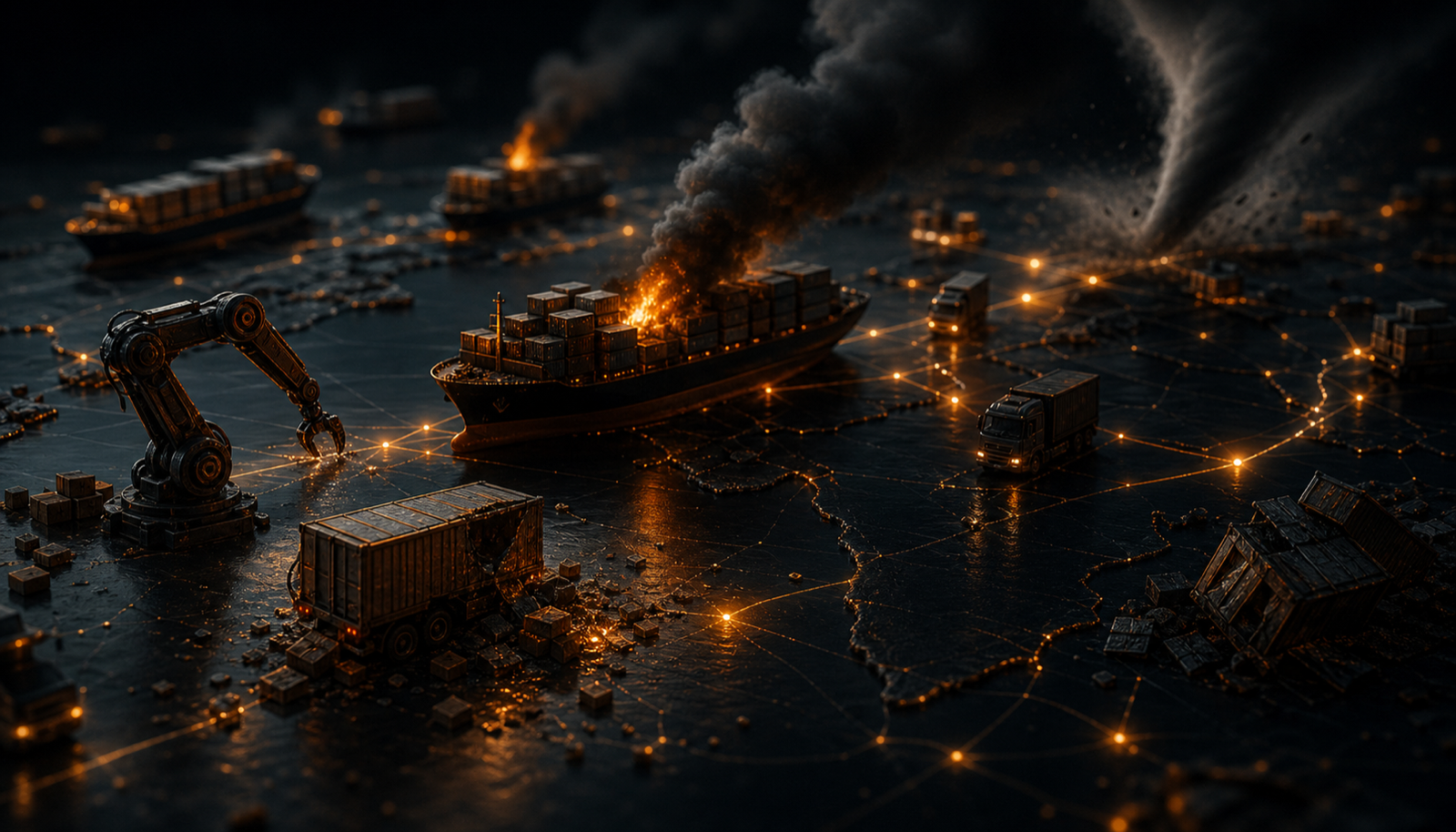
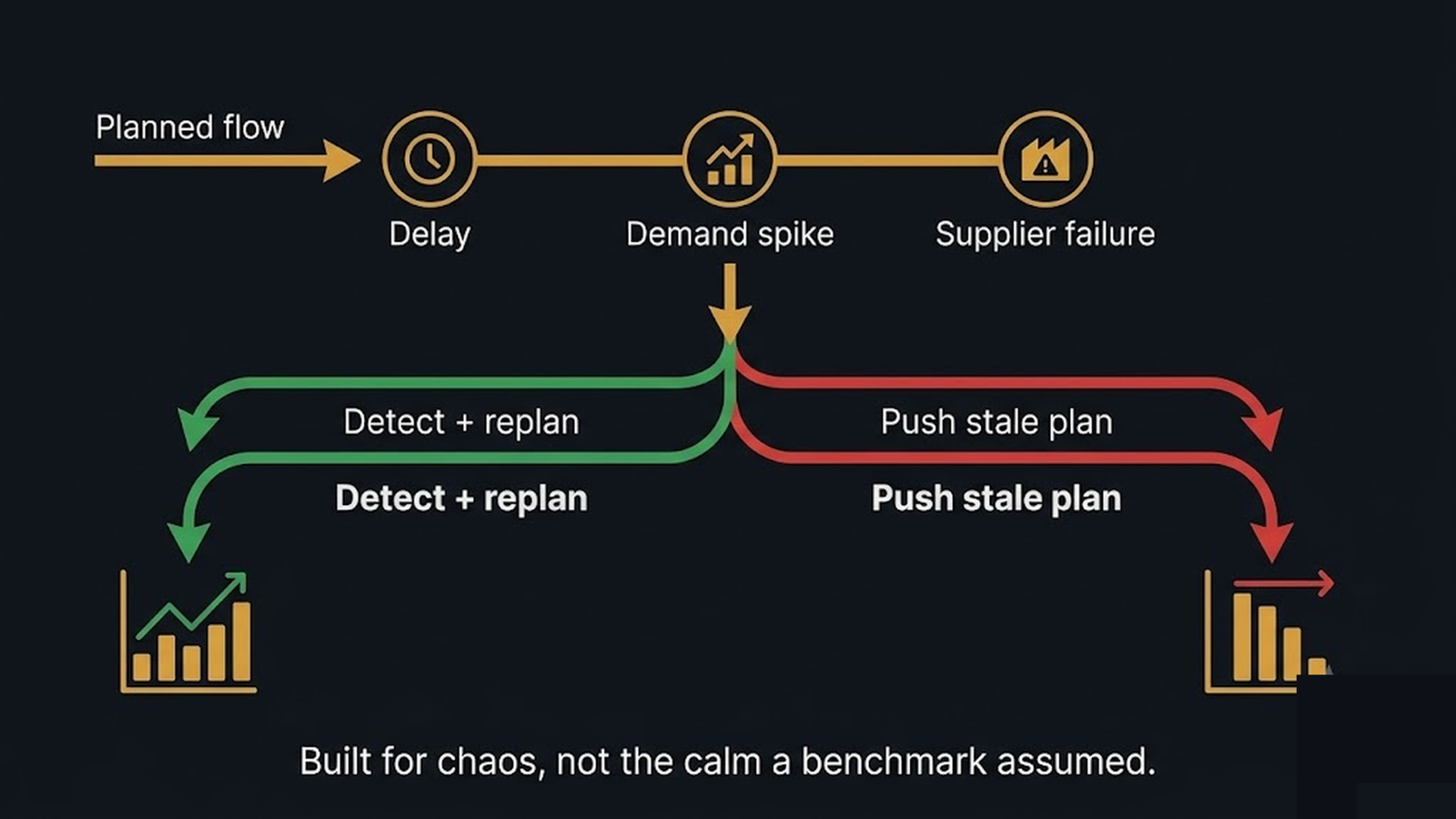
Because the agent was built and tested on a version of the supply chain that does not exist in operation. A test or a demo presents a stable world: predictable demand, reliable lead times, suppliers that deliver and the agent optimizes a plan for that world and performs well. The real supply chain is the opposite, a shipment delayed at a port, a demand spike from an event nobody forecast, a supplier disruption, a logistics failure and the agent's carefully optimized plan has no provision for any of it. The reason benchmarks like SupChain-Bench had to be built is precisely that performance on the idealized case is not informative about the real one, where the variability dominates. So the agent that looked capable, hitting its targets under stable conditions, meets the first real disruption and either pushes its now-invalid plan forward or has no adaptive response, because it was optimized for a stability the real world does not provide. The failure is not that the agent is weak; it is that it was tuned for the wrong distribution, the calm one rather than the chaotic one that actually governs supply chains.
The danger is that the stable-case performance gives false confidence. The agent's good numbers in testing suggest it is ready, when those numbers only mean it handles the easy conditions and the conditions that matter, the disruptions, are exactly the ones the test omitted.
What survives real conditions?
Detection and adaptation built for volatility. Design the agent to monitor for the disruptions that actually occur, delays, demand shifts, supplier failures and to replan when conditions change rather than executing a plan that reality has invalidated. Test it against realistic variability, not idealized stability, so its measured performance reflects the conditions it will face. Where a disruption exceeds what the agent can handle, route it to human judgment. The supply chain agent that survives is the one built to expect chaos and adapt to it, not the one that optimized a beautiful plan for a calm that never arrives.
| Agent design | Behavior under disruption |
|---|---|
| Optimized for stability | Pushes an invalid plan, no adaptive response |
| Built to detect and adapt | Replans for the disruption or escalates |
Building for that variability is part of what VibeModel does as the Pattern Intelligence Layer. We model the patterns of the disruptions a supply chain actually faces and the adaptive responses they require, so the agent is ready for the chaos that defines real operations rather than the calm a benchmark assumed.
Frequently asked questions
Why test against variability?
Because idealized performance does not predict real-world reliability, which is why benchmarks like SupChain-Bench exist. Test on the conditions you will face.
Can the agent handle every disruption?
No. Build it to detect and adapt to the common ones and to escalate the disruptions that exceed its scope.
Why does stable-case performance mislead?
It only measures the easy conditions. The disruptions that dominate real supply chains are exactly what the stable test omits.