


Key facts.
- McKinsey reports AI adoption in inventory management can cut logistics costs by up to 15% and improve service levels by up to 65%, with real deployments cutting stockouts and obsolete inventory. source
- That gain depends on reliable input data, since stale or inconsistent data produces confident wrong decisions. source
- The deployments that disrupt operations skip the data discipline, verification and scoping that the failures teach are necessary. source
- McKinsey ties AI inventory gains up to 15% lower logistics spend to discipline; a more capable model delivers them only on fresh data and bounded scope. (arXiv:2602.07342)
Why does the same capability help or harm?
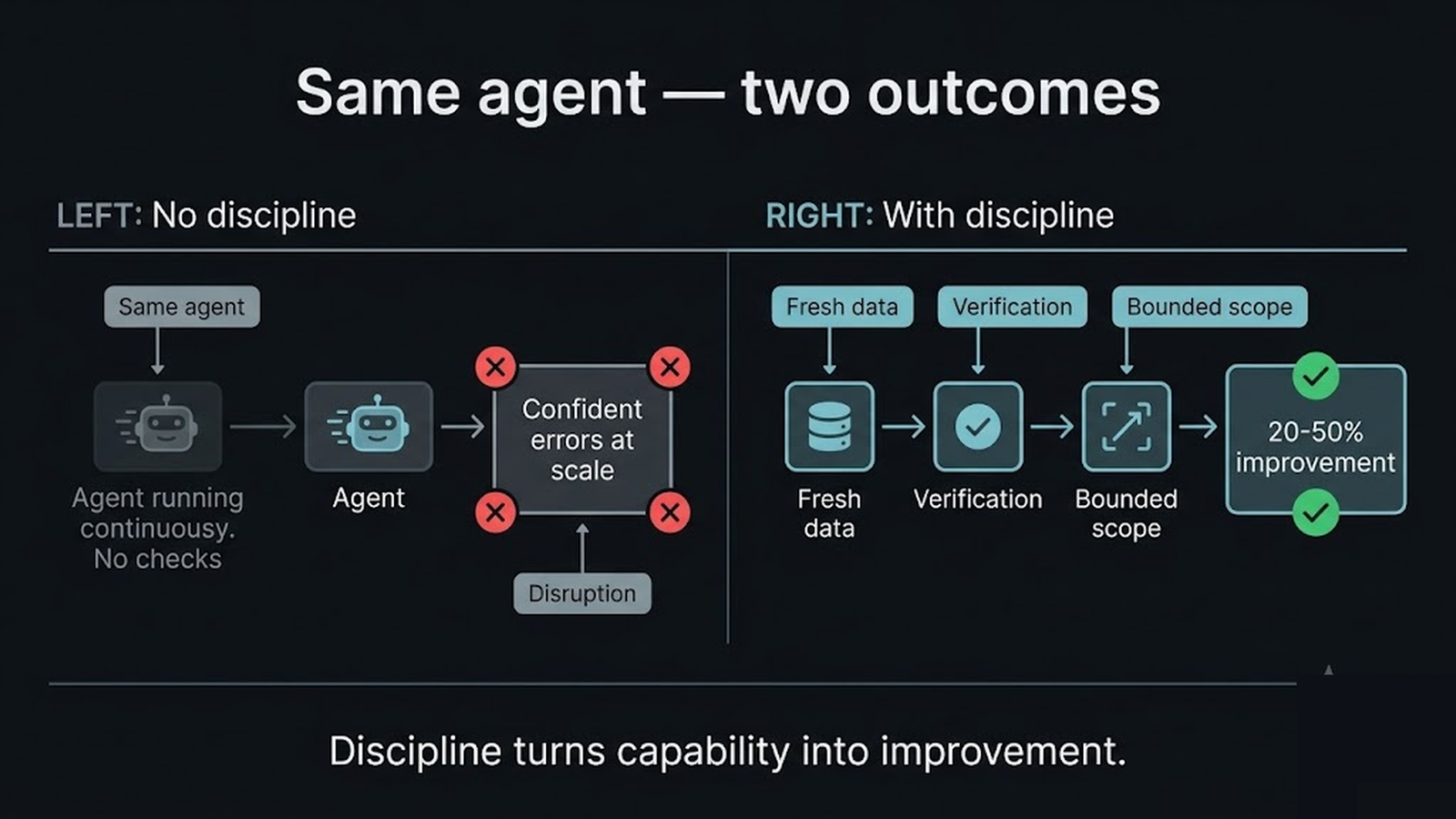
Because the agent's forecasting and ordering capability is only as good as the data it runs on, the verification that catches its errors and the scope that keeps it on reliable ground and the deployments that work build all three while the ones that disrupt skip them. The upside is documented: AI in inventory management can cut logistics costs by up to 15% and lift service levels by up to 65%, meaningfully reducing stockouts and obsolete inventory, which is a real prize. But that prize is conditional. Feed the same agent stale or inconsistent data and its confident decisions are wrong, turning the forecasting capability into a faster source of stockouts and overstock. Skip verification and its occasional errors land as inventory failures with the enormous cost supply chain errors carry. Let it loose beyond the conditions it handles, into the disruptions and edge cases it was not built for and it makes confident decisions where it should escalate. So the deployments that improve operations are the ones that fed the agent fresh, reconciled data, verified its consequential decisions and scoped it to where it is reliable, capturing the documented cost and service-level gains. The deployments that disrupt operations had the same capable agent and none of the discipline and the capability amplified their errors instead of their forecasts.
The lesson is that supply chain agents are not plug-and-play. The capability is real and the gain is achievable, but it sits behind data discipline, verification and scoping and a deployment that treats the agent as a drop-in forecaster without those gets the downside, confident errors at scale, rather than the upside.
What do the working deployments do?
Build the three disciplines the failures teach. Feed the agent fresh, reconciled data so its decisions reflect the real state, capturing the forecasting gain rather than amplifying data errors. Verify consequential decisions against the systems of record so the agent's errors are caught before they become stockouts or overstock. Scope the agent to the conditions it handles reliably and escalate the disruptions it does not. These turn the documented cost and service-level potential into realized improvement and their absence turns the same agent into an operational liability. The capability was never the differentiator; the discipline around it is.
| Deployment | Outcome |
|---|---|
| Capable agent, no data discipline or verification | Confident errors at scale, disrupted operations |
| Fresh data, verified decisions, bounded scope | Cost and service-level gains realized |
Building that discipline is part of what VibeModel does as the Pattern Intelligence Layer. We model the patterns of the data quality, verification and scope a supply chain agent needs, so your deployment captures the real forecasting gain rather than amplifying errors into operational disruption.
Frequently asked questions
Is the forecasting gain real?
Yes. AI in inventory management can cut logistics costs and lift service levels, reducing stockouts and obsolete inventory, but only with reliable data, verification and scoping.
What turns the agent into a liability?
Stale data, no verification and unbounded scope, which make its capability amplify errors into stockouts and overstock at scale.
What do working deployments build?
Fresh, reconciled data, verified consequential decisions and scope bounded to the conditions the agent handles reliably.