


Key facts.
- $1.7 trillion in stockout and overstock losses hit global retailers in 2024. Poor forecasting and bad input data drove most of it.source
- Traditional demand-forecasting methods can miss by 50% or more. Feed an agent numbers that wrong at the start and every downstream decision compounds the error.source
- Supply chain data lives across systems that update on different schedules and rarely agree with each other. Freshness and consistency aren't edge cases. They're the default state of the data.source
Why does data freshness break the agent?
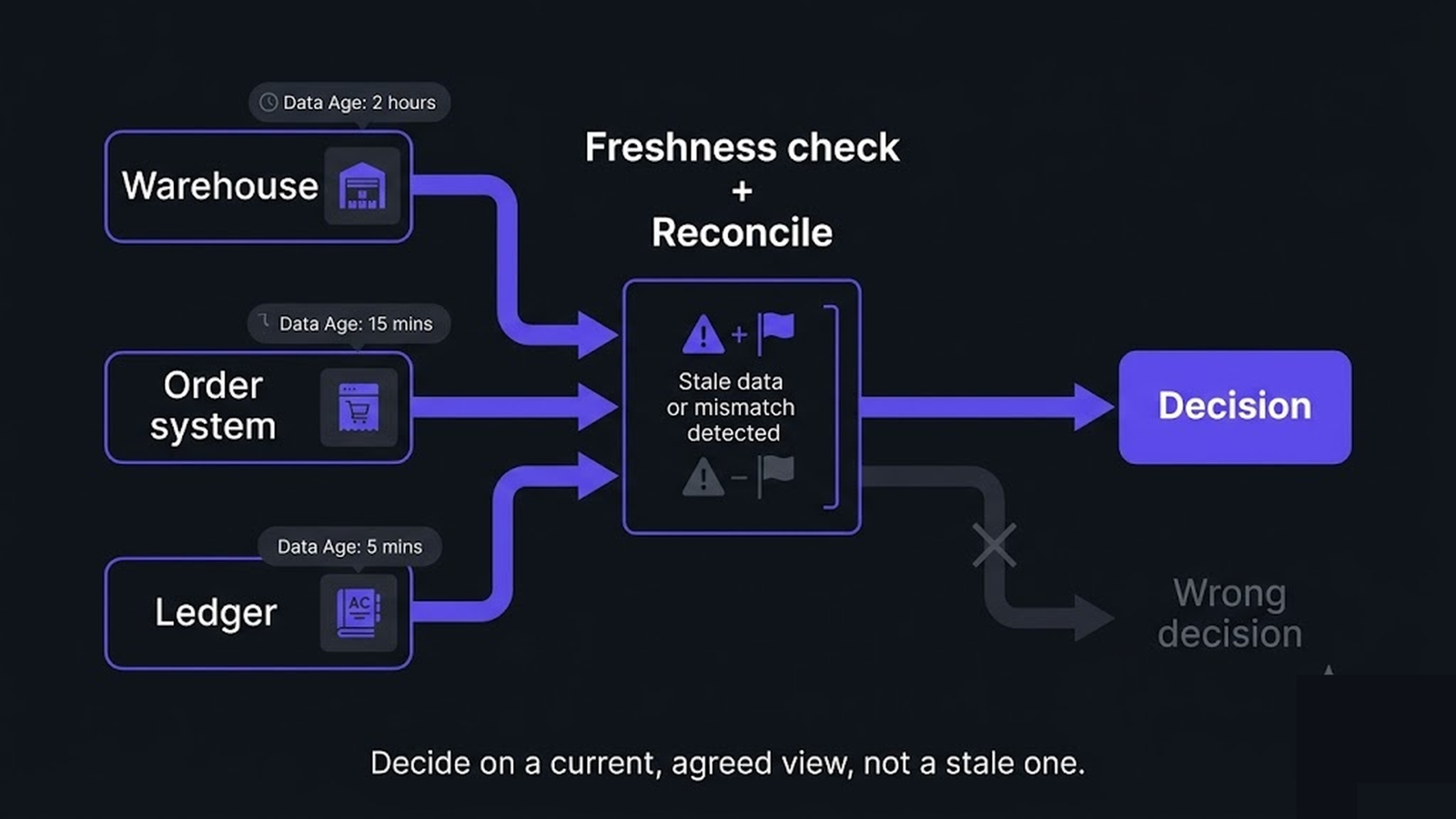
I've seen supply chains where the warehouse count, the order system, and the finance ledger each report a different number for the same SKU. No one's lying. They're just looking at different moments. The warehouse updated 4 hours ago. The ledger batches overnight. The order system is live. The agent picks whichever came in most recently and makes the call. That's not reasoning. It's luck. The $1.7T in losses didn't happen because companies were stupid. It happened because confident decisions got made on numbers that hadn't caught up to reality yet.
More integrations don't help. They just route the stale data faster. The staleness problem travels right through the integration layer unless you specifically gate on it.
What makes the data trustworthy?
Before acting, check the timestamp. Is this number recent enough to trust for this decision? Do the systems that should agree actually agree? If not, don't proceed on the bad number. Widen the margin, flag it, escalate. Simple gate. Most agents skip it. That's how a capable agent ends up making a confident wrong call on inventory that moved 8 hours ago.
| Data handling | Decision quality |
|---|---|
| Trust integrated data as fresh | Confident decisions on a stale, inconsistent view |
| Verify freshness and reconcile | Decisions on data that reflects the real state |
Bad data drove $1.7T in 2024 stockout and overstock losses; a more capable agent on stale data just decides about a world already moved. (arXiv:2602.07342)
Verifying that freshness and consistency is part of what VibeModel does as the Pattern Intelligence Layer. We model the patterns of data that is too stale or inconsistent to act on and reconcile across systems. A supply chain agent decides on a current, agreed view of the world rather than a delayed, mismatched one.
Frequently asked questions
Why is supply chain data so unreliable?
It is scattered across systems that update on different schedules and do not always reconcile, so the agent's view is a composite of stale and mismatched numbers.
How costly are data-driven errors?
Stockouts and overstocks cost retailers around $1.7 trillion in 2024, with poor data and forecasting as primary drivers.
What should the agent do with stale data?
Flag it, widen safety margins or escalate, rather than deciding confidently on a value too old or inconsistent to trust.