


Key facts.
- Stockouts and overstocks cost global retailers roughly $1.7 trillion in 2024, the downstream cost of wrong demand and inventory decisions. source
- Inventory carrying costs can reach 20 to 30% of inventory value, so overstock from an over-order is expensive to hold. source
- A stockout loses the immediate sale and can drive the customer to a competitor, so the cost exceeds the missed transaction. source
Why do small errors become large costs?
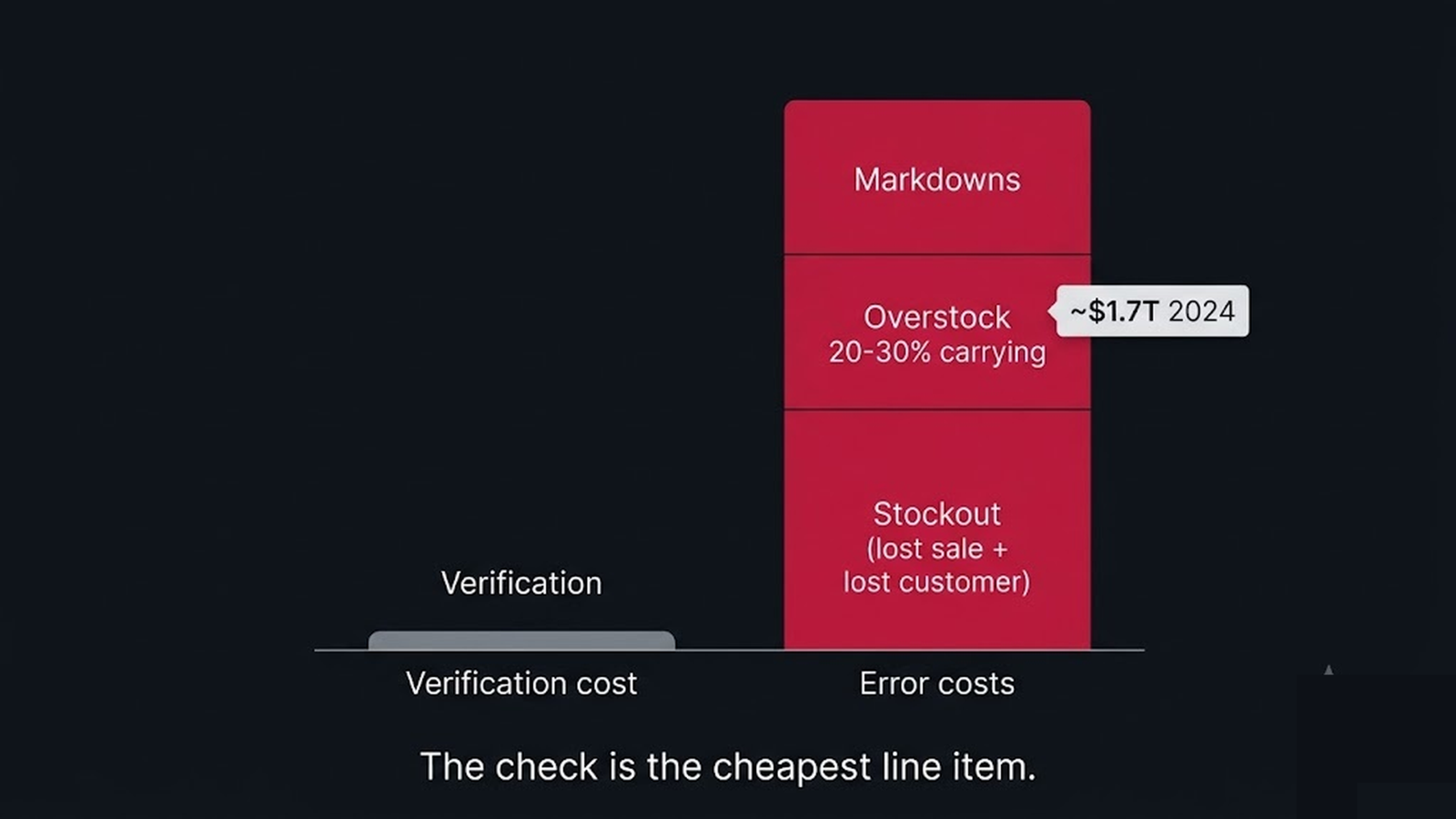
Because supply chain errors translate directly into one of two expensive outcomes and both scale. An agent that under-orders, from a low forecast or a missed signal, causes a stockout, which loses the immediate sale and can send the customer to a competitor, costing more than the single missed transaction. An agent that over-orders causes overstock, which ties up capital and carries an ongoing holding cost that can reach 20 to 30% of the inventory value, plus markdowns and obsolescence. Neither error is small in consequence even though the decision that caused it looked minor and across the volume of decisions a supply chain makes, these add up to the $1.7 trillion figure that stockouts and overstocks cost retailers in a year. So a supply chain agent's error rate is not an abstract quality metric; it is a direct input to that enormous loss number, because every wrong order or bad forecast lands as a stockout or an overstock with real cost. The agent does not have to be badly wrong to be expensive; it has to be wrong often enough and current agents on real supply chain tasks are wrong often.
This cost structure is what makes verification economically obvious. The check that catches a wrong order before it ships or a bad forecast before it drives an order, costs little against the stockout or overstock it prevents and given the scale of supply chain loss, the verification pays for itself many times over.
How do you act on this?
Price the error and verify accordingly. Estimate the downstream cost of the agent's errors, the stockout losses and overstock carrying costs they produce at the agent's real error rate and compare it to the modest cost of verifying decisions before they drive orders. Given the $1.7 trillion scale of supply chain loss, the verification is cheap insurance, so gate consequential ordering and forecasting decisions on a check that catches the error before it becomes a stockout or an overstock. The agent accelerates the decisions; the verification keeps its errors from landing as expensive inventory outcomes, which is the difference between an agent that saves money and one that quietly feeds a staggering loss.
| Decision | Economics |
|---|---|
| Skip verification | Errors land as stockouts and overstock at scale |
| Verify consequential decisions | Small check cost, large losses prevented |
Pricing that tradeoff is part of what VibeModel does as the Pattern Intelligence Layer. We model the patterns of a decision whose error would become a costly stockout or overstock and where verification prevents it, so the agent's mistakes are caught before they add to the supply chain's enormous loss number.
Frequently asked questions
If we run a more capable model, can we relax the verification?
Stockouts and overstock hit retailers ~$1.7T in 2024 and agents err often on real tasks; a better model still feeds that loss when it slips. (source)
Why is a small order error expensive?
It becomes a stockout that loses the sale and the customer or an overstock that carries 20-30% holding cost. Neither is small in consequence.
How large is the total cost?
Stockouts and overstocks cost global retailers around $1.7 trillion in 2024, which agent error rates feed directly.
Where should verification focus?
On consequential ordering and forecasting decisions, where catching an error prevents a stockout or overstock far more expensive than the check.