


Key facts.
- Finance Agent Benchmark: the best model reached ~46.8% accuracy at ~$3.79 per query, so the agent is both costly per call and wrong over half the time on real tasks.source
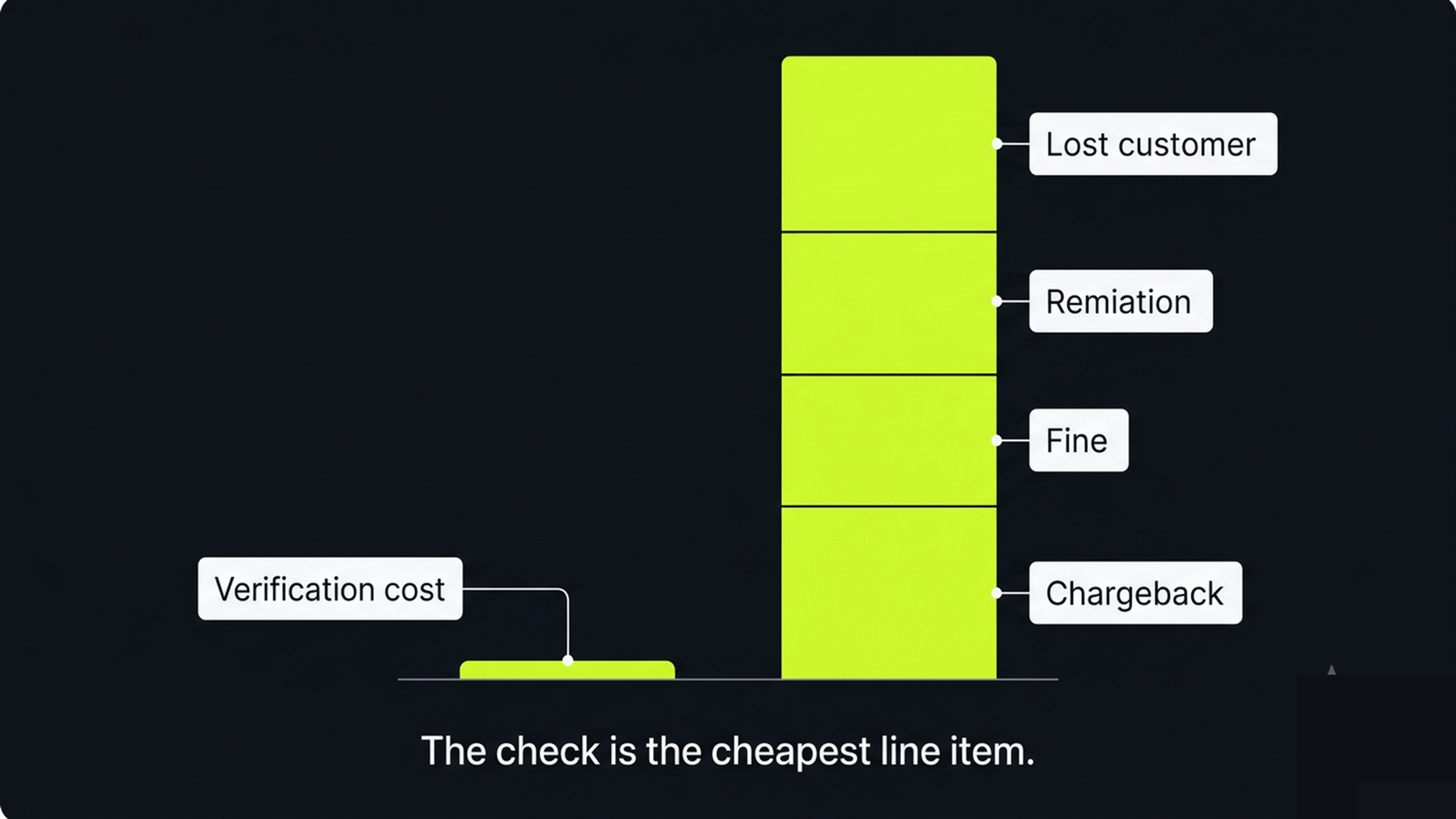
- A financial error carries downstream costs, chargebacks, fines, remediation, lost customers, that dwarf the cost of a verification check.source
- The economics favor verification heavily, because the error it prevents is far more expensive than the check itself.source
- At ~46.8% best-model accuracy on the Finance Agent Benchmark; a chargeback costs an order more, so the upgrade keeps the check. (arXiv:2508.00828)
Why is verification economically obvious in finance?
Because the cost asymmetry is enormous. Run the numbers the benchmark gives you: the agent costs real money per query and is right under half the time on genuine financial tasks. A meaningful fraction of its outputs are wrong and in finance a wrong output is not a typo, it is a chargeback, a misfiled report that draws a fine, a customer who leaves after a botched transaction or a remediation effort. Each of those costs far more than the verification step that would have caught the error before it landed. So the calculation is not close: spend a little on a deterministic check and human gate for the high-stakes actions and you prevent errors that each cost many multiples of the check. Skipping verification to save the cost of the check is saving pennies to risk dollars and the benchmark accuracy says the dollars are genuinely at risk, not hypothetically.
This is the finance-specific version of a general truth. In low-stakes domains you can debate whether verification is worth it. In finance, where each error carries chargebacks, fines and lost trust. The error cost so dominates the check cost that the debate is over before it starts. Verification is not an expense you justify, it is the cheapest insurance in the system.
How do you make the case internally?
Price the error, not just the agent. Estimate the cost of the failures the agent will produce at its real accuracy, the chargebacks, the fines. The remediation, the churn and compare that to the cost of the verification that prevents them. The benchmark gives you the accuracy to estimate the error rate and the domain gives you the cost per error and the product is the risk you are carrying without verification. Set against the modest cost of deterministic checks and human gates on high-stakes actions. The verification pays for itself many times over. The teams that skip it are not saving money, they are deferring a larger bill.
| Decision | Economics |
|---|---|
| Skip verification | Save the check cost, carry the full error cost |
| Verify high-stakes actions | Small check cost, prevent expensive errors |
Pricing that tradeoff is part of what VibeModel does as the Pattern Intelligence Layer. We model the patterns of the costly financial error and where verification prevents it. The check lands where the error cost most dominates and verification is the cheap insurance it actually is.
Frequently asked questions
Isn't verification an added cost?
A small one, against errors that each cost many multiples more. In finance the asymmetry makes verification the cheapest line item, not an expense to cut.
How do I estimate the error cost?
Use the agent's real accuracy to estimate the error rate, then price each error in chargebacks, fines, remediation and churn. The product is your uncovered risk.
Where should verification focus?
On the high-stakes actions where the error cost is largest. Match the rigor of the check to the cost of the mistake it prevents.