


Key facts.
- Research found that without coordinated, stable agent behavior, supply chain agents amplify variance across the chain as each party reacts independently. source
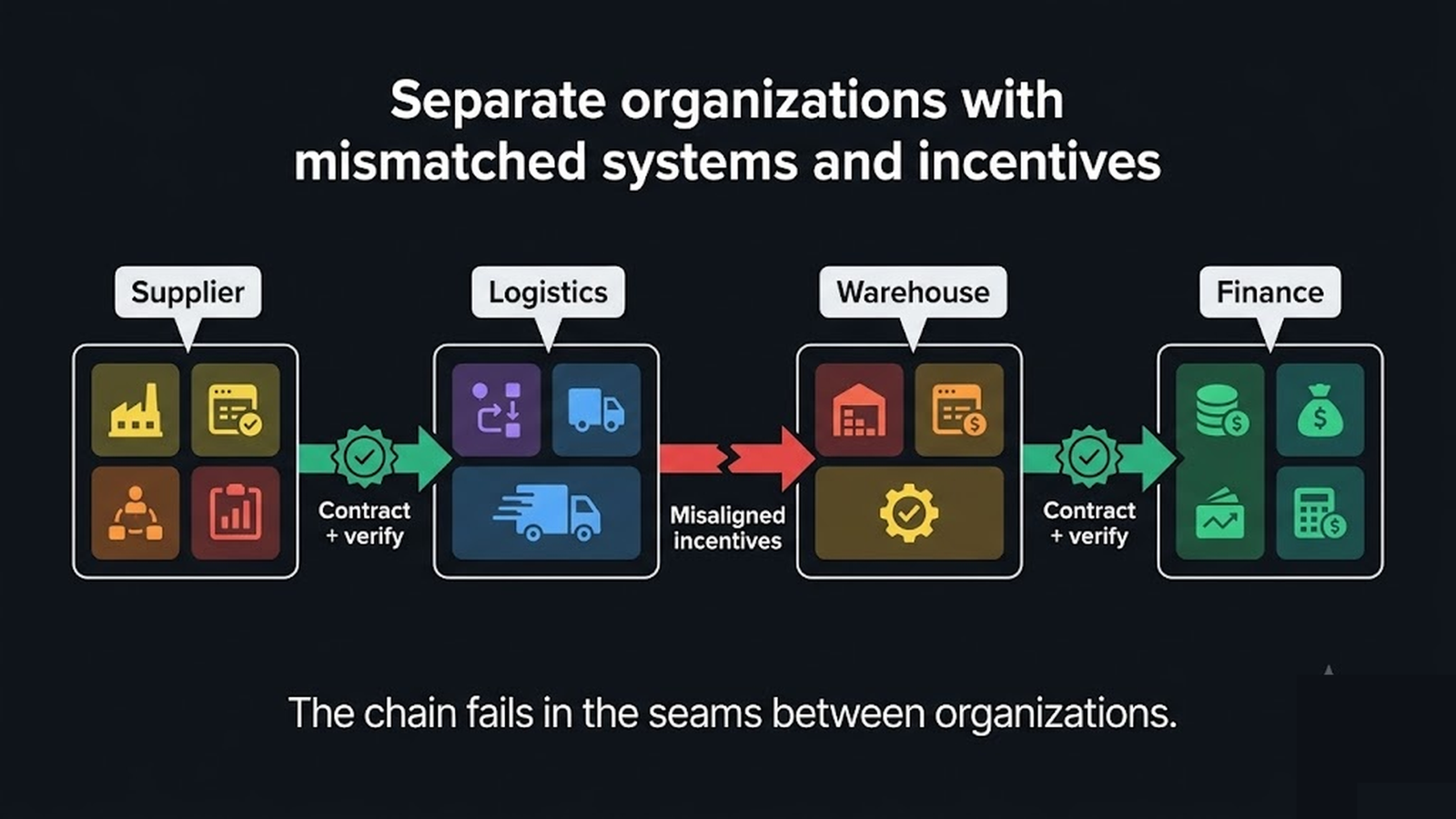
- A supply chain spans separate organizations with different systems, data formats and incentives that do not naturally align. source
- The coordination failures live in the gaps between parties, not within any single party's operation. source
- Each party reacting alone compounds variance across the chain (arXiv 2505.18597); a more capable agent at one node leaves the gaps between functions open. (arXiv:2505.18597)
Why is cross-party coordination so hard?
Because a supply chain is not one system, it is many organizations stitched together and the stitching is where coordination breaks. Suppliers, logistics carriers, warehouses and finance functions each run their own systems, hold their own data in their own formats and optimize for their own incentives, which do not naturally align, a supplier wants to ship efficiently, a warehouse wants level inventory, finance wants working capital optimized and these goals pull against each other. An agent operating in this environment cannot assume the parties coordinate cleanly, because they do not and the bullwhip research shows what happens when coordination is absent: each party reacts to its local signal independently, the reactions compound and the chain amplifies instead of stabilizing. The agent that plans as if the other parties will respond predictably and share clean data is planning for a chain that does not exist and its plan breaks at the first boundary where another party's system, data or incentive diverges from the assumption. The failure is in the seams between organizations, which is exactly where no single agent has visibility or control.
This is why upgrading the agent at one node disappoints. The coordination problem is distributed across the boundaries and a better agent in one organization still has to interact with other organizations whose systems and incentives it cannot change, so the cross-party gaps remain.
What makes cross-party coordination hold?
Explicit boundaries and verified handoffs across organizations. Define clear interfaces for what data passes between parties and in what format, so the agent is not assuming a clean exchange that does not happen. Verify the handoffs across organizational boundaries, confirming that an order, a shipment or a payment landed correctly in the next party's system rather than trusting it did. Coordinate the agents' behavior so they do not each independently over-react and amplify the chain. And account for the misaligned incentives, designing the coordination so it works despite parties pursuing different goals, not assuming they share one. The coordination that holds is the one built for the reality of separate organizations, not the fiction of a single aligned chain.
| Coordination assumption | Result across organizations |
|---|---|
| Parties coordinate cleanly | Breaks at the first misaligned boundary |
| Explicit interfaces, verified handoffs | Coordination holds despite misalignment |
Designing for those boundaries is part of what VibeModel does as the Pattern Intelligence Layer. We model the patterns of coordination across misaligned organizations and verify the handoffs between them, so a supply chain agent works across the seams where the chain actually fails rather than assuming an alignment that does not exist.
Frequently asked questions
Why does one capable agent not fix coordination?
Because the problem lives in the boundaries between organizations whose systems and incentives the agent cannot change. The gaps remain.
What makes the boundaries hard?
Different systems, data formats and misaligned incentives across separate organizations, none of which align by default.
How do I coordinate across parties?
Define explicit data interfaces, verify handoffs across organizational boundaries and coordinate agent behavior so parties do not each over-react.