


Key facts.
- The Coordination Primacy Hypothesis holds that inter-agent coordination protocol design is a primary driver of financial decision quality, often more than model scaling. source
- The work documents five pervasive evaluation failures (look-ahead bias, survivorship bias, backtesting overfitting, transaction-cost neglect, regime-shift blindness) that can reverse the sign of reported returns. source
- It introduces a cost-aware metric to test whether multi-agent coordination adds genuine value net of transaction costs. source
Why does multi-agent finance raise the stakes of coordination?
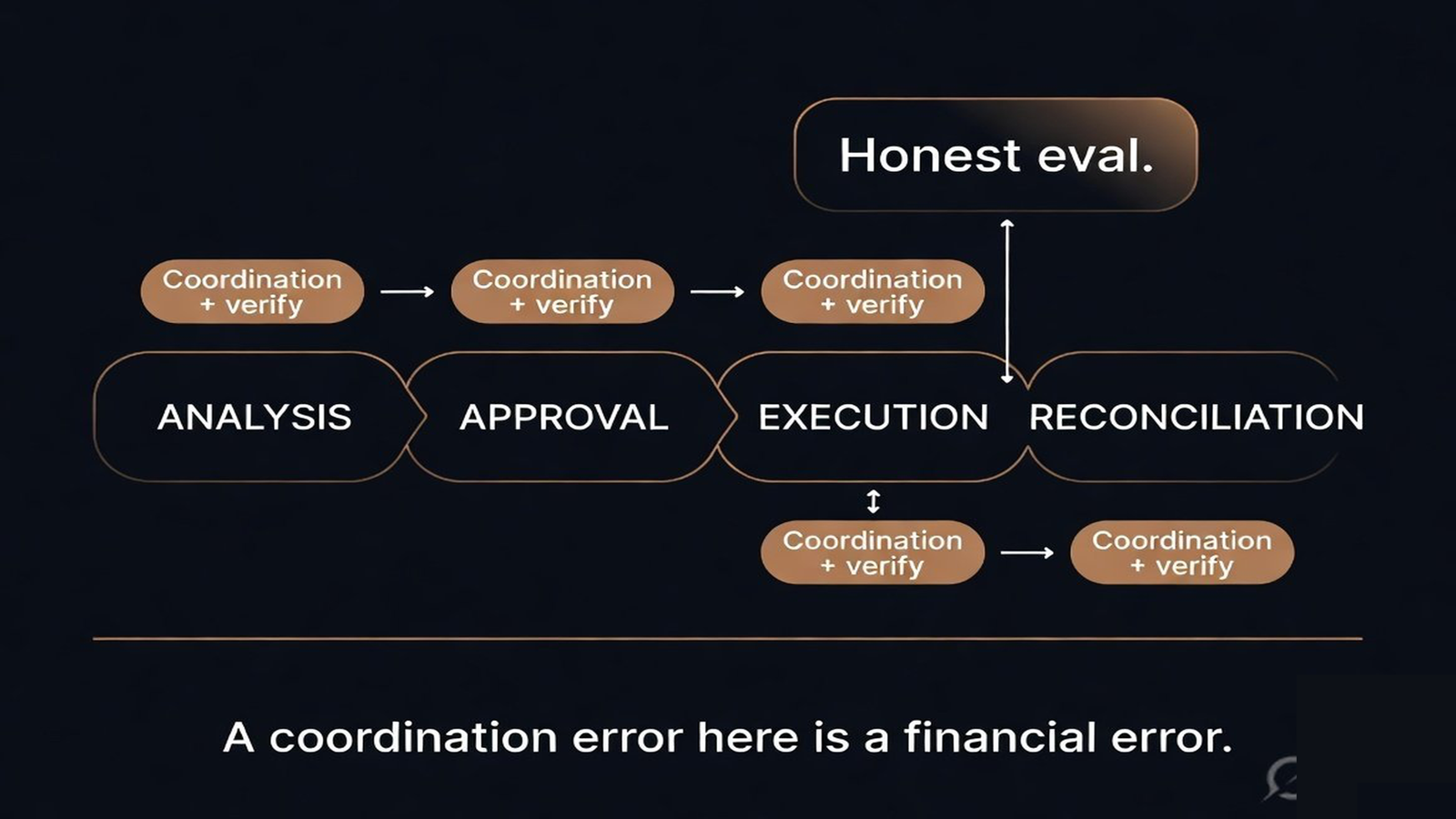
Because the workflow, analysis, approval, execution, reconciliation, is a chain where each handoff moves real money and the research says coordination is what determines whether the chain works. The Coordination Primacy Hypothesis is the striking finding: how the agents coordinate matters more than how capable each one is, so a finance team of strong agents with weak coordination underperforms and the failure shows up as money moved on a misread analysis, an approval based on a wrong figure, an execution that did not match the decision or a reconciliation that confirmed something false. In finance these are not abstractions, they are losses and compliance events. And the five evaluation failures the paper documents make it worse, because a multi-agent finance system can report attractive returns that are artifacts of look-ahead bias or ignored transaction costs, so the system looks like it is working while it is actually losing money. Coordination errors and measurement errors compound into a system that is both wrong and convincing.
This is why adding agents to a finance workflow without investing heavily in coordination and honest measurement is dangerous. You have multiplied the handoffs where money can move wrongly and added evaluation traps that can hide the losses, so the apparent sophistication masks elevated risk.
What makes these workflows reliable?
Designed coordination, verified handoffs and honest evaluation. Treat the coordination protocol as a primary design concern, because the research says it drives quality more than model choice, with explicit contracts for what each agent passes to the next. Verify every handoff that moves money, so a misread between analysis and execution is caught before it settles. And evaluate the system honestly, avoiding the five failures that can reverse the sign of returns, so you know whether the multi-agent design actually adds value net of costs rather than just looking like it does. In finance, the coordination and the measurement are the reliability, not the individual agents.
| What you invest in | Result |
|---|---|
| Capable agents, weak coordination and measurement | Money moved wrongly, losses hidden by eval traps |
| Coordination design, verified handoffs, honest eval | Reliable workflow, value measured truthfully |
Designing that coordination and verification is part of what VibeModel does as the Pattern Intelligence Layer. We model the coordination and verification patterns a money-moving finance pipeline needs, so a multi-agent workflow is reliable and honestly measured rather than sophisticated and quietly lossy.
Frequently asked questions
Can a stronger model carry a multi-agent finance workflow alone?
Coordination beats model scale in finance multi-agent systems, eval flaws flip returns' sign; a more capable model loses while looking fine. (arXiv:2603.27539)
Does coordination really matter more than the model?
The Coordination Primacy Hypothesis says yes for financial decision quality. A strong-agent team with weak coordination underperforms.
How can a losing system look profitable?
Through evaluation failures like look-ahead bias and ignored transaction costs, which the research shows can reverse the sign of reported returns.
What should I verify at handoffs?
Every transfer of a money-moving decision: that the receiving agent read the analysis correctly and the action matches the approval.