


Key facts.
- Five evaluation failures, look-ahead bias, survivorship bias, backtesting overfitting, transaction-cost neglect, regime-shift blindness, can reverse the sign of reported financial returns.source
- A cost-aware metric is needed to test whether a system adds genuine value net of transaction costs, not apparent value.source
- Coordination design drives decision quality more than model scale, so the working deployments invest there.source
Why do failing finance deployments look like successes?
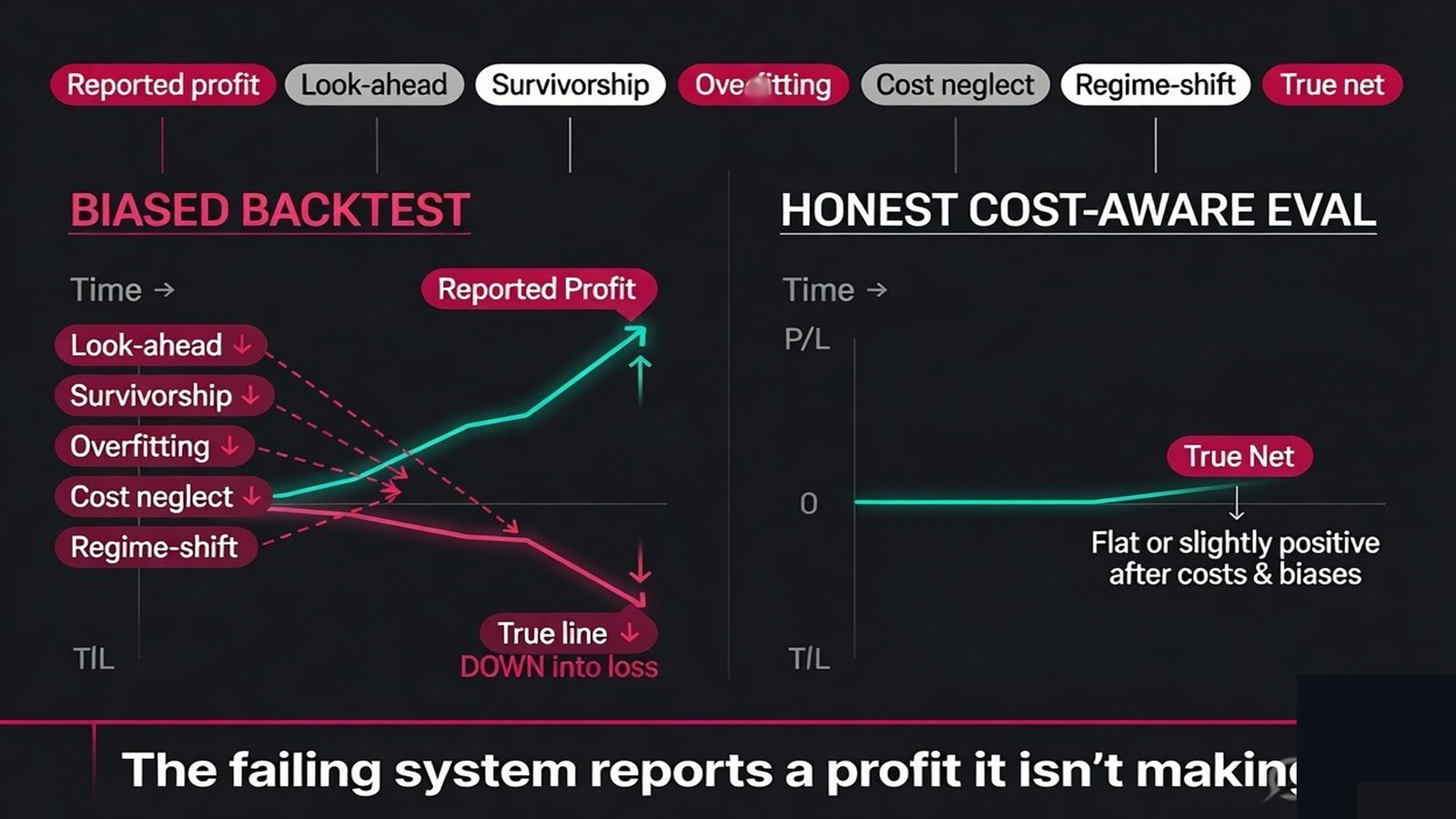
Because their evaluation lies to them and finance is unusually rich in ways to be fooled. The research catalogs five of them: look-ahead bias lets the system use information it would not have had in real time, survivorship bias tests it only on instruments that survived. Overfitting tunes it to historical noise, transaction-cost neglect ignores the fees that eat the returns and regime-shift blindness assumes the future looks like the backtest. Any of these can make a losing system report a profit and together they can reverse the sign of the returns. A deployment that is actually losing money presents a backtest that says it is winning. This is the most dangerous failure mode because it does not announce itself. A system that crashed would be caught; a system that quietly loses money while reporting gains runs until the real losses accumulate enough to notice, by which time the cost is large. The deployments that fail are not the ones that looked bad. They are the ones whose flawed evaluation made them look good.
The working deployments are defined by the opposite: evaluation rigorous enough to avoid these traps and the discipline to measure value net of real costs. They also, per the coordination finding, invest in how the agents work together rather than in raw model power. That happens because that is what actually drives decision quality. The pattern that separates success from failure is honesty in measurement and care in coordination, not capability.
What does the working deployment do?
It measures honestly and coordinates deliberately. It avoids the five evaluation failures, testing on data it would actually have had, including survivors and non-survivors, accounting for transaction costs and checking resilience across market regimes. The reported result reflects reality. It uses a cost-aware metric to confirm the system adds value net of costs rather than apparent value. And it invests in coordination design, because the research says that drives quality more than model choice. The failing deployment skips this rigor and trusts a backtest the biases inflated. Same domain, same models, opposite outcome, decided by whether the evaluation told the truth.
| Deployment | What its evaluation shows |
|---|---|
| Trusts a biased backtest | Reports profit while losing money |
| Rigorous, cost-aware evaluation | Reflects the true net outcome |
Finance multi-agent research names five eval flaws that flip returns' sign; a better model leaves the failing system reporting fake profit. (arXiv:2603.27539)
Building that honest evaluation is part of what VibeModel does as the Pattern Intelligence Layer. We model the patterns of the evaluation failures that hide financial losses and the coordination that drives quality. A finance deployment is measured truthfully and built to work rather than built to look like it works.
Frequently asked questions
How can a backtest reverse the real outcome?
Through biases like look-ahead and ignored transaction costs, which the research shows can reverse the sign of reported returns, making a loser look like a winner.
What is the most dangerous failure?
The quiet one: a system that reports gains while actually losing money, because it runs unchecked until the real losses accumulate.
What do working teams prioritize?
Honest, cost-aware evaluation and coordination design, which drives decision quality more than raw model capability.