


Key facts.
- Real-world supply chain tasks are hard enough for single LLM agents that dedicated benchmarks like SupChain-Bench were built to measure them. source
- Adding agents adds coordination surface on top of work each agent does not yet do reliably on its own. source
- Without coordinated behavior, supply chain agents amplify variance across the chain rather than stabilizing it. source
Why does orchestration multiply the failure?
SupChain-Bench was built because single agents struggle; a more capable one at a node does not fix handoffs across procurement and logistics. (arXiv:2602.07342)
Because a multi-agent supply chain pipeline, a procurement agent feeding a logistics agent feeding a planning agent feeding finance, adds handoffs to a problem that is already hard and each handoff is a new place to fail. The single-agent supply chain task is difficult enough that benchmarks exist to measure how poorly agents do it, so splitting the work across specialized agents does not start from a reliable base, it starts from an unreliable one and adds coordination on top. The procurement agent's output becomes the logistics agent's input and if it is slightly wrong or misread, the logistics agent acts on a flawed premise; the planning agent reconciles outputs that may not agree; the finance agent settles against numbers that may not match the physical reality and at each boundary the supply chain's intolerance for coordination error turns a handoff mistake into a real operational failure, a misordered shipment, a misplanned inventory level, a mispaid invoice. The bullwhip research adds the dynamic version: uncoordinated agents amplify variance, so a multi-agent setup without disciplined coordination does not just risk handoff errors, it can actively destabilize the chain by having each agent over-react independently. You have built a digital supply chain team with all the coordination problems of a human one and fewer of the informal mechanisms that keep human teams aligned.
The temptation to add more specialized agents makes it worse, because every new agent is another node and another set of handoffs and the coordination cost grows faster than the benefit when the underlying tasks are not yet reliable and the domain punishes coordination errors with real inventory and financial consequences.
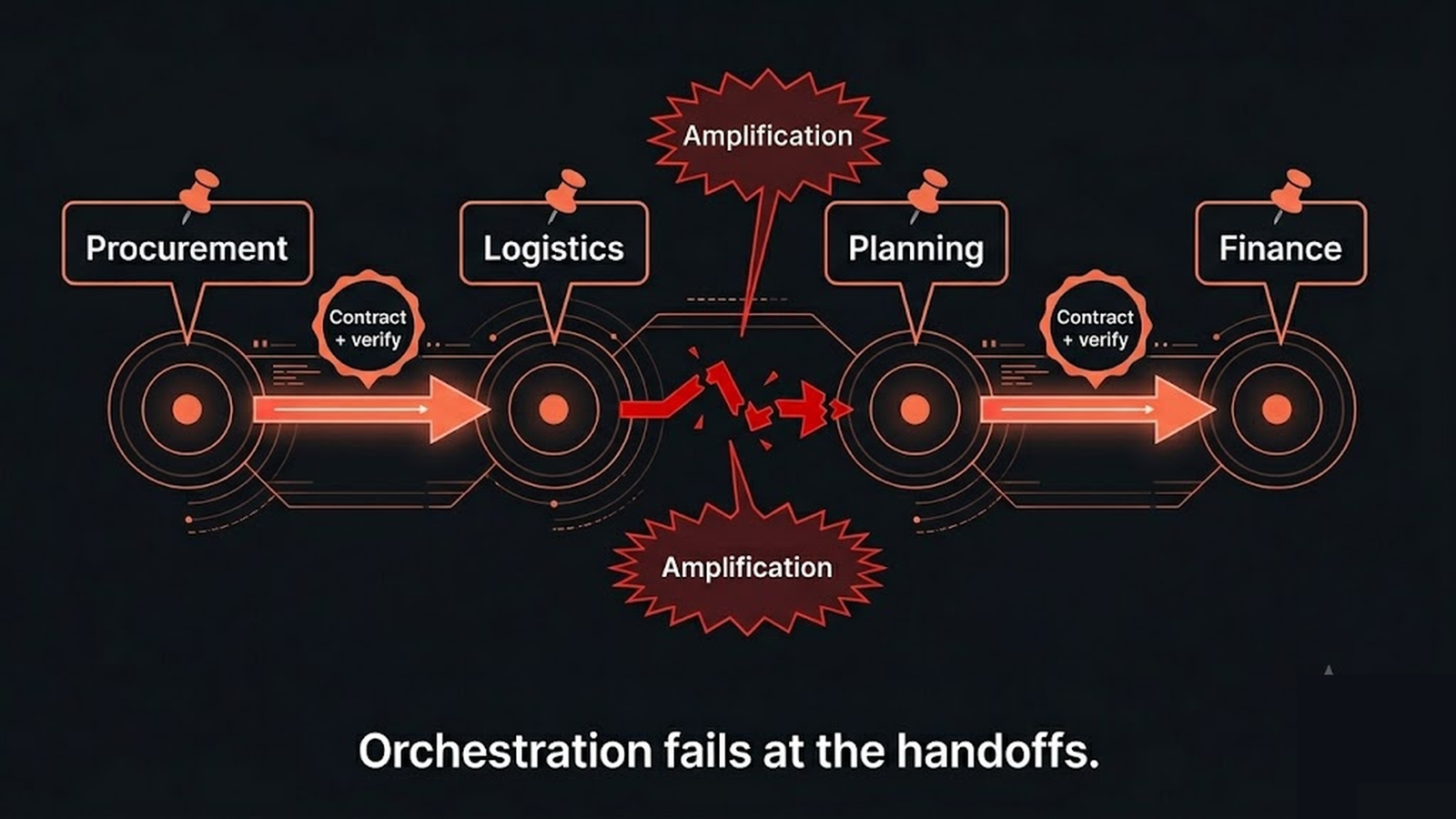
What makes orchestration hold?
Disciplined coordination and verified handoffs, applied only where multi-agent genuinely helps. Define explicit contracts for what each agent passes to the next, verify the handoffs so a procurement output is confirmed before logistics acts on it and a planning result is reconciled before finance settles and coordinate the agents' behavior so they do not amplify variance. Critically, do not split the work across more agents than the coordination can support, since the underlying tasks are not yet reliable and each handoff adds risk; reach for multi-agent orchestration where the work genuinely parallelizes and the handoffs can be disciplined, not by default. The orchestration that holds is the one built with the coordination treated as the hard part, because in supply chains it is.
| Orchestration design | Result |
|---|---|
| Many agents, undisciplined handoffs | Handoff errors and variance amplification |
| Coordinated, verified handoffs, right-sized | Orchestration holds where it genuinely helps |
Designing that coordination is part of what VibeModel does as the Pattern Intelligence Layer. We model the patterns of disciplined coordination and verified handoffs a supply chain pipeline needs, so multi-agent orchestration stabilizes the chain instead of multiplying the coordination failures the domain punishes.
Frequently asked questions
Should I split supply chain work across many agents?
Only where the work parallelizes and the handoffs can be disciplined. The underlying tasks are not yet reliable, so each added agent adds risk.
Why does orchestration multiply failure?
It adds handoffs to already-unreliable tasks and the supply chain punishes coordination errors with real inventory and financial consequences.
What holds the orchestration together?
Explicit coordination contracts, verified handoffs and coordinated behavior so agents do not amplify variance.