


Key facts.
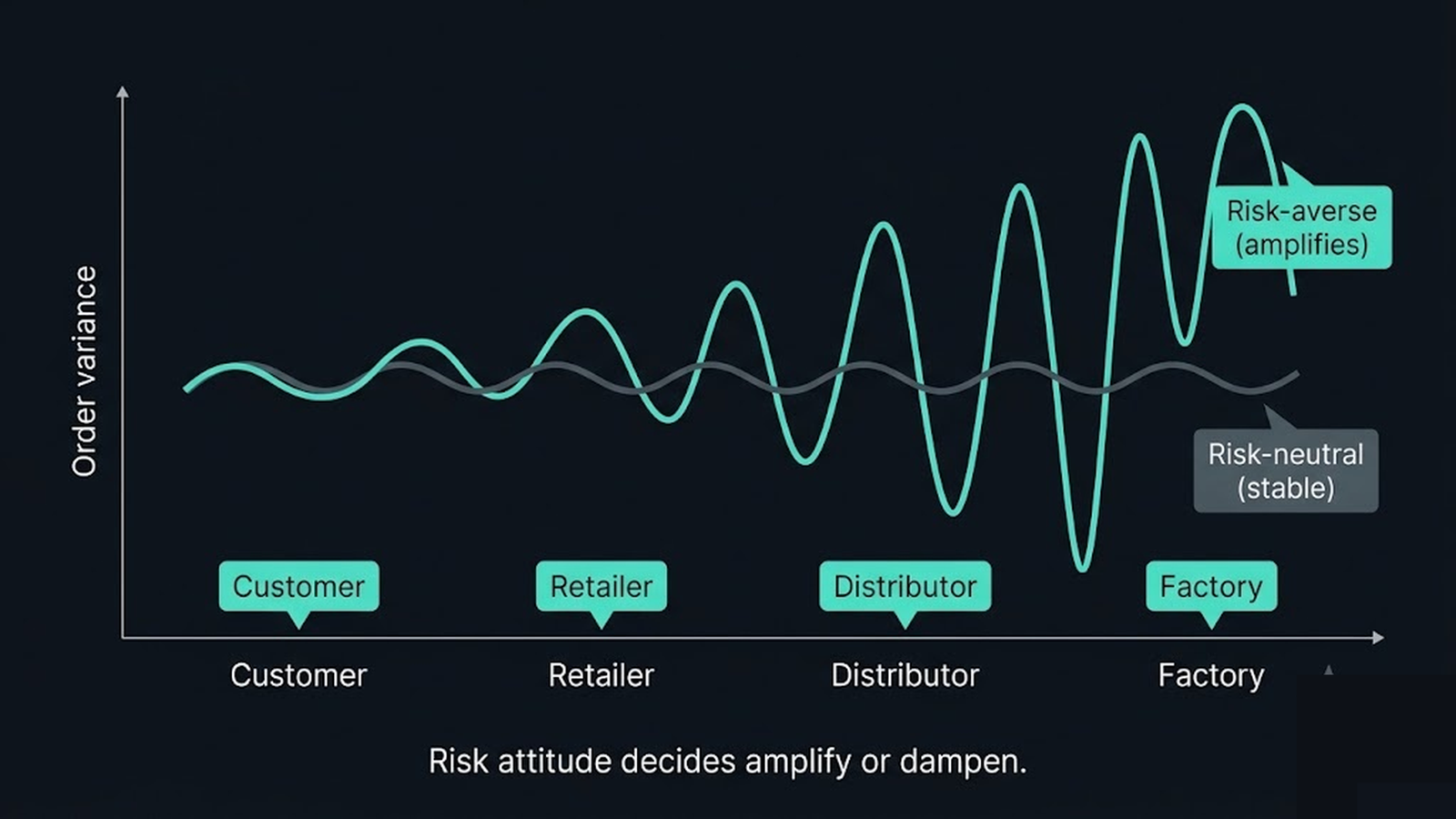
- Research found risk-averse LLM supply chain agents produce pronounced bullwhip effects with dramatic amplification and order volatility. source
- Risk-neutral LLM agents substantially mitigated the bullwhip effect, with stable order quantities and minimal variance amplification. source
- The amplification is driven by the agent's reaction to uncertainty, not by raw capability, so it must be tuned deliberately. source
Why does a cautious agent amplify demand swings?
Because caution at each stage compounds up the chain, which is the bullwhip effect and the research shows LLM agents are prone to exactly the risk-averse behavior that drives it. When an agent reacts to a small uptick in demand by over-ordering to avoid a stockout and the supplier above it does the same in response to that inflated order and so on up the chain, a minor ripple at the customer end becomes a wild swing at the manufacturer, producing overstock, then a correction, then shortage. The study found that risk-averse LLM agents do this dramatically, amplifying variance and creating volatile orders, while risk-neutral agents keep orders stable and minimize the amplification. So the agent's risk attitude, an emergent property of how it weighs the cost of a stockout against the cost of overstock, is the lever that determines whether it dampens or amplifies the chain's instability. Left to default, an agent optimizing locally to avoid the visible pain of a stockout creates the larger, distributed pain of bullwhip amplification that nobody sees until inventory and cost swing out of control.
This is a coordination failure expressed through individual caution. Each agent's locally reasonable hedge against uncertainty becomes a globally destructive amplification, because the agents are not coordinating their risk behavior, they are each independently over-reacting and the over-reactions stack.
What keeps the agent from amplifying?
Tuned risk behavior and constrained ordering. Set the agent's risk posture deliberately toward the risk-neutral behavior the research shows mitigates bullwhip, rather than letting default caution drive over-ordering. Constrain order quantities so the agent cannot produce the volatile swings that amplify up the chain and where multiple agents operate, coordinate their behavior so they do not each independently over-react. The goal is an agent whose response to demand uncertainty is stable and measured, dampening the chain's swings rather than amplifying them, which is a design choice about risk and constraints, not a property you get from a more capable model.
| Agent risk behavior | Effect on the chain |
|---|---|
| Risk-averse, unconstrained | Dramatic bullwhip amplification |
| Risk-neutral, constrained | Stable orders, dampened swings |
Tuning that risk behavior is part of what VibeModel does as the Pattern Intelligence Layer. We model the ordering patterns that amplify versus dampen the bullwhip effect, so a supply chain agent stabilizes the chain instead of turning a small demand ripple into a destructive swing.
Frequently asked questions
Won't a smarter supply chain model stop amplifying demand swings?
Risk-averse LLM agents amplify the bullwhip while risk-neutral ones damp it (2505.18597); a more capable model inherits the posture set. (arXiv:2505.18597)
Is the bullwhip effect the agent's fault?
It is the agent's risk behavior. Risk-averse agents amplify it dramatically; risk-neutral agents mitigate it. The behavior is tunable.
Does a smarter model dampen the swings?
Not by itself. The amplification comes from how the agent reacts to uncertainty, which must be designed toward stability.
How do I prevent amplification?
Tune the agent toward risk-neutral ordering, constrain order quantities and coordinate behavior across agents so they do not each over-react.