


Key facts.
- EY has reported 30 to 50% of initial RPA projects failed, so most organizations carry a recent automation disappointment into any new agent conversation. source
- Forrester found roughly 45% of firms reported their bots breaking weekly, the kind of recurring pain that teaches people to distrust the next automation. source
- On GAIA, GPT-4 with tools solves about 15% of reasoning tasks against roughly 92% for humans, a reminder that a burned team's caution about reliability is grounded. source
Why does the last failure shape this one?
EY puts early RPA failure at 30 to 50%; a bigger model does not erase that scar, so the late catch is real. (arXiv:2311.12983)
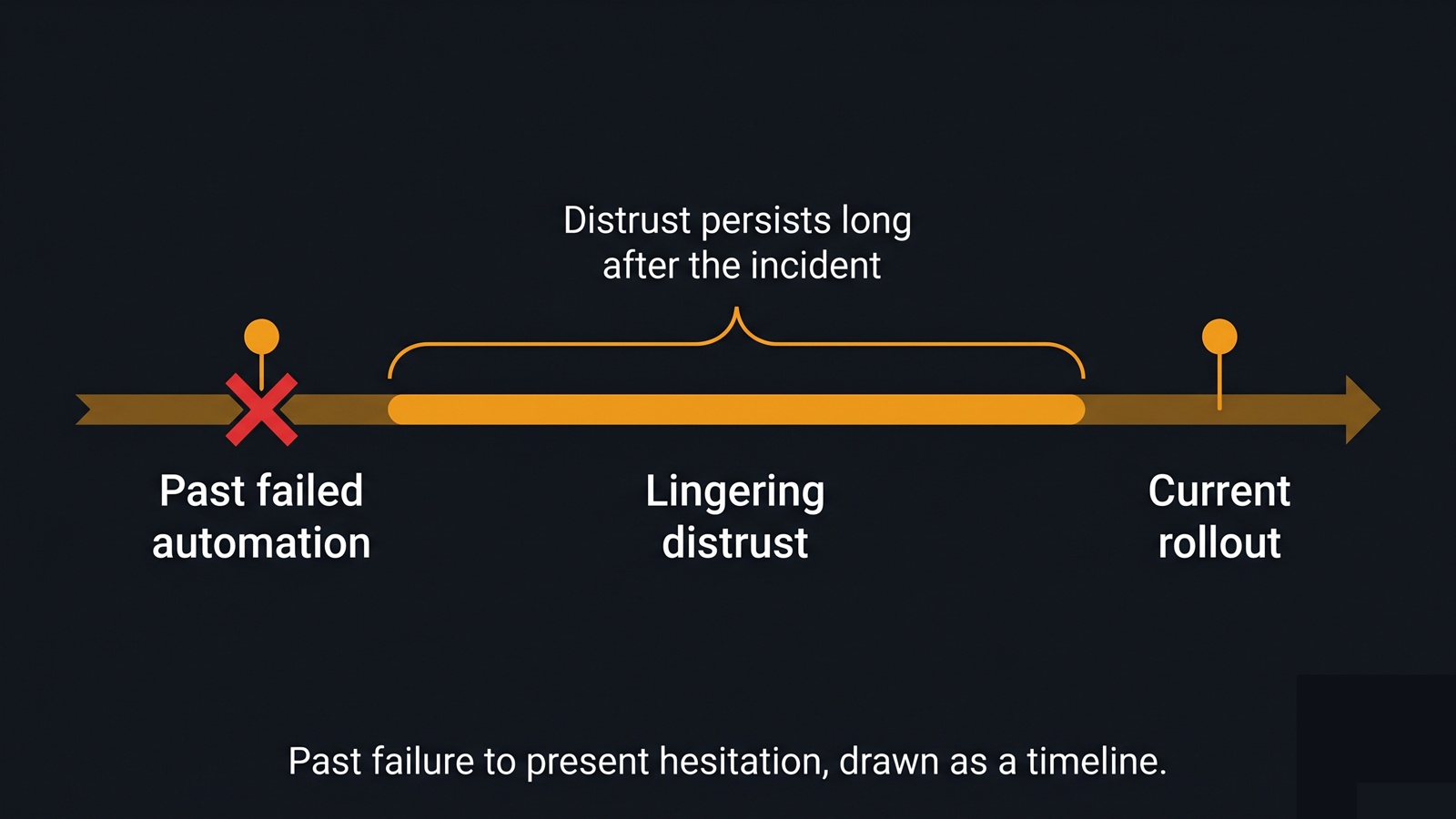
People generalize from experience and a team that watched an RPA bot break every week or a chatbot embarrass them in front of customers has learned a specific lesson: automation arrives with promises and leaves with cleanup. That lesson does not evaporate because the new thing is called an agent. It shows up as slow engagement, withheld trust and a quiet expectation that this too will fail. The Forrester weekly-breakage finding is the texture of that memory, the daily friction that taught the distrust in the first place.
The mistake is to pretend the history did not happen and lead with fresh enthusiasm. That reads as either ignorance or spin to people who lived the last failure. The move that works is the opposite: name the prior project, say what went wrong and show the specific things that are different this time, the verification, the narrow scope, the owner with a veto. You are not fighting their memory, you are using it as the design brief.
How do you turn the scar into a design brief?
| Past failure mode | What it taught the team | What this rollout does differently |
|---|---|---|
| Bot broke on variability | Automation is brittle | Narrow scope, proven before widening |
| No one owned the fallout | We clean up the mess | Named owner, clear escalation |
| Silent wrong outputs | You cannot trust it | Verification and visible corrections |
Every one of those differences is a reliability commitment and reliability is what VibeModel delivers as the Pattern Intelligence Layer. When you can show a once-burned team that the agent handles their patterns the same correct way every time, you are not asking them to forget the last failure. You are giving them the concrete reason this one will not repeat it.
Frequently asked questions
Should I avoid mentioning the old project?
No. Naming it builds credibility. Pretending it did not happen reads as spin to the people who lived it.
What if the old project was a different technology?
The lesson still transferred. People generalize "automation burned us," so address the pattern, not just the specific tool.
How fast does trust come back?
As fast as you can show a visible, reliable win on their work. Proof rebuilds trust that promises cannot.