


Key facts.
- Writer's 2025 Enterprise AI Adoption report found 41% of Millennial and Gen Z employees admit to actively resisting or sabotaging their employer's AI strategy, from refusing to use tools to feeding them poor inputs.source
- EY's AI Anxiety in Business Survey (2023) found roughly 75% of employees worried that AI would make certain jobs obsolete, a fear that predicts how hard they push back.source
- OSWorld reports the strongest models complete about 12.24% of real computer-use tasks versus 72.36% for humans, so frontline skepticism about reliability is grounded in the numbers.source
Why does resistance beat the technology to the kill?
Most agent pilots that die do not die in a code review. They die when the people who were supposed to use the thing decide, quietly, not to. A support rep who fears the agent is being built to replace her will not flag its mistakes. Will not teach it the edge cases only she knows and will route around it the moment a manager stops watching. None of that shows up in your evals. All of it shows up in production. As an agent that never gets the corrections it needed to improve and a usage curve that flattens a month after launch.
The mistake is treating this as a communications problem to handle after the build. By then the story has already formed: this is happening to me, not with me. The Writer finding is blunt about where that leads. With two in five younger employees admitting they undermine the strategy on purpose. You cannot out-message that with a launch email. You can only prevent it by changing who is in the room while the agent is being scoped.
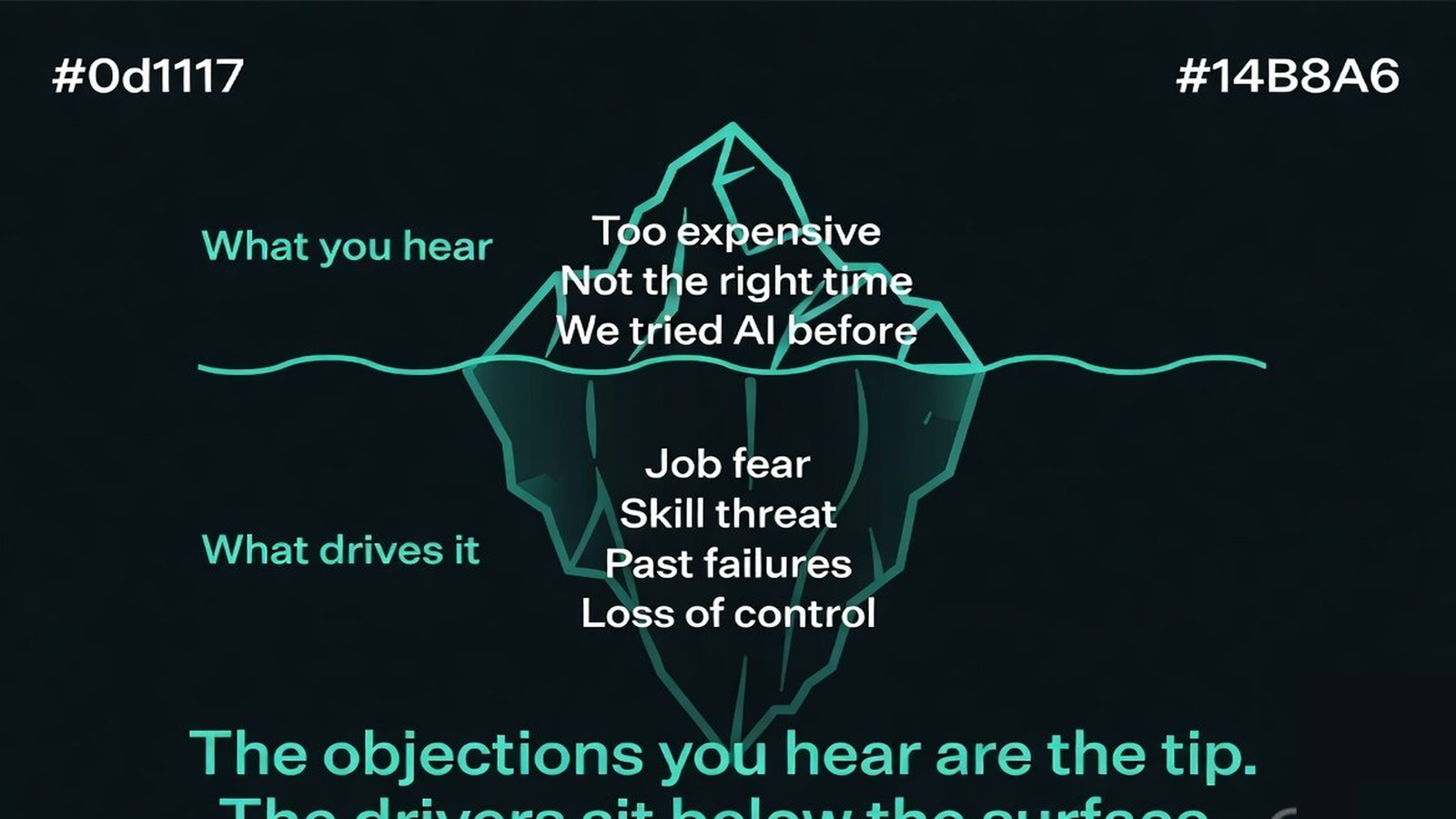
What actually moves people from opponent to ally?
The pattern is consistent across the rollouts that hold. Name the augmentation honestly, so the agent takes the tedious 60% and the person keeps the judgment. Give the workflow owner a veto over what the agent is allowed to do unsupervised. Turns the most anxious person into the most invested one. And show a benefit they can feel in the first week. Not a productivity number their manager will feel next quarter. Resistance falls If the agent visibly removes a thing the person hated doing.
| Approach | Resistance as a comms problem | Resistance as a design input |
|---|---|---|
| When people are involved | At launch announcement | During scoping, with veto power |
| What the agent optimizes | Headline automation rate | The task the worker hated |
| Who catches its mistakes | Nobody, quietly | The owner who shaped it |
| Six-month outcome | Usage flatlines, project shelved | Corrections compound, agent improves |
This is also why reliability and adoption are the same problem wearing two hats. People trust what behaves predictably. An agent that fails the same way twice teaches them to stop relying on it. VibeModel is the Pattern Intelligence Layer because reliability at the pattern level. The same situation handled the same correct way every time, is what earns the trust that adoption is built on. You cannot communicate your way to that. You have to engineer it and then the people come along.
Frequently asked questions
Will a stronger model buy back the trust?
People, not the model, stall a rollout; a stronger model will not buy back skipped trust and the cost is real (OSWorld 12%). (arXiv:2404.07972)
Is resistance just fear of change?
Often it is rational. People who lived through a failed automation project or who can see the agent miss tasks a human would catch, are reading real signal. Engage it, do not dismiss it.
Who should have veto power over the agent?
The workflow owner whose work the agent changes. Giving them authority over its unsupervised scope converts the most anxious stakeholder into the one most invested in making it work.
Does a better model reduce resistance?
Not by itself. Benchmarks like OSWorld show even top models miss most real tasks, so trust comes from consistent behavior on your workflows, not from the model name on the box.