


Key facts.
- Research on the dark side of AI adoption documents real human costs of poorly handled rollouts, so caution can be grounded rather than reflexive. source
- RULER shows the effective usable context of long-context models is far below the claimed length, a documented limit a skeptic may be sensing. source
- Resistance is often data; a newer model does not lift RULER's short context, so a skeptic's dropped-context warning is a late failure. (arXiv:2404.06654)
Why is resistance often rational?
It is comfortable to label every objection as fear of change, because that lets you push past it without engaging. But resistance frequently carries information. The person who watched the last automation project fail learned something true about how these efforts go wrong. The compliance officer worried about an unaccountable action is naming a real risk. The analyst skeptical that the agent can handle a long, complex task may be sensing exactly the limit RULER documents, where usable context falls short of the claim and the agent quietly drops what it needed. Dismissing these voices does not make the risks go away; it just ships them.
Engaging resistance as data is more work and far better. You ask what specifically the skeptic is worried about, test whether the concern is real and either fix the problem or show, with evidence, that it is handled. Often you find the skeptic was right about something the enthusiasts, eager to ship, had glossed over and you have caught a flaw before it reached production. The Nature research is the reminder that the human costs of getting this wrong are real too, so engaging resistance is not just about better engineering, it is about leading the change in a way that does not harm the people living it.
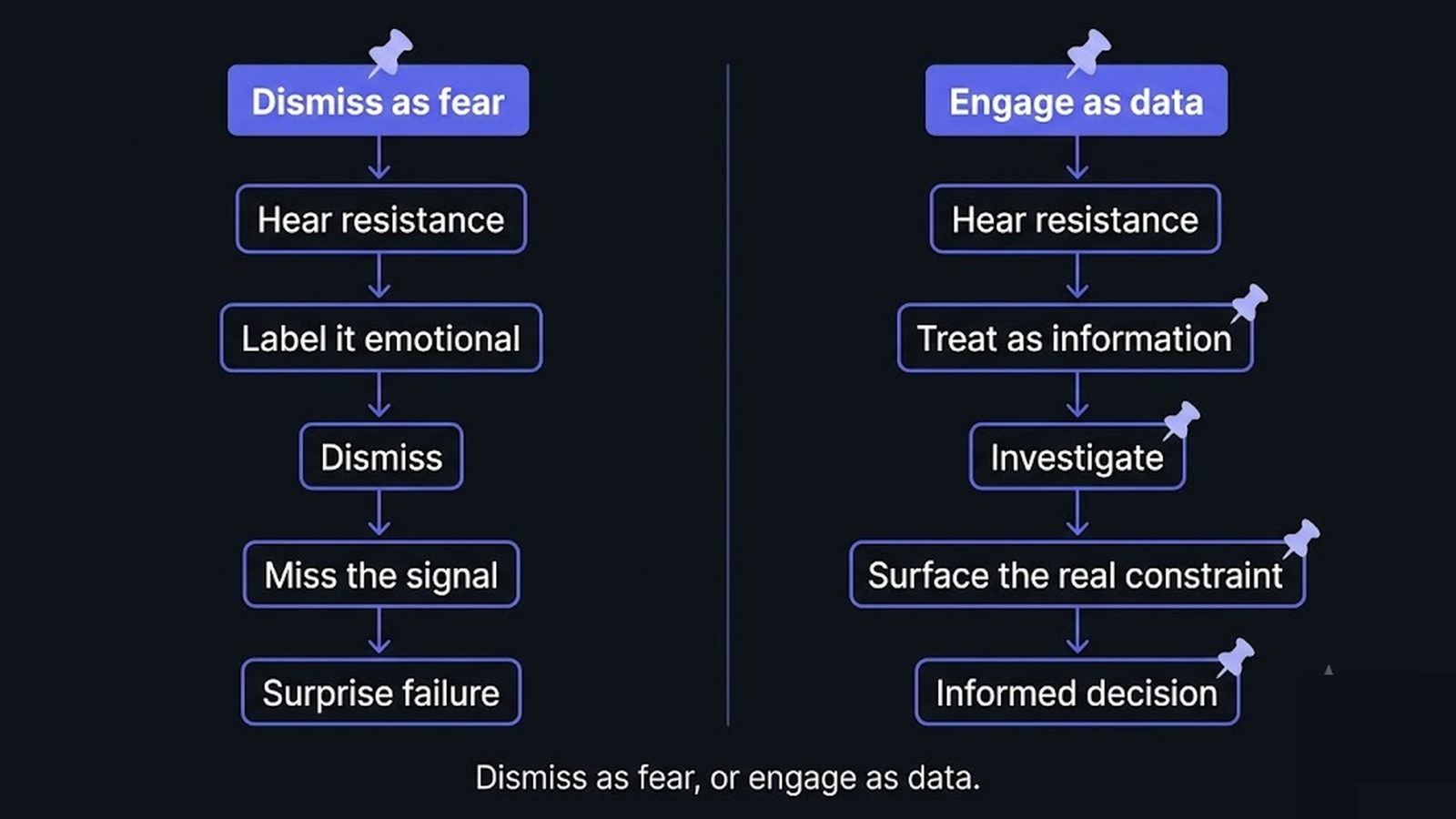
How do you engage resistance as data?
| Step | Dismiss as fear | Engage as data |
|---|---|---|
| Reaction | Push past it | Ask what is the worry |
| Test | None | Check if the risk is real |
| If valid | Shipped anyway | Fixed before production |
| If not | Resentment | Answered with evidence |
Answering a skeptic with evidence requires reliable data on how the agent actually behaves, which is what the Pattern Intelligence Layer provides. VibeModel makes the agent's reliability legible at the pattern level, so a concern, say that the agent will mishandle a particular situation, can be tested against how it actually handles that pattern and the resistance is resolved with proof rather than dismissed with a slogan.
Frequently asked questions
Isn't some resistance just fear?
Some is, but much of it is information about real risks or past failures. Treating all of it as fear throws away signal you need.
How do you tell valid concerns from noise?
Test them. Ask what specifically the skeptic fears and check it against evidence, like whether the agent really handles a long, complex task given limits such as those RULER documents.
What if the skeptic is right?
Then you caught a flaw before production. That is the whole value of engaging resistance instead of steamrolling it.