


Key facts.
- Edmondson's work on psychological safety shows teams learn and take healthy risks when they feel safe, the condition under which an agent is received as help not threat.source
- Around four in five leaders link psychologically safe organizations to more working AI adoption, reinforcing that identity and safety drive uptake.source
- Models still hallucinate at measurable rates on benchmarks like HaluEval, so the craft-defining judgment should stay with the people.source
Why does identity decide adoption?
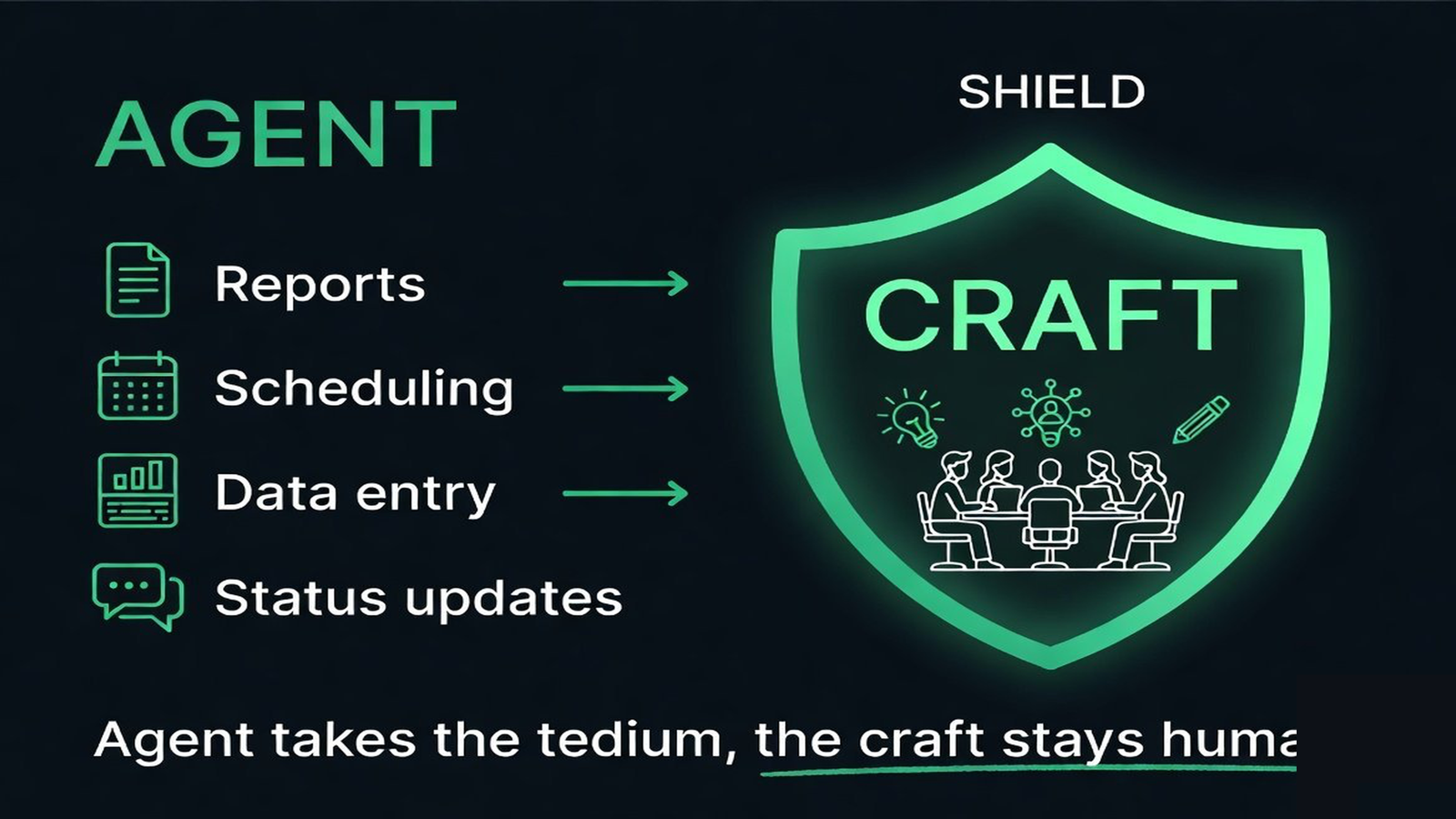
People don't just do tasks: they are their work. A radiologist is their diagnostic judgment. An analyst is their interpretation. A writer is their voice. Aim an agent at exactly that part, and they resist. That's not stubbornness. The agent is aimed at their identity. The same agent aimed at the tedious work around that identity: the prep, the formatting, the first pass: gets welcomed. It gives them more time for the part they're proud of. What the agent takes and what it leaves is an identity choice. That choice decides whether you get an ally or an opponent.
Psychological safety drives this. Edmondson's research shows people engage and learn when they feel safe. An agent that respects identity makes the environment safer. One that threatens the craft triggers the defensiveness that kills adoption. Keeping judgment with people isn't just diplomatic: it's correct. Models still hallucinate. HaluEval and similar benchmarks document this. The craft-defining decisions are exactly the ones that should stay human. That also happens to protect identity.
How do you design for identity?
| Choice | Threatens identity | Enhances identity |
|---|---|---|
| What the agent takes | The craft-defining work | The tedium around it |
| Decision authority | Shifted to the agent | Stays with the person |
| How it feels | Aimed at me | Frees me for my craft |
| Response | Resistance | Advocacy |
Leave people the judgment that defines their craft; a newer model still hallucinates, so designing past it buys avoidable rework. (arXiv:2305.11747)
Designing the agent to take the tedium and leave the craft requires drawing the line precisely and holding it. The Pattern Intelligence Layer makes this possible. VibeModel keeps the agent handling its scoped patterns the same correct way every time and routes the judgment calls back to the person. The boundary that protects identity is enforced in the system rather than left to drift, and the agent reliably makes people more themselves.
Frequently asked questions
Why does identity matter more than efficiency?
Because people resist tools aimed at the part of their work they are proud of, regardless of efficiency. Design the agent to protect identity and adoption follows.
Should the agent ever take judgment work?
Sparingly and verifiably. Models still hallucinate on benchmarks like HaluEval, so craft-defining judgment is both an identity matter and a reliability matter and should stay human.
How do you keep the boundary from drifting?
Enforce it in the system, so the agent cannot quietly expand into the judgment work that defines the team.