


Key facts.
- When managers fostered safety around experimentation, employees reported up to 20 points higher AI readiness and were 1.4 times more likely to be high-frequency users. source
- NoLiMa shows long-context models collapse on inference beyond literal matching, so an agent missing the context people hold is brittle exactly there. source
Why are human factors the highest-return move?
Most teams reach for technical levers first: a better model, more tools, more integration. Those help, but they are expensive and they do nothing about the largest source of failure, which is people not using, trusting or correcting the agent. Human-factors work is cheap by comparison and moves the odds before a single line of integration changes. The psychological-safety numbers make the return concrete: making experimentation safe lifted readiness by up to 20 points and made people markedly more likely to actually use the agent. That is adoption bought with management attention, not engineering budget, which is why it is the highest-return move on the board.
The human work also improves the technical odds indirectly, because the people hold context the agent needs. An agent scoped without that context has to infer beyond what it was given, and NoLiMa shows that is precisely where models break down. So addressing human factors early, involving the people, surfacing their knowledge, building the trust that gets them to correct the agent, raises both the adoption odds and the reliability odds at once. The reason to lead with people is not sentiment; it is that it is the cheapest lever that moves the most.
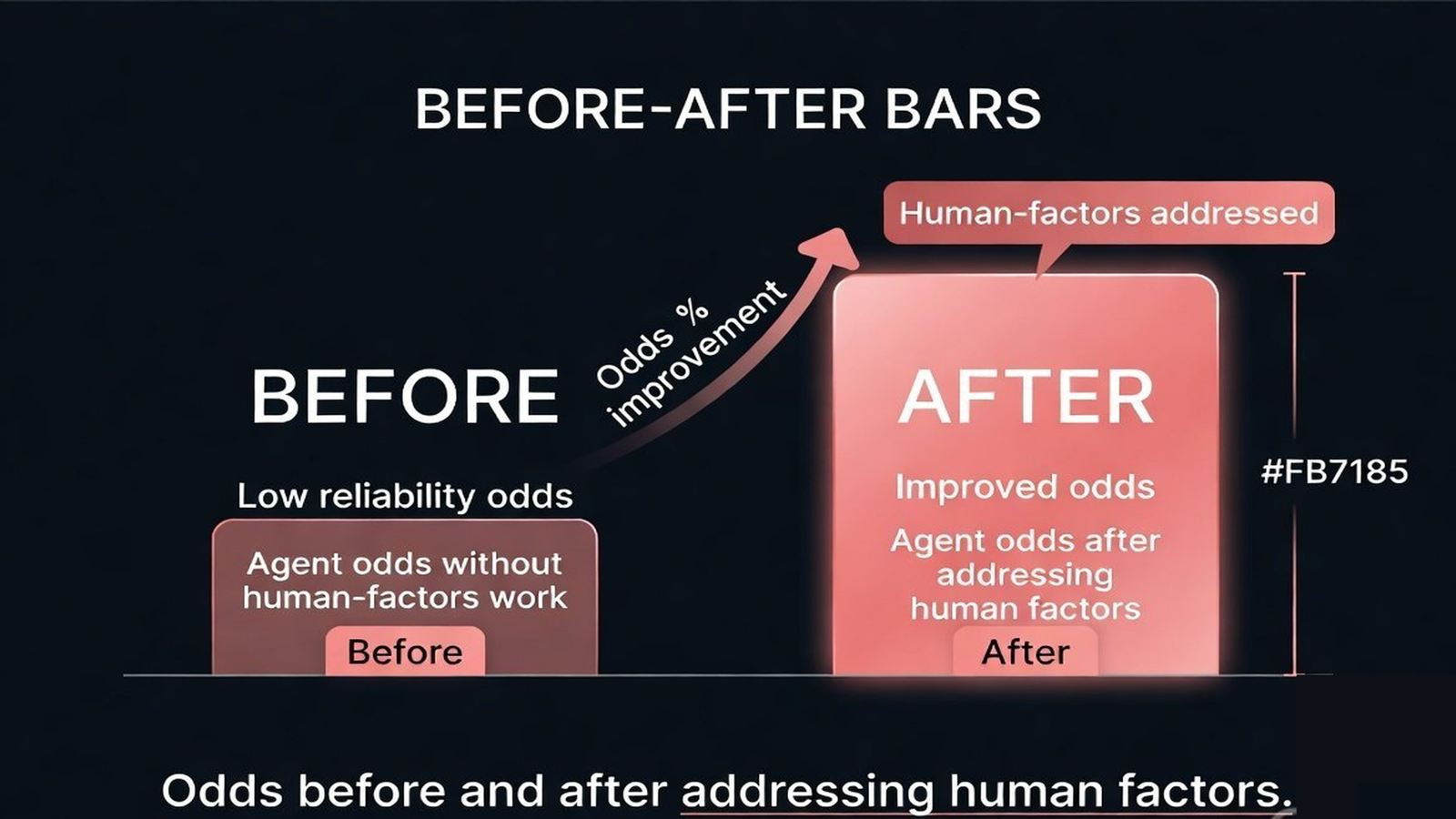
What human factors move the odds?
| Lever | Cost | Effect on odds |
|---|---|---|
| Psychological safety | Management attention | Higher readiness and use |
| Involvement in scoping | Time up front | Better agent, less rework |
| Trust building | Transparency | People correct the agent |
| Technical levers | High | Help, but not the main gap |
Human-factors work pays off fully only when the context people contribute actually shapes the agent, which is what the Pattern Intelligence Layer ensures. VibeModel turns the knowledge and corrections people provide into patterns the agent handles the same correct way every time, so the cheap, high-return human work compounds into a more reliable agent rather than evaporating between the conversation and the deployment.
Frequently asked questions
Is buying a more capable model the cheapest way to lift our odds?
The cheapest lift is human; a bigger model holds no context people do, and NoLiMa shows reasoning collapse, so involvement wins first. (arXiv:2502.05167)
Why start with people, not the model?
Because human factors are the cheapest lever that moves the most. Better models help, but people not using or correcting the agent is the larger gap.
How big is the human-factors effect?
Measurable: experimentation safety raised AI readiness by up to 20 points and made staff 1.4x more likely to be high-frequency users.
Do human factors affect reliability too?
Yes. People hold context the agent needs; without it the agent must infer beyond its limits, where models like those in NoLiMa break down.