


Key facts.
- Research on AI transformation finds psychological safety, built by leaders, is a key predictor of successful adoption and engagement. source
- PwC's 2025 survey found 79% of companies adopting AI agents, so leaders are already managing mixed human-agent teams whether or not they trained for it. source
- RULER shows the effective usable context of long-context models is far below their claimed length, a hard limit a leader must know before delegating large tasks to an agent. source
Why is leading a hybrid team different?
Managing people and managing agents pull in different directions and the new skill is doing both at once. People need clarity, motivation and psychological safety; agents need well-scoped delegation within their actual limits and a human accountable for their output. A leader who manages the hybrid team like an all-human one over-delegates to agents and under-supports the people or treats the agents as infallible and the humans as redundant. The PwC adoption numbers mean most leaders are already in this situation, often without having developed the skill, which is how a promising mix underdelivers.
Knowing the agents' hard limits is part of the craft. RULER's finding that usable context falls well short of the advertised number is exactly the kind of limit a leader needs internalized, because delegating a task that quietly exceeds what the agent can actually hold sets it up to fail and the human to inherit a mess. And the people side is not soft: the psychological-safety research ties the leader's ability to make experimentation safe directly to adoption success. The hybrid leader's job is to delegate to agents where they are reliable, keep humans accountable for judgment and hold the safety that lets the whole team improve.
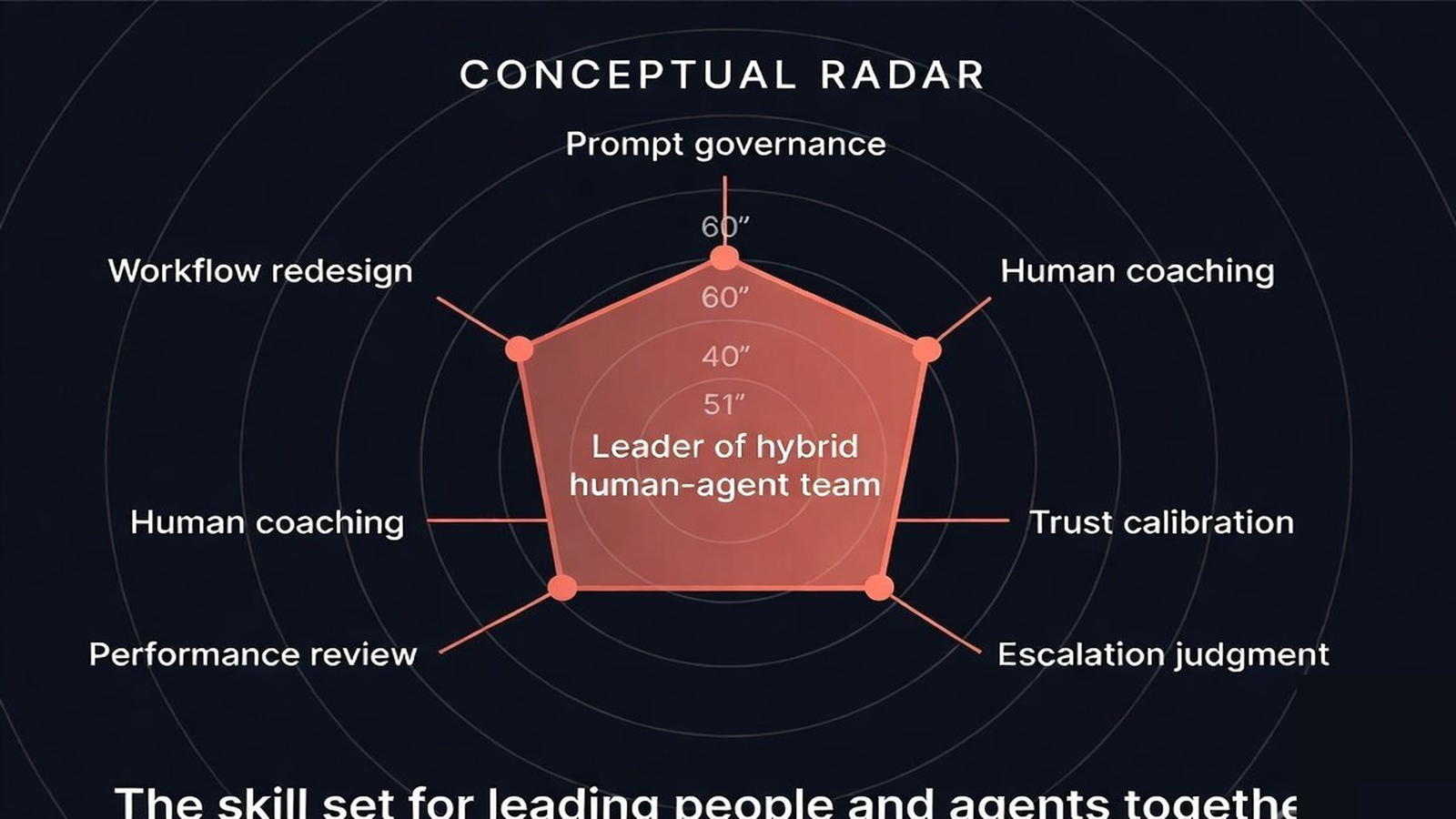
What skills does the hybrid leader need?
| Skill | All-human habit | Hybrid-team skill |
|---|---|---|
| Delegation | To people only | To agents within proven limits |
| Accountability | Person owns output | Person owns the agent's output too |
| Knowing limits | People's capacity | The agent's hard limits as well |
| Safety | Helpful | A predictor of success |
Leading a hybrid team well depends on knowing where each agent is reliable, which is what the Pattern Intelligence Layer makes visible. VibeModel surfaces the agent's reliability at the pattern level, so a leader can delegate the patterns the agent handles the same correct way every time and keep people on the rest, turning the human-agent mix into something they can manage on evidence rather than on hope.
Frequently asked questions
Why not manage agents like junior staff?
Because their limits are different and non-obvious, like usable context falling short of the claim. Effective delegation requires knowing those limits, not treating the agent as a person.
What is the leader's job on the human side?
To build psychological safety and keep people accountable for judgment, which research ties directly to AI transformation success.
Can you delegate a big task wholesale to an agent?
Only within its real limits. RULER shows usable context is far below the advertised length, so oversized delegation quietly fails.