


Key facts.
- Microsoft's Work Trend Index 2025, surveying 31,000 professionals across 31 countries, describes the rise of human-agent teams and new roles where human oversight and judgment grow more critical as AI advances.source
- 2026 skills-gap reporting finds new demand concentrated in AI governance, agentic workflow design and human-AI collaboration specialists, roles most orgs have not But defined.source
- On the Berkeley Function-Calling Leaderboard, multi-turn and agentic categories often sit between 12 and 60% for top models, so an accountable verifier is not optional.source
Why do these roles need to exist?
An agent in production is a system that makes decisions, takes actions and fails in ways that need a human to notice and correct. That is a job, several jobs in fact and on most org charts nobody holds them. The work falls to whoever is nearest, usually an engineer who built the agent and has no time to operate it, so monitoring lapses, scope drifts and the first real incident finds no one accountable. The BFCL numbers are why this matters: agentic tool use is unreliable enough that a named verifier earns their keep and an unowned agent accumulates silent failures until one becomes loud.
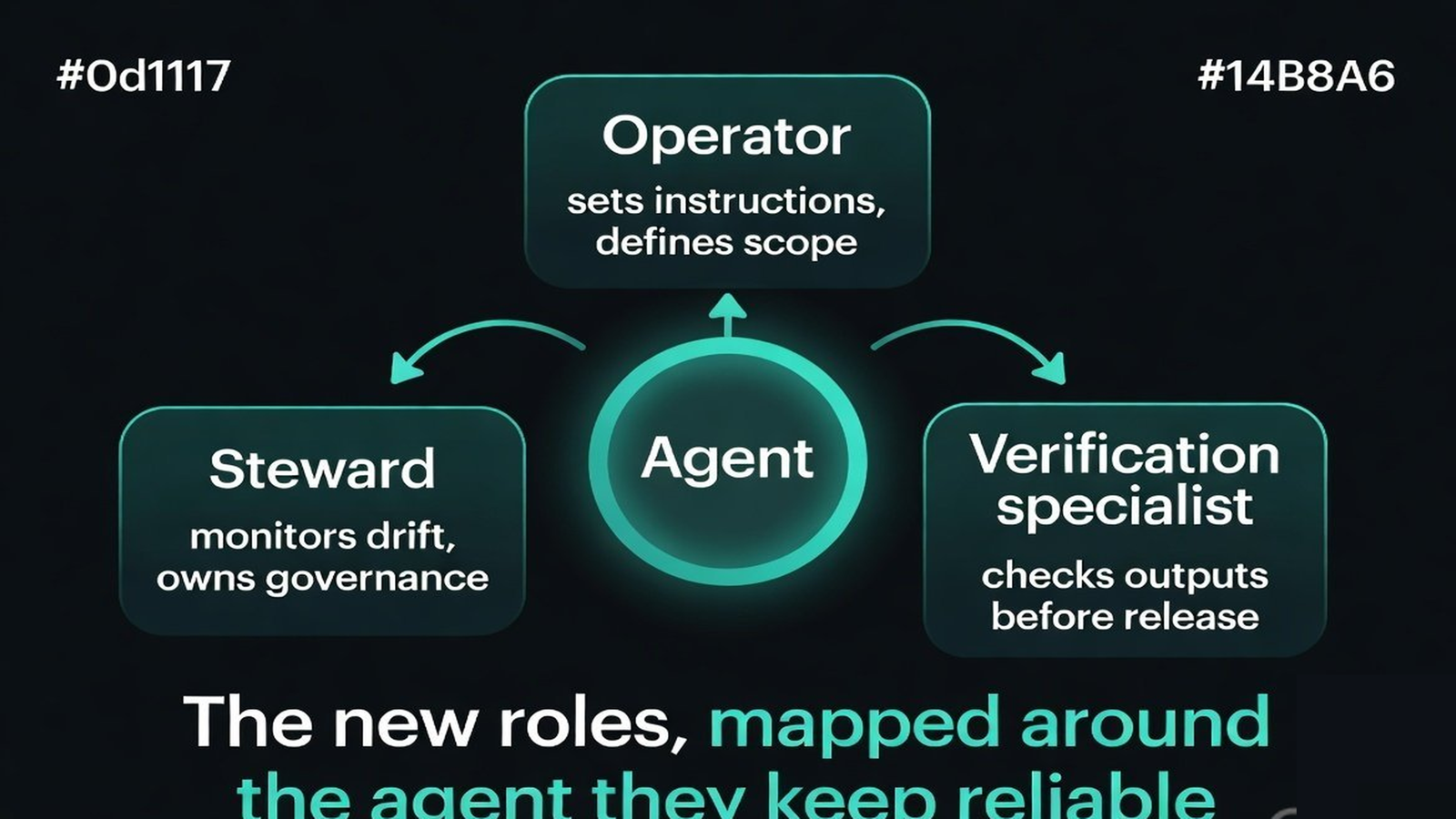
Microsoft's framing of the human-agent team is useful because it reframes the roles as additive, not as overhead. The operator keeps the agent healthy, the steward owns what it is allowed to do and how it should behave and the verification specialist checks the work that benchmarks say is most likely to be subtly wrong. These are the jobs that turn an impressive demo into a system the business can depend on.
What does each new role own?
| Role | Owns | If unfilled |
|---|---|---|
| AI operator | Day-to-day health and runs | Failures go unnoticed |
| Agent steward | Scope, behavior, boundaries | Scope drifts, no accountability |
| Verification specialist | Checking the high-risk work | Confident wrong answers ship |
On BFCL, agentic tool use lands 12 to 60% even for more capable models, so operator, steward and verifier are jobs no org chart has But . (source)
These roles are how an organization makes reliability somebody's job and reliability at the pattern level is what VibeModel provides as the Pattern Intelligence Layer. When the steward can define how a situation should always be handled and the system enforces that pattern, the new roles stop being heroics and become a sustainable operating model the agent can run inside.
Frequently asked questions
Do these have to be new hires?
Not always. They can be redefined responsibilities for existing people, but they must be named and owned, not left to whoever is nearest.
Which role matters first?
The steward, who owns scope and behavior. Without clear boundaries, the operator and verifier have no standard to hold the agent to.
Is a verification specialist worth it?
Benchmarks like BFCL show agentic tool use is unreliable enough that yes, a named verifier catches the confident wrong answers that would otherwise reach customers.