


Key facts.
- World-class ops: false positive rates below 10%, meaning 90%+ of surfaced alerts are real. That's the bar. Above it, the alerts stop getting taken seriously.source
- Too many false alarms trains teams to ignore the agent. One consequential miss and they switch it off entirely. Both paths end the same way.source
- Ops agent trust is asymmetric: false positives erode it gradually, one bad false negative collapses it immediately.source
- World-class ops keep false positives under 10% so alerts get believed; a more capable model with poor precision still trains the team to ignore it. (source)
Why do false positives and negatives decide trust?
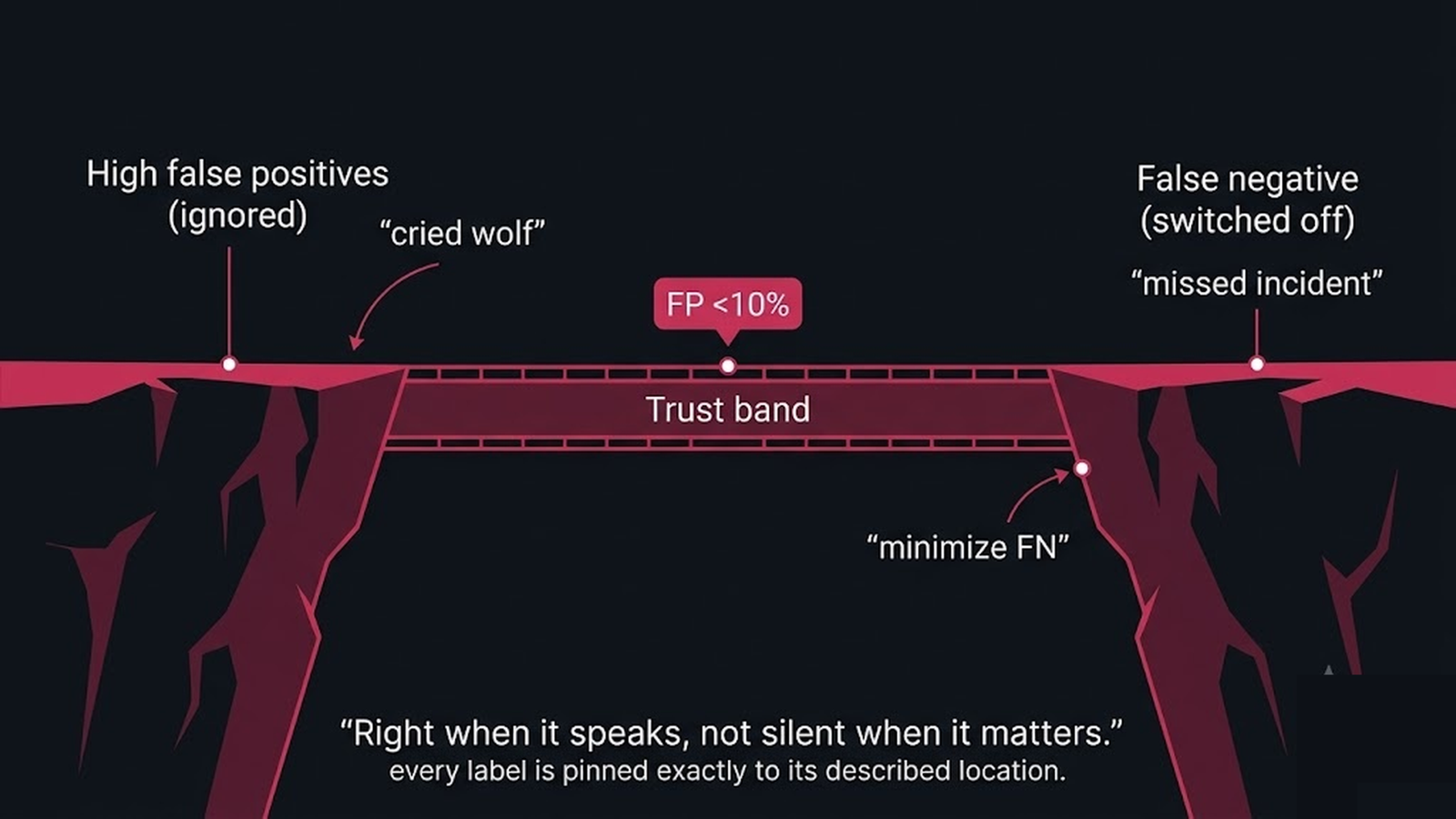
An ops agent is only useful if the team acts on its signals. Both error types eat that away. Flood the team with false alarms and they learn to ignore it. The alerts keep coming, the team stops reading them, and eventually the agent is running and nobody cares. That's the boy-who-cried-wolf scenario, and it's why world-class ops targets under 10% false positives. Above that threshold, alerts lose credibility faster than the agent can build it back.
False negatives are faster to kill trust. One real incident the agent missed, cleared, or deprioritized, and the team pulls it. Doesn't matter how many correct alerts came before. One consequential miss is enough. So the agent has to be precise on the false positive side and reliable on the false negative side, at the same time. Trust lives in that narrow band. Drift out of it in either direction and the agent gets disabled or, worse, stays running while the team stops believing it.
How do you build durable trust?
Tune false positives toward the sub-10% world-class bar, so alerts are worth reading. On consequential incidents, be conservative about clearing or deprioritizing, because the miss cost is trust-collapse, not just a missed alert. Pass confidence scores to the team so they can calibrate, high confidence means act now, low confidence means review before acting. That calibration is what keeps the relationship intact when the agent is uncertain. Right when it speaks, not silent when it matters, sustained. That's not a model property. It's a precision and reliability discipline you build around the model.
| Agent error profile | Trust outcome |
|---|---|
| High false positives | Team ignores the agent (cried wolf) |
| A consequential false negative | Team switches the agent off |
| Low false positives and negatives | Durable, acted-on trust |
Tuning that balance is part of what VibeModel does as the Pattern Intelligence Layer. We model the patterns that keep false positives low and catch the consequential real incidents, so an IT ops agent earns the durable trust that makes the team act on its signals rather than ignore or disable it.
Frequently asked questions
Which error is worse for trust?
Both are fatal. False positives erode trust gradually until the team ignores the agent; one consequential false negative collapses it suddenly.
What false-positive rate should I target?
Toward the world-class under-10% bar, so over 90% of surfaced alerts are genuine and worth the team acting on.
How does confidence help trust?
Passing confidence honestly lets the team calibrate, trusting high-confidence alerts and scrutinizing low-confidence ones, rather than abandoning the agent after one surprise.