


Key facts.
- 73% of security teams call false positives their biggest detection headache, according to the SANS 2025 survey. That's not a minority opinion. It's the majority, by a wide margin.source
- Around 2,992 security alerts land per organization per day on average. Most go untouched. The queue fills faster than anyone can work through it.source
- Under 10% false positives is the world-class benchmark. Fewer than one in ten surfaced alerts should be noise. That's the precision target any agent has to hit to actually help.source
Why does alert volume defeat the agent too?
Teams face ~2,992 alerts a day, false positives their top complaint (SANS 2025); a more capable model skipping precision clears noise faster (source)
Ask any ops lead what kills their team and it's the same answer: everything looks urgent. 2,992 alerts, most of them junk, and no way to tell which ones actually need a human in the next 10 minutes. That's what alert fatigue is. Not too much work. Too much noise drowning the real work. An agent that clears alerts fast doesn't fix that. It just processes the noise faster. The critical incident still sits in the queue because the queue has no way to distinguish it from the rest. SANS 2025 confirmed the problem is false positives, not throughput. An agent should be solving the false positive problem.
Nine out of ten alerts should be real by the time they reach a human. That's the benchmark. Under 10% false positive rate. Most teams aren't near it. Closing that gap is the job. An agent that moves the ratio there earns its place.
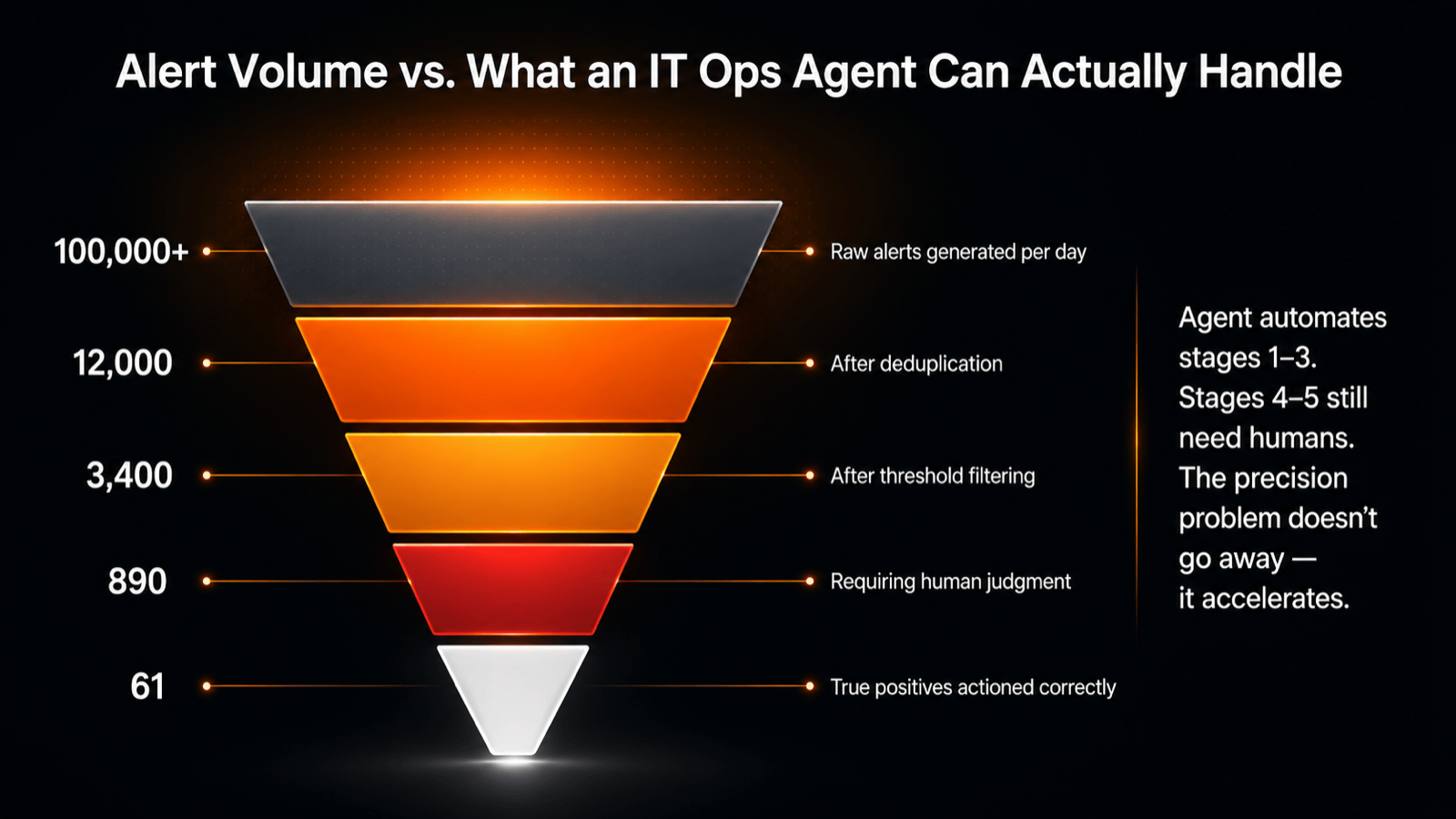
What makes an alert agent actually help?
Correlate signals. Suppress duplicates. Cut noise before surfacing anything. Once precision improves, layer in urgency: time-critical incidents should jump the queue, not wait behind false alarms. Fewer alerts, more of them real, and the ones that matter get seen first. That's the goal. An ops team working that way has capacity. One running an agent against the raw feed at current precision has a faster version of the same nightmare.
| Agent goal | Outcome |
|---|---|
| Automate triage at current precision | Faster noise, urgent incidents still buried |
| Raise precision, prioritize by urgency | Genuine urgent incidents surfaced |
Raising that precision is part of what VibeModel does as the Pattern Intelligence Layer. We model the patterns that separate a genuine, urgent incident from the false-positive flood. An IT ops agent surfaces the alerts that matter instead of automating the noise that buries them.
Frequently asked questions
Can an agent reduce alert volume?
It can reduce false positives if precision is the target. An agent that just triages faster at the current precision reproduces the flood at machine speed.
Why is urgency a special concern?
Because a time-critical real incident hidden in the flood can be cleared along with the noise, which is the failure ops teams most fear.
What is the precision target?
Under 10% false positives, the world-class benchmark, so over 90% of surfaced alerts are genuine and worth a human's time.