


Key facts.
- Rule-based AML transaction monitoring generates false positives in roughly 85 to 95% of alerts, per 2025 industry benchmarking.source
- Alert precision for rule-based systems is typically 5 to 15%, so most analyst time confirms legitimate activity.source
- KYC and AML rules evolve constantly, so an agent tuned to today's rules drifts out of compliance as they change.source
Why is the false-positive flood the core problem?
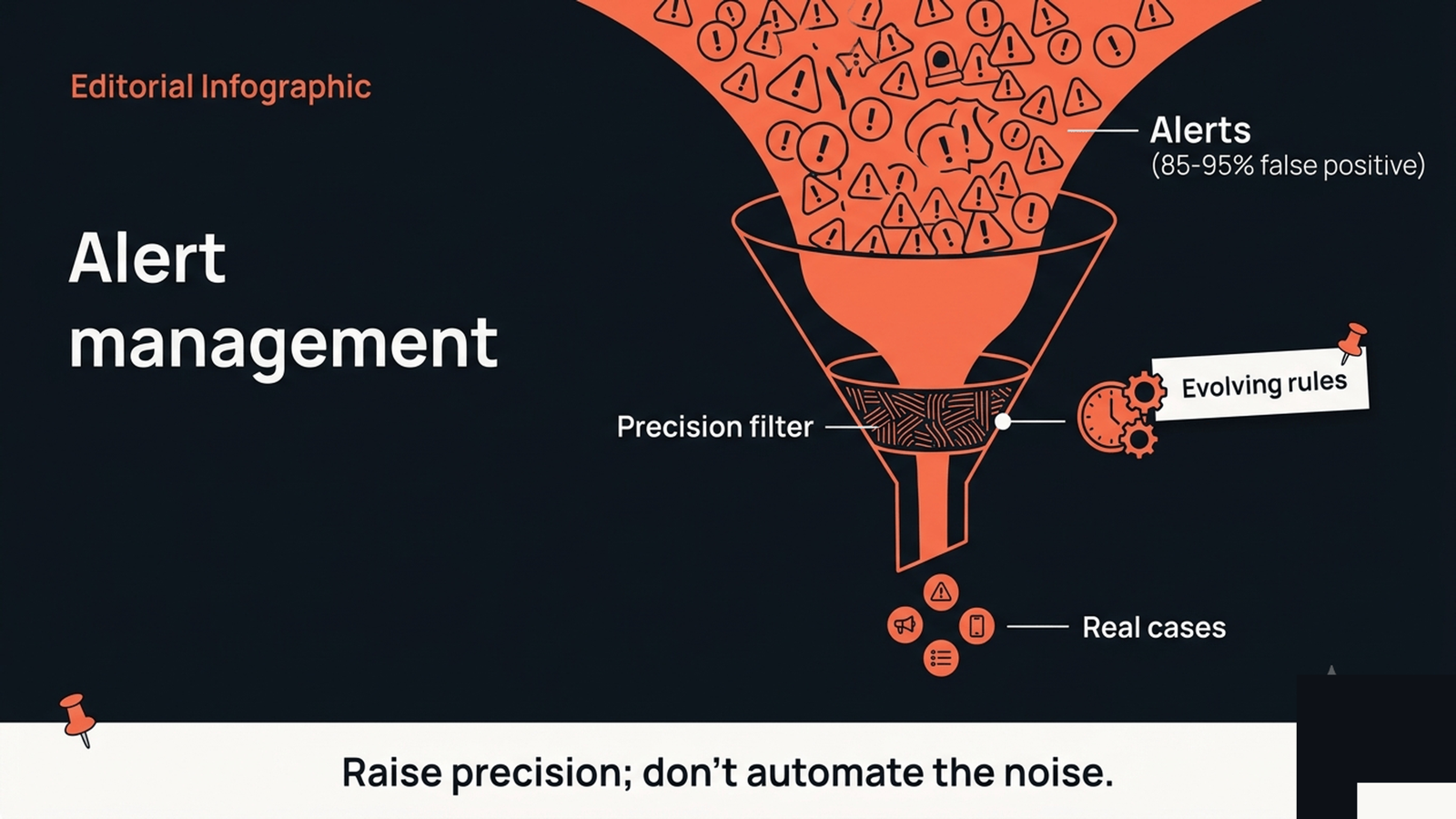
Cost and missed cases both come from the false-positive flood. When 85 to 95% of AML alerts are false, analysts spend most of their time clearing activity that was never suspicious. Expensive and exhausting. The real cases hide in that pile and get missed. An agent dropped on this without improving precision doesn't help. It automates the noise. Faster alert generation, faster false-positive triage, and the signal stays buried. A missed real case in compliance is a violation. Automating the flood makes those misses more likely, not less. The goal is to surface fewer, better alerts. Not to process the same flood at higher throughput.
Evolving rules compound this. KYC and AML requirements shift as regulations change and typologies evolve. An agent tuned to today's rules is a snapshot. Snapshots age. In compliance, an aging snapshot drifts into violation. The agent has to track rules as they move, not freeze them at the day it was deployed.
What makes an AML agent actually help?
Precision and adaptability. Target the agent at reducing the false-positive flood. Surface genuinely suspicious cases with much higher precision than the rule-based baseline. Analysts use their time on real cases instead of clearing noise. Build it to track evolving KYC and AML rules rather than freezing them at launch. It stays compliant as requirements shift. And make every flagged or cleared decision auditable. In compliance, you have to defend why each case was escalated or not. The win is fewer, better alerts and current rules, not the same flood faster.
| Agent goal | Outcome |
|---|---|
| Automate the existing flow | Same 85-95% false positives, faster |
| Optimize precision, track rules | Fewer, real alerts; stays compliant |
Optimizing for precision and current rules is part of what VibeModel does as the Pattern Intelligence Layer. We model the patterns that separate a real suspicious case from the false-positive flood and how the rules evolve. A KYC or AML agent surfaces signal instead of automating noise.
Frequently asked questions
Will a smarter model cut the AML false-positive flood?
Rule-based AML flags 85-95% false positives, so the problem is precision; a more capable model makes that noise faster, not precise. (arXiv:2502.15865)
Can AI reduce AML false positives?
Yes, substantially, when precision is the target. But an agent that just automates the existing flow reproduces the 85-95% false-positive problem at speed.
Why do evolving rules matter?
KYC and AML requirements change. An agent frozen at deployment drifts out of compliance as rules shift, so it must track them.
What about the cases it clears?
Clearing decisions must be auditable too, because compliance requires defending why a case was not escalated, not just why one was.