


Key facts.
- Rule-based sanctions and AML screening generate false positives in roughly 85 to 95% of alerts, so genuine hits are rare among overwhelming noise. source
- A missed sanctions hit is a serious regulatory violation, so the cost of a false negative on these edge cases is high. source
- Unusual transactions and system outages are out-of-distribution cases where an agent's routine handling is the wrong response. source
Why do the edge cases break the agent?
Because they combine the two things agents handle worst: rarity and high stakes. A sanctions hit is rare by design, hidden in a stream where 85 to 95% of flagged items are false positives, so the agent must find a faint signal in overwhelming noise and an agent tuned to clear the routine flow will clear the real hit along with the noise. An unusual transaction is, by definition, outside the distribution the agent was built for, so its routine handling, the default that works for normal transactions, is exactly the wrong response and the agent has no signal that this case is different. A system outage during a financial operation is an edge case where the agent must recognize that normal completion is impossible and stop safely rather than push forward. In each case the failure is the same: the agent applies routine handling to a non-routine, high-stakes case and the cost of getting these specific cases wrong, a missed sanction, a fraudulent transfer cleared, a transaction half-completed during an outage, is far higher than the cost of any routine error.
This asymmetry is why edge cases deserve special handling rather than the agent's default. The routine cases are where the agent saves time at low risk; the edge cases are where it can cause the expensive failures and they need detection and human judgment, not the same flow that works for the easy 99%.
What handles the edge cases right?
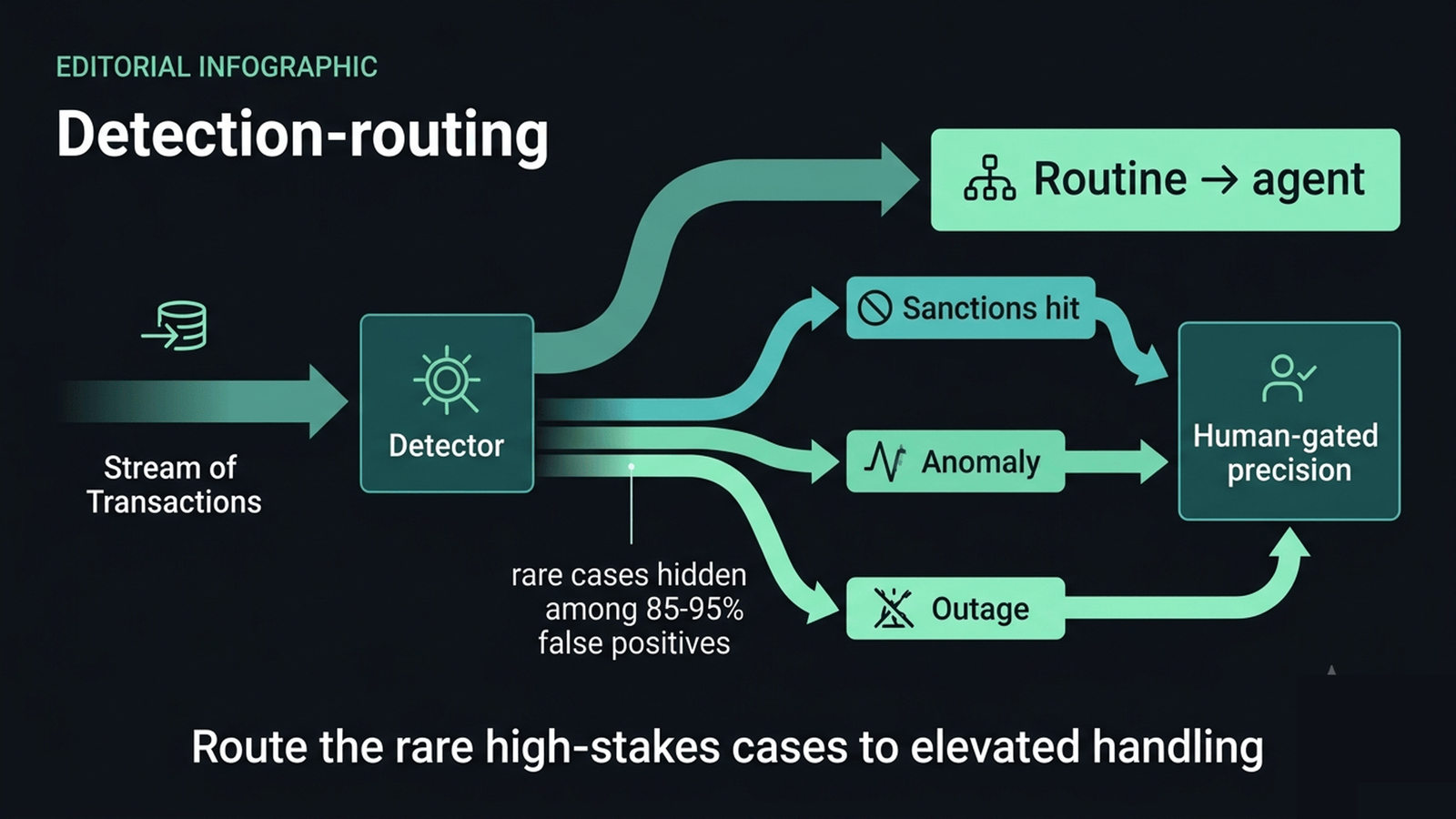
Detection plus high-precision, human-gated handling. Build the agent to recognize the edge cases, the possible sanctions hit, the anomalous transaction, the outage condition and route them out of the routine flow to high-precision screening and human judgment, rather than clearing them with the default. Optimize the screening for precision so the rare genuine hit is not lost in the false-positive flood and gate the high-stakes decisions on a human who can weigh the regulatory consequence. The agent owns the routine and the edge cases get the elevated handling their stakes demand.
| Edge-case handling | Outcome |
|---|---|
| Routine flow for everything | Misses rare hits, mishandles anomalies and outages |
| Detect and route to human-gated precision | Rare high-stakes cases get elevated handling |
Sanctions and AML screening already runs 85-95% false positives, real hits rare; a more capable model inherits that base rate, not a fix. (arXiv:2502.15865)
Detecting those edge cases is part of what VibeModel does as the Pattern Intelligence Layer. We model the patterns that mark a sanctions hit, an anomalous transaction or an outage condition, so the agent routes the rare high-stakes cases to the handling they need instead of clearing them with a routine default.
Frequently asked questions
Why is sanctions screening so hard?
The genuine hits are rare among 85-95% false positives, so finding the real one requires high precision the routine flow does not provide.
What makes an unusual transaction dangerous?
It is out of distribution, so the agent's routine handling is the wrong response and there is no default signal that the case is special.
How should the agent handle an outage?
Recognize that normal completion is impossible and stop safely, rather than pushing a transaction forward into an inconsistent state.