


Key facts.
- The UW study found intersectional amplification, where agent behavior compounds unpredictably across multiple characteristics, mirroring multi-factor HR situations.source
- HR policy frequently depends on circumstances, intent, history and fairness that a literal rule cannot capture.source
- An agent applies policy literally and consistently, which is right for clear cases and wrong for ones requiring discretion.source
Why do nuanced cases break the agent?
Intersectional bias compounds unpredictably, HR's hardest cases per UW; a more capable model cannot make the call the policy never wrote, a cost. (arXiv:2407.20371)
Because HR is a domain of exceptions and the agent is built to apply rules. Much of HR policy reads as clear rules. The cases that matter are the ones where the rule meets a circumstance it did not anticipate: an accommodation request that depends on context, a conduct issue that hinges on intent and history, a fairness judgment that requires weighing factors the policy lists but does not rank. The UW finding of intersectional amplification is the technical echo of this: when multiple factors combine, the agent's behavior becomes unpredictable. Is precisely the multi-factor situation HR handles daily. So the agent handles the clear case, the standard PTO request, the routine benefits question, correctly and then applies the same literal logic to a case that needed discretion and gets it wrong. That happens because it cannot weigh the human circumstances the policy assumed a person would consider. The failure is not that the agent broke a rule. It is that it followed the rule into a situation where following the rule was the wrong answer.
This is why the nuanced cases are the dangerous ones. They look like cases the agent can handle. That happens because there is a relevant policy, but the policy does not contain the judgment the case requires and the agent has no signal that this case is different from the clear-cut ones it handles well.
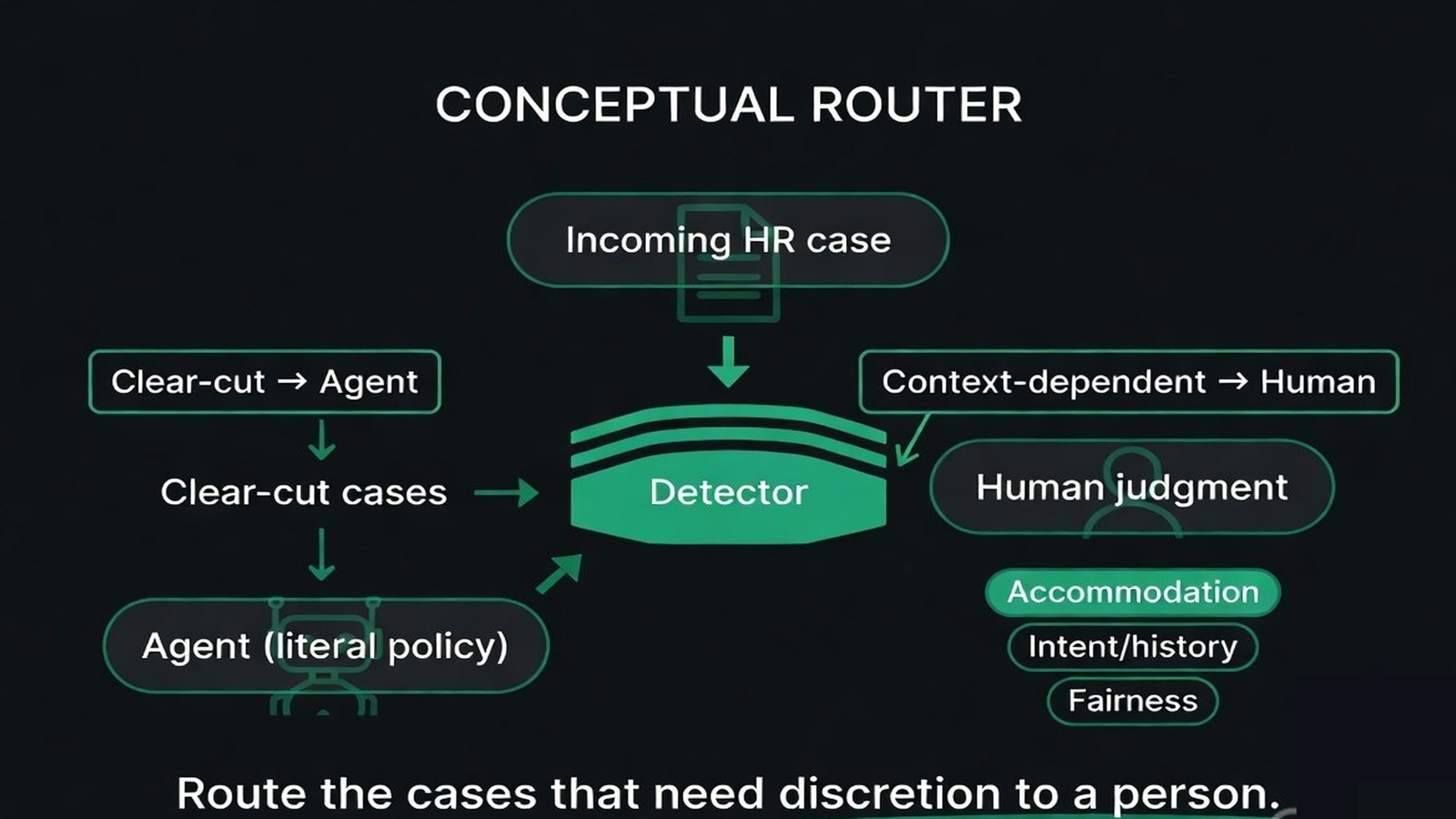
What handles the human cases?
Detection and routing to human judgment. Build the agent to recognize when a case is context-dependent, an exception, an intersection of factors. A situation requiring discretion and route it to a person rather than applying policy literally. Keep the agent on the clear-cut, high-volume cases where literal application is correct and let humans own the nuanced employee-relations decisions where circumstances the policy never enumerated determine the right answer. The skill is the detection: an agent that knows which cases it should not decide is far more valuable than one that confidently decides all of them.
| Case handling | Outcome |
|---|---|
| Apply policy literally to all cases | Clear cases right, nuanced ones wrong |
| Detect and route context-dependent cases | Discretion applied where it is needed |
Detecting the context-dependent case is part of what VibeModel does as the Pattern Intelligence Layer. We model the patterns that mark a case as requiring human judgment. The HR agent owns the clear cases and routes the nuanced ones to a person instead of applying a rule the situation outgrew.
Frequently asked questions
Why not write more detailed policies?
Because the nuance is in circumstances no policy can fully enumerate. Detection and routing handle what exhaustive rules cannot.
Which HR cases need a human?
Accommodations, conduct issues, fairness judgments and any case where intent, history or context determines the right answer.
How does the agent know a case is nuanced?
You build detection signals for exceptions, intersecting factors and discretion-requiring situations, routing those out of the literal-policy path.