


Key facts.
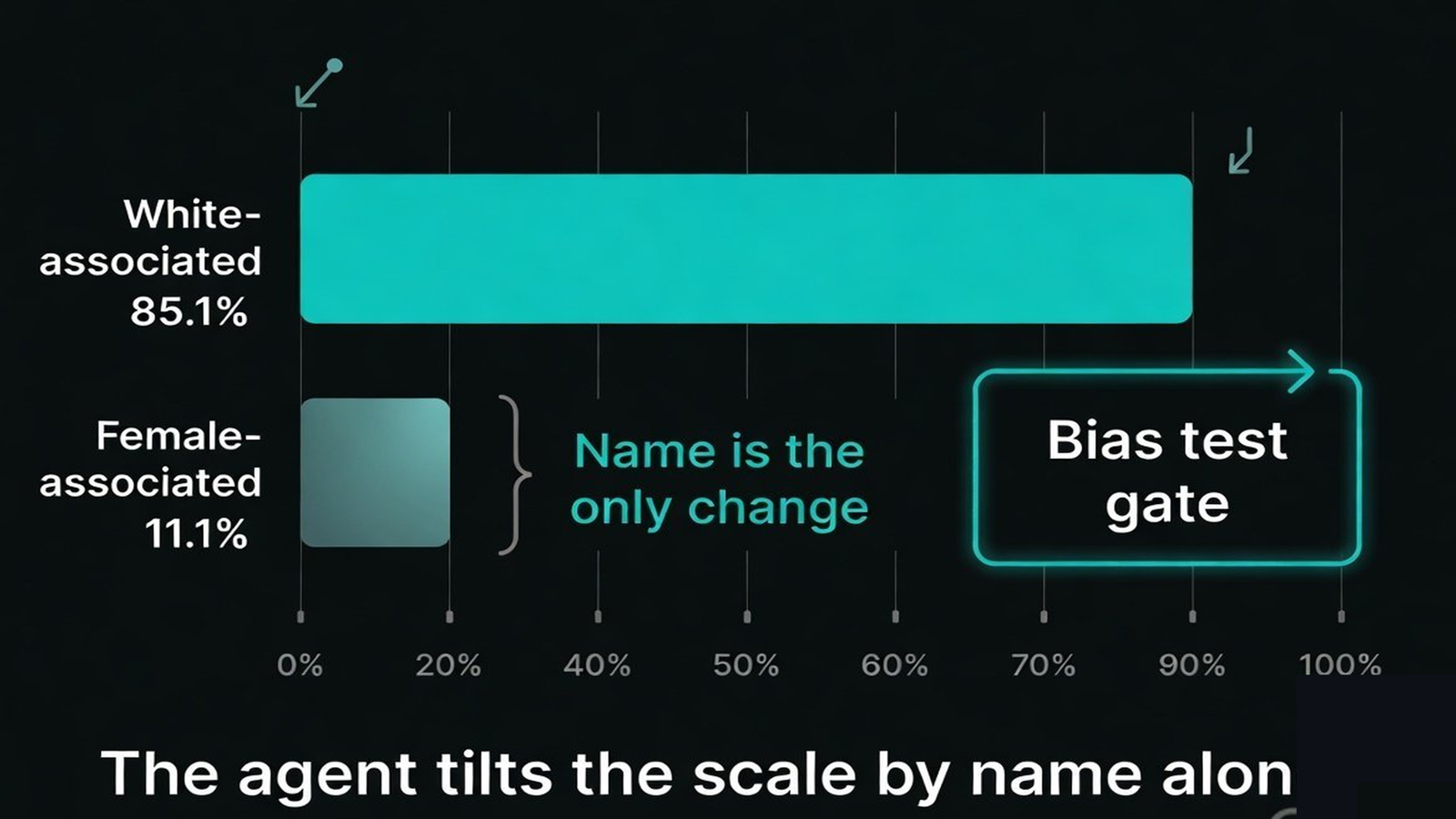
- A 2024 University of Washington study found LLMs ranking 550 resumes favored White-associated names 85.1% of the time and female-associated names only 11.1%.source
- The biases showed intersectional amplification, compounding unpredictably across multiple protected characteristics.source
- AI is now widespread in hiring, with estimates that a large majority of large employers use it, so the bias operates at scale.source
Why does the agent reproduce bias?
Because it learned from human decisions that contained bias and it applies what it learned without the hesitation a fair process requires. The University of Washington result is stark: changing only the name on a resume shifted the ranking, favoring White-associated names in the large majority of comparisons and female-associated names in a small minority, which is discrimination on a protected characteristic driven by nothing but the name. The model is not malicious, it is faithful, reproducing the statistical patterns in its training data and those patterns encode the historical bias of the decisions it learned from. Worse, the intersectional amplification finding shows the bias compounds across characteristics in ways that are hard to predict, so an agent that looks acceptable on one axis can be severely biased on a combination. And because the agent applies this consistently and at scale, it turns scattered human bias into systematic discrimination, faster and more uniform than any individual recruiter.
The consistency is what makes it dangerous. A biased human recruiter affects the candidates they personally review; a biased agent affects every candidate, identically, which is both a larger harm and a clearer legal liability, because the disparate impact is systematic and measurable.
What keeps an HR agent fair?
Bias testing as a gate, not a hope. Test the agent for disparate impact across protected groups, including intersections, using the kind of name-swap and outcome analysis that surfaces the bias the UW study measured and gate deployment and ongoing operation on passing that test. Where the agent shows disparate impact, it does not ship or it ships with the biased step removed and a fairer process in its place. The model will not become fair on its own, because the bias is in what it learned, so fairness has to be measured and enforced from outside the model. An HR agent that has not been tested for bias is not neutral, it is biased and unexamined.
| HR agent handling | Outcome |
|---|---|
| Trust the model's ranking | Systematic, scaled discrimination |
| Bias-test and gate | Disparate impact caught before it harms |
Testing and enforcing fairness is part of what VibeModel does as the Pattern Intelligence Layer. We model the patterns of disparate impact across protected groups and gate on them, so an HR agent is measured for fairness rather than trusted to be neutral when the model is not.
Frequently asked questions
Does a better model fix hiring bias?
No. It applies the learned bias more consistently. The fix is bias testing and enforcement outside the model, not raw capability.
What is intersectional amplification?
Bias compounding across multiple protected characteristics in unpredictable ways, so an agent acceptable on one axis can be severely biased on a combination.
Why is a biased agent worse than a biased human?
It applies the bias systematically to every candidate, making the discrimination larger, more consistent and a clearer legal liability.