


Key facts.
- The EU AI Act classifies AI for recruitment, candidate evaluation, promotion, termination and performance assessment as high-risk under Annex III.source
- Obligations include risk assessment, technical documentation, bias testing, human oversight, transparency and continuous monitoring, enforceable from August 2026.source
- The deploying organization is responsible for compliance, with extraterritorial reach to any system affecting EU-based applicants or employees.source
Why is employment AI classified as high-risk?
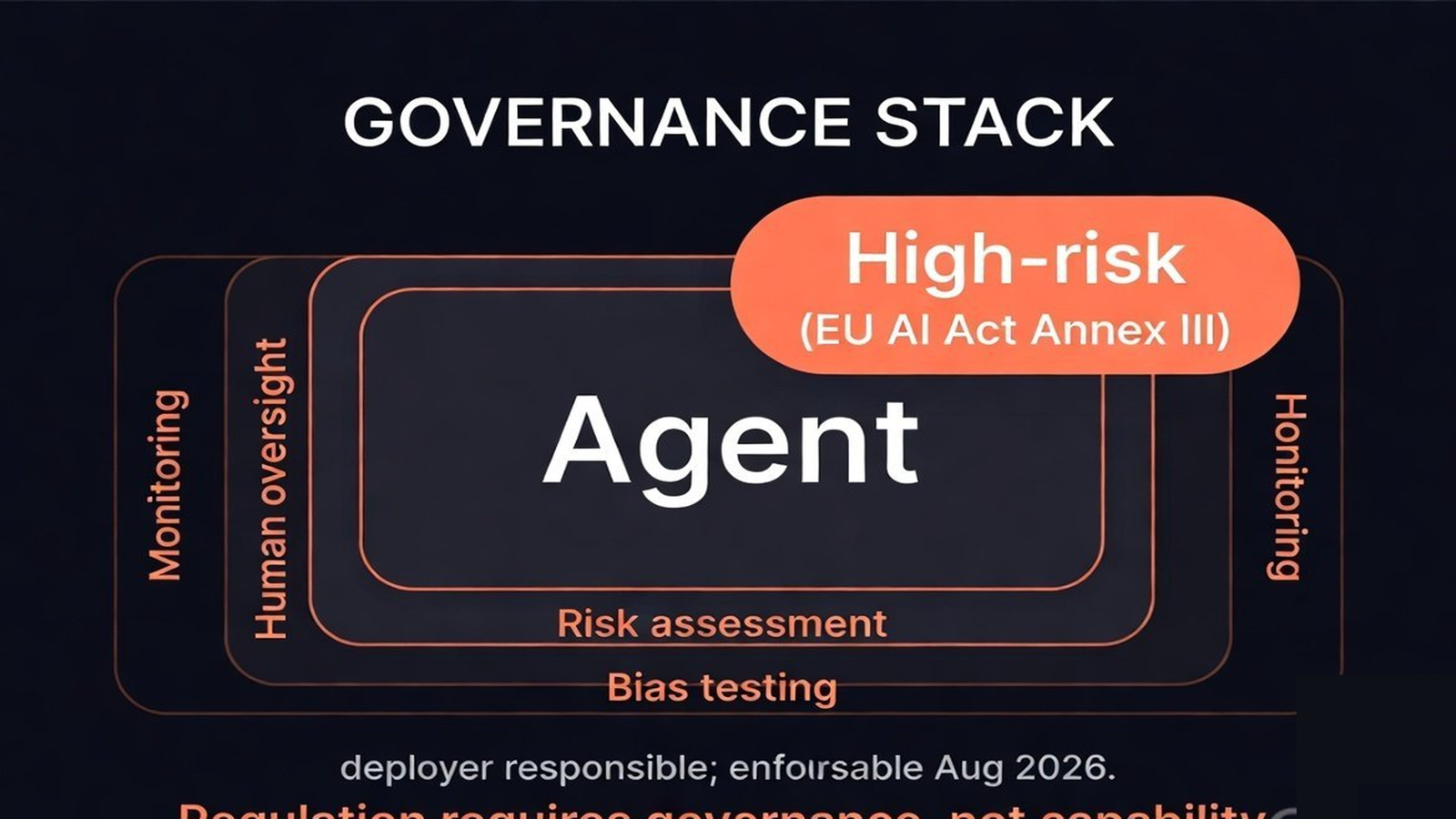
The EU AI Act makes recruitment AI high-risk, bias testing enforceable from 2026; a more capable agent satisfies none, only governance, a late cost. (source)
Because the decisions it influences materially affect people's livelihoods and regulators have concluded that warrants binding safeguards. The EU AI Act's Annex III names employment AI explicitly: systems that screen applications, rank candidates. Evaluate performance or inform promotion and termination are high-risk because they shape who gets hired, advanced or let go. The classification is not symbolic; it attaches concrete obligations, risk assessments, documentation, bias testing, human oversight, transparency and ongoing monitoring. That become enforceable from August 2026 and crucially the deploying organization bears the responsibility, not the vendor. So an HR agent in production is not just a tool that should be governed as good practice. It is a regulated high-risk system whose obligations an ungoverned deployment cannot meet. The Act even reaches extraterritorially, applying to any system affecting EU-based applicants or employees regardless of where it was built. The obligations follow the agent wherever its decisions land on EU workers.
This changes the deployment question from "is the agent good" to "is the agent governed." A highly accurate HR agent with no bias testing, no documented human oversight and no monitoring is non-compliant. That happens because the regulation requires the governance artifacts, not just the performance. Capability does not substitute for the obligations.
What governance does a high-risk HR agent need?
The full stack the regulation names. Risk assessment of the agent's employment decisions, bias testing for disparate impact, documented human oversight so a person is accountable for consequential decisions. Transparency to affected candidates and employees and continuous monitoring so drift and emerging bias are caught. Build these as the conditions of deployment, because from August 2026 they are enforceable obligations the deploying organization owns and because they are what makes the agent fair and accountable regardless of jurisdiction. The governed HR agent is deployable; the ungoverned one, But capable, is a compliance liability.
| HR agent in production | Regulatory standing |
|---|---|
| Accurate, no governance | Non-compliant high-risk system |
| Bias-tested, overseen, monitored, documented | Meets high-risk obligations |
Building that governance is part of what VibeModel does as the Pattern Intelligence Layer. We model the patterns of bias testing, oversight and monitoring a high-risk employment agent requires. An HR agent in production meets the obligations regulation now attaches to it rather than relying on capability that does not satisfy them.
Frequently asked questions
Is my HR agent really high-risk?
Under the EU AI Act, yes, if it influences recruitment, evaluation, promotion or termination. Annex III names these explicitly, with obligations from August 2026.
Who is responsible for compliance?
The deploying organization, even if the vendor says otherwise and the obligations reach any system affecting EU-based applicants or employees.
Does a better model help?
No. The regulation requires governance artifacts, bias testing, oversight, monitoring, documentation, which capability does not provide.