


Key facts.
- NYC Local Law 144 mandates independent bias audits of automated employment decision tools, with public reporting and candidate notification, as a condition of use.source
- Compliance and fairness obligations are conditions of operating, not enhancements, so a pilot without them cannot scale into regulated markets.source
- Employee trust, earned through transparency and demonstrated fairness, determines whether an HR agent is accepted at scale.source
Why do HR pilots stall on non-technical factors?
HR pilots scale by building the bias-audit foundation NYC Local Law 144 demands; a more capable model clears the demo, not compliance. (arXiv:2407.20371)
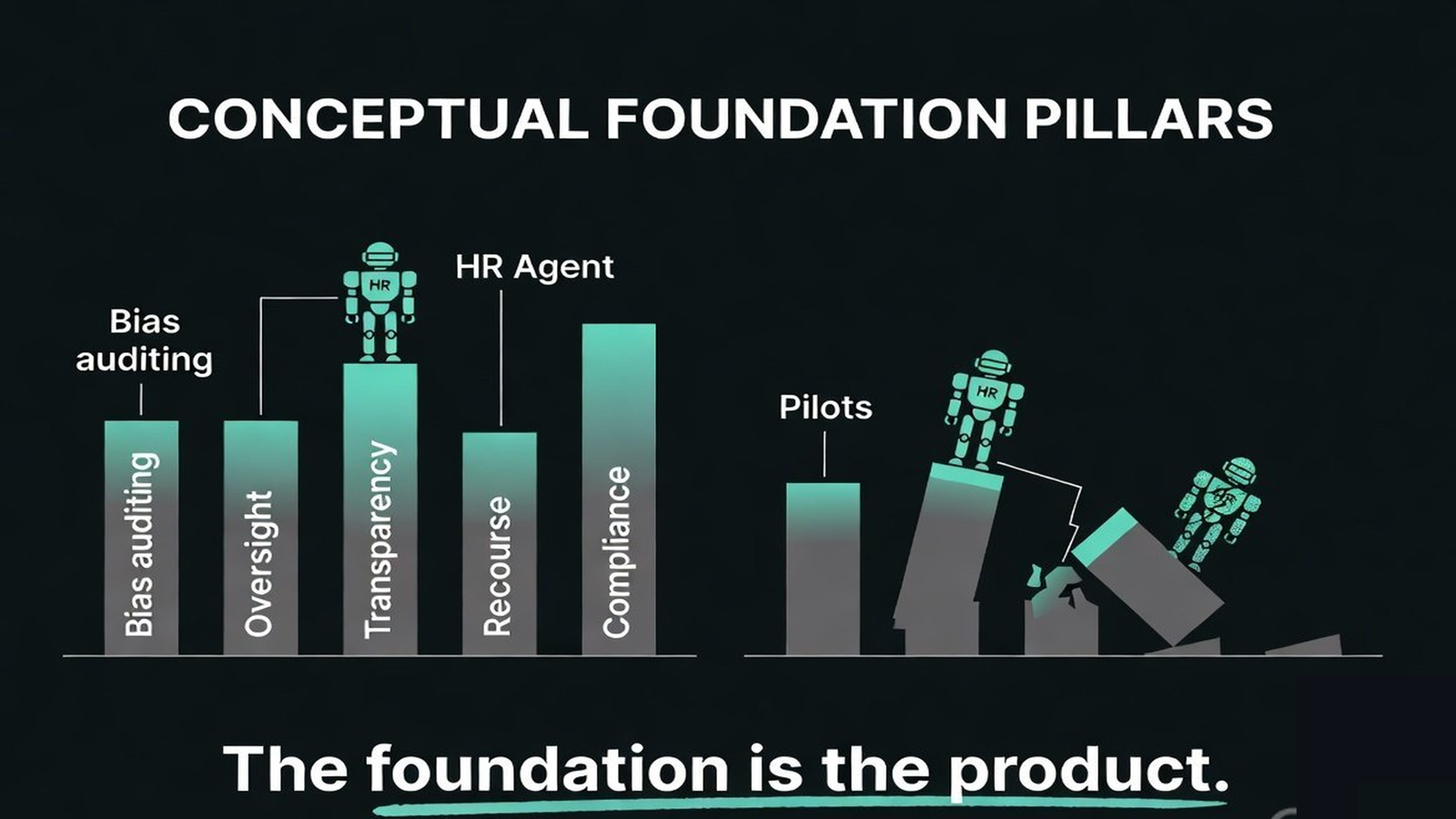
The gap between a pilot and a production HR system is trust. Pilots rarely build it. They prove the agent can screen resumes or answer benefits questions. That's the easy part. They fail to scale because they have no bias audit, no documented human oversight, no transparency to candidates, no compliance with laws like Local Law 144 that make those mandatory. These aren't enhancements to bolt on later. They're conditions of operating an HR agent in a growing number of jurisdictions. They take real work: independent audit, public reporting, notification processes, recourse mechanisms. The pilots that stall treated this as future paperwork. At scale-up, they couldn't deploy into regulated markets. Employees rejected a system whose fairness was never demonstrated. The capability was never the blocker. The foundation was.
The pilots that scale invert this. They build fairness and compliance alongside capability. When the pilot succeeds, the agent is already auditable, governed, transparent, and trusted. Scaling is a matter of expanding a system that was production-shaped from the start.
What does the scaling foundation include?
Build the foundation during the pilot, not after. Run the independent bias audit. Be ready to publish it. Document the oversight so accountability is clear. Be transparent with candidates about where and how the agent is used. Provide recourse when it errs. Meet the legal requirements of the markets you operate in. These are what production demands and what the demo skipped. The HR pilots that scale are the ones that built this in from the start. In HR, the foundation is the product. Capability without it doesn't reach production.
| Pilot foundation | Outcome |
|---|---|
| Capability only, compliance deferred | Stalls at the regulated, trust-dependent scale-up |
| Fairness, oversight, compliance built in | Scales as a production-shaped system |
Building that foundation is part of what VibeModel does as the Pattern Intelligence Layer. We model the patterns of the fairness, oversight and compliance an HR agent needs to scale. Your pilot is built like the ones that reach production rather than the ones that stall on the work the demo skipped.
Frequently asked questions
Why can't I add compliance after the pilot?
Because in regulated markets it is a condition of operating, not an enhancement. A pilot without it cannot deploy into those markets at all.
What stalls HR pilots most?
The absence of bias auditing, oversight, transparency and compliance, the trust-and-fairness foundation production requires and the demo skipped.
What do scaling pilots do differently?
They build the fairness and compliance foundation alongside the capability, so the agent is production-shaped from the start.