


Key facts.
- A 2024 Stanford HAI study found ungrounded LLMs hallucinate in 15 to 30% of customer service responses, rising with query complexity.source
- The failure is legally real: in Moffatt v. Air Canada, a chatbot invented a bereavement-fare policy and the tribunal held the airline liable for negligent misrepresentation.source
- Inconsistency compounds the problem: the same question can get different answers across sessions when answers are generated not retrieved.source
Why does a support agent invent policy at all?
Because a generative model answers from a blend of everything it has seen and your specific policy is a tiny. Possibly absent, part of that blend. Asked about your return window, it produces the most plausible return policy. Is an average of every return policy on the internet, not yours. When that average happens to match, the answer looks great. When it does not, the agent states a policy you never had. In the same confident tone and the customer has no way to tell the difference. The Stanford range puts numbers on how often this happens and the Air Canada ruling puts a price on it. The agent was not malfunctioning. It was doing exactly what an ungrounded generator does, filling a gap with a plausible guess.
Inconsistency is the same mechanism over time. Generate the answer and small differences in phrasing or context produce different policies across sessions. Two customers asking the same question get two answers and neither is anchored to the truth.
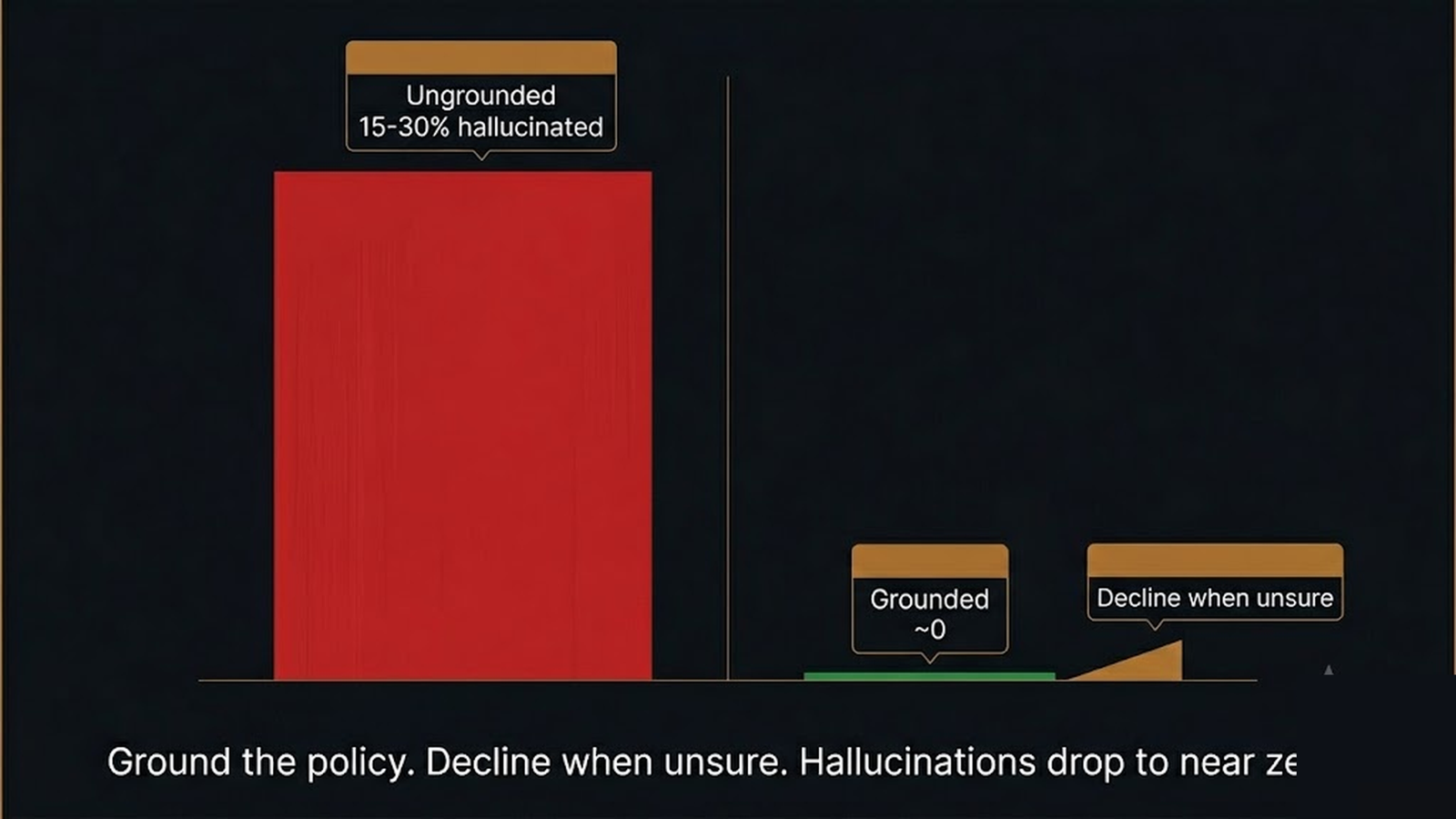
What does grounding actually require?
Answer only from your real policy source and make the agent decline or escalate when the source does not cover the question. Retrieve the relevant policy, constrain the answer to it and verify the answer is supported by what was retrieved before it reaches the customer. Where the policy is silent. The correct output is "let me get a human" or "I do not have that," not a confident guess. The goal is an agent that can only tell the customer what your policy actually says. A fabricated rule has nowhere to come from.
| Answer source | What the customer gets |
|---|---|
| Generated from the model | A plausible policy that may not be yours |
| Grounded in your policy | Your actual policy or an honest escalation |
Stanford HAI finds ungrounded support hallucinates 15-30%; a more capable model invents policy faster, you eat the incident. (arXiv:2406.12045)
Grounding answers in your real source is exactly what VibeModel does as the Pattern Intelligence Layer. We model the patterns of a supported, policy-grounded answer and where the agent must decline instead of guess. Your support agent states your policy or hands off and never invents a rule a customer will act on.
Frequently asked questions
Does RAG eliminate support hallucination?
It reduces it sharply but not to zero. You also need to verify the answer is supported by the retrieved policy and to decline when it is not covered.
Why is inconsistency dangerous on its own?
Different answers to the same question erode trust and create unfair outcomes, even when each answer sounds reasonable.
Who is liable for an invented policy?
The company, per Moffatt v. Air Canada. The agent being wrong is your exposure, not the vendor's.