


Key facts.
- ConflictBank shows knowledge conflicts, between general rules and specific cases, current and stale facts, contradictory sources, are a major and rarely-studied source of model failure. source
- A policy exception is a conflict between the standard rule and the specific situation, which the agent resolves by invisible weighting unless built to flag it. source
- An angry customer or a complex complaint is an out-of-default case where the agent's standard playbook is the wrong response. source
Why do the hard cases break the default agent?
Because the agent has one playbook and the hard cases need a different one. The angry customer needs de-escalation, not a cheerful canned answer that reads as dismissive. The complex complaint spans issues the agent's single-pass resolution cannot untangle. The policy exception is, in ConflictBank's terms, a knowledge conflict, the general policy says one thing and this customer's specific situation warrants another and the agent, with no conflict-handling, picks one silently and confidently. In each case the default behavior is not just unhelpful, it is actively wrong for the situation and applying it makes things worse. The easy tickets never revealed this because the default playbook fit them. The hard tickets are where the missing branches show.
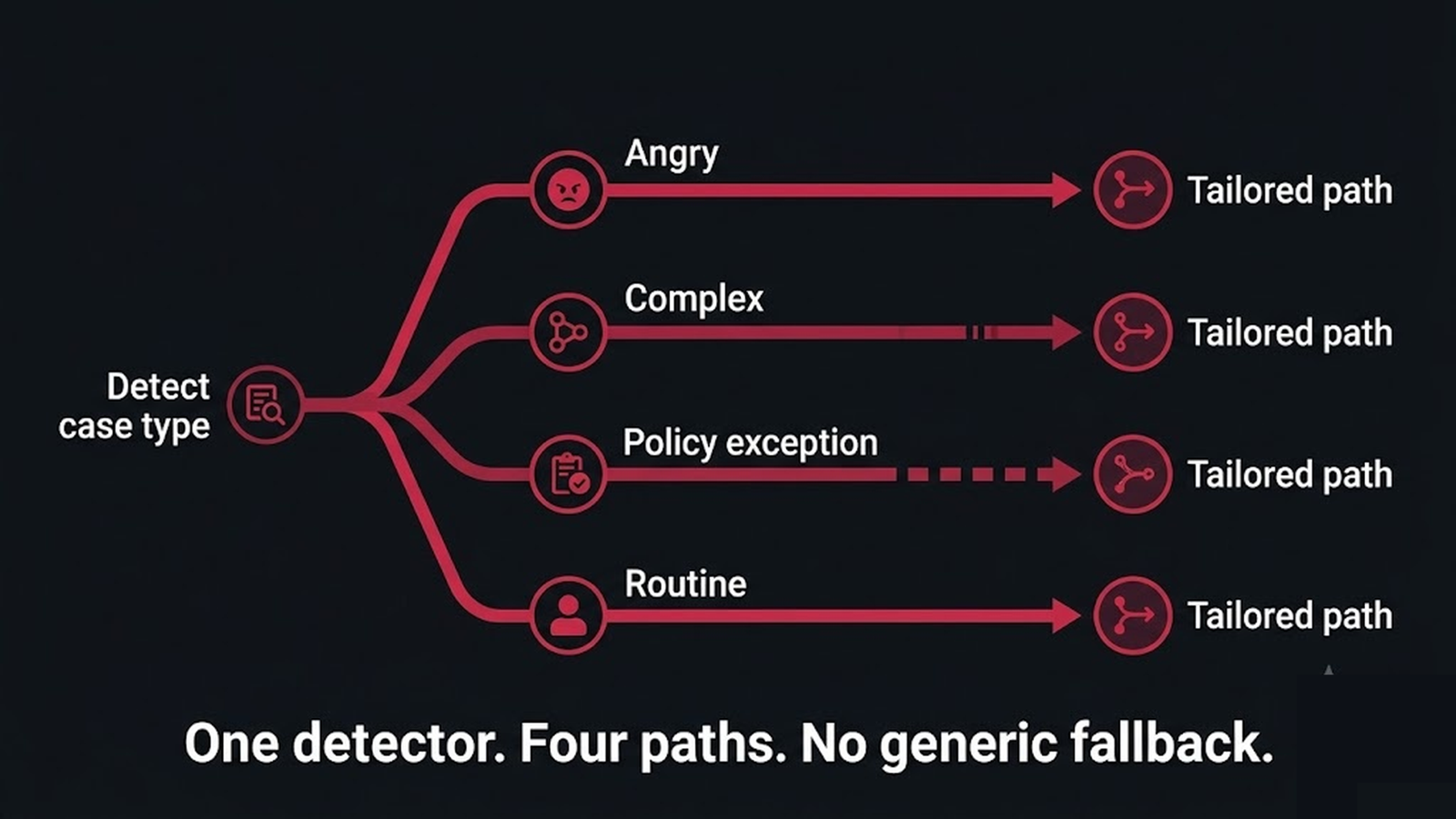
The throughline is that these cases need to be recognized as different before they are handled. An agent that treats the furious customer like a routine query or the exception like the rule, has already failed by not noticing the case was special.
What does handling them well require?
Detection plus tailored routing. Build signals for the hard cases, sentiment for the angry customer, complexity for the tangled complaint, conflict between rule and situation for the exception and route each to a path designed for it: de-escalation or a human for anger, a structured or human process for complexity, an exception workflow or approval for a policy bend. The agent's job on these cases is often to recognize them and hand off, not to resolve them with a playbook built for easy tickets. Getting the hard cases right is mostly getting the detection right.
| Hard-case handling | Outcome |
|---|---|
| Default playbook for everything | Wrong response to anger, complexity, exceptions |
| Detect and route by case type | The right path for each hard case |
A policy exception is a rule-versus-case conflict, and ConflictBank shows conflicts break models; a more capable agent gets it wrong, incident. (arXiv:2408.12076)
Modeling that detection is part of what VibeModel does as the Pattern Intelligence Layer. We model the patterns that mark an angry customer, a complex complaint or a policy exception, so your support agent recognizes the hard case and routes it instead of applying an easy-case playbook to it.
Frequently asked questions
Why is a policy exception so hard for an agent?
It is a conflict between the general rule and the specific case. Without conflict-handling, the agent resolves it invisibly and usually wrong, as ConflictBank's findings imply.
Should the agent resolve angry customers?
Usually it should detect and de-escalate or hand off. A default cheerful answer to a furious customer makes it worse.
How do I detect the hard cases?
Signals for sentiment, complexity and rule-versus-situation conflict, each routing to a path built for that case.