


Key facts.
- Around four in five leaders say psychologically safe organizations adopt AI more successfully, with 84% observing a direct connection between safety and AI outcomes. source
- NoLiMa shows long-context models collapse on tasks needing inference beyond literal matching, so an agent missing stakeholder context is brittle where that context mattered. source
Why does the scoping room matter so much?
Who scopes decides what the agent misses; a bigger model cannot recover edge cases absent stakeholders knew, as NoLiMa shows, so scope right first. (arXiv:2502.05167)
The people you include when you scope an agent determine what it knows about the work. Scope it with a small technical group and you get an agent built around their model of the process, which is usually the clean, documented version. The messy reality, the exceptions the frontline handles daily, the constraints the compliance team enforces, the edge cases support sees, never makes it into the design, because the people who hold that knowledge were not in the room. The agent then meets that reality in production and breaks and you pay in rework to add what diverse scoping would have surfaced for free.
There is a resistance dividend too. People who helped scope the agent are far more likely to back it, which is why the psychological-safety research ties inclusive, safe environments to better AI outcomes. Exclusion produces both a worse agent and a more resistant org, a double cost. And the technical fragility is not abstract: an agent missing context has to infer beyond what it was given, exactly the reasoning that benchmarks like NoLiMa show models failing at. Diverse scoping is cheaper than the rework and resistance that narrow scoping guarantees.
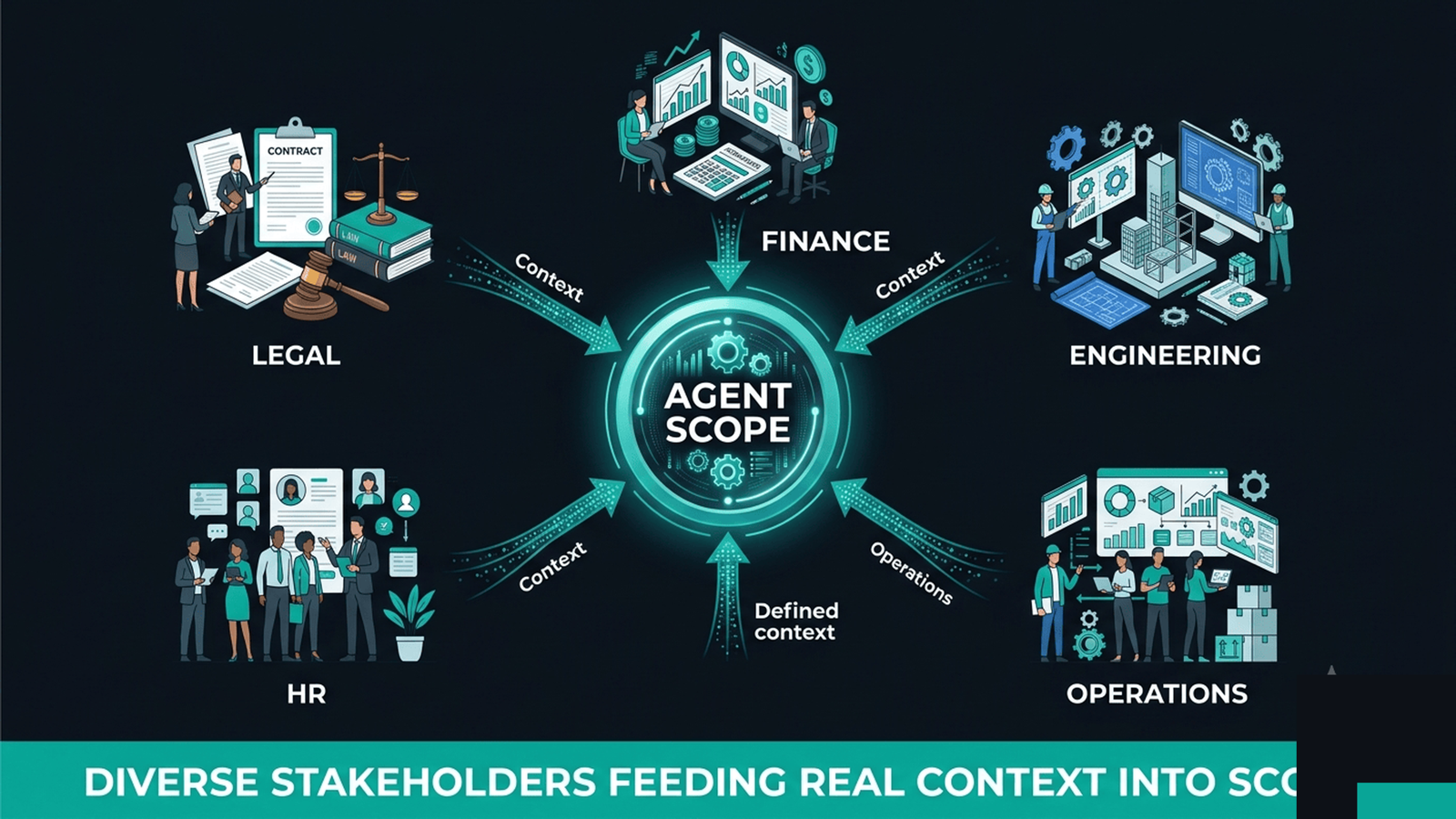
Who belongs in the room?
| Stakeholder | Narrow scoping | Diverse scoping |
|---|---|---|
| Frontline workers | Excluded | Bring the real exceptions |
| Governance/compliance | Consulted late | Shape the boundaries early |
| Support/edge cases | Missed | Surface the long tail |
| Cost | Rework and resistance | Built right the first time |
Capturing diverse context is only useful if the agent then applies it consistently, which is what the Pattern Intelligence Layer ensures. VibeModel turns the edge cases and constraints that stakeholders contribute into patterns the agent handles the same correct way every time, so the knowledge gathered in a well-scoped room actually shows up in the agent's behavior rather than getting lost between the workshop and the deployment.
Frequently asked questions
Doesn't wider scoping slow things down?
A little up front, far less than the rework narrow scoping causes when the agent meets the reality nobody described. It is cheaper overall.
Who is most often left out?
The frontline workers and edge-case handlers who hold the messy knowledge and the governance people whose constraints the agent must respect.
What is the resistance benefit?
People who helped scope the agent back it. Inclusive scoping reduces later resistance, which is part of why safe, inclusive orgs adopt AI better.