


Key facts.
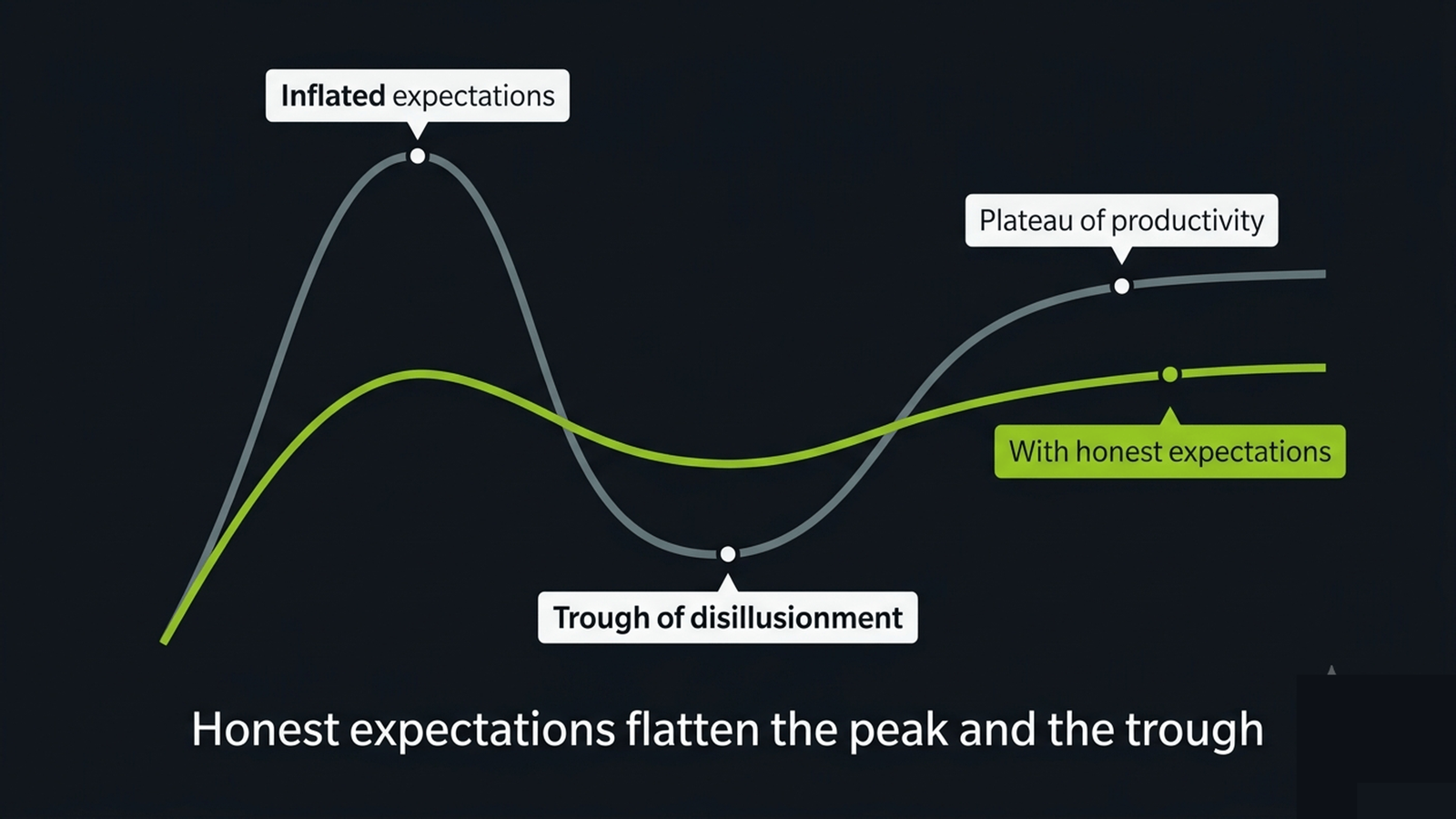
- Gartner's 2025 Hype Cycle for AI places generative AI in the Trough of Disillusionment, the phase that follows inflated expectations. source
- On GhostCite, leading LLMs fabricate citations 14 to 95% of the time depending on model and domain, a concrete failure mode worth naming before deployment. source
Why does overselling cost more than it earns?
An oversold agent buys a burst of enthusiasm and a much larger bill later. People adopt it expecting magic, hit the first confident wrong answer and recalibrate hard, not to the agent's real reliability but below it, because they feel misled. That overcorrection is the trough Gartner describes and it is more expensive than the honest path because it converts neutral users into skeptics. The GhostCite numbers show how quickly the bill arrives: an agent pitched as a flawless researcher that fabricates a citation in front of a customer has not just made an error, it has broken a promise someone made on its behalf.
Honest expectation-setting spends a different, more durable kind of trust. When you tell people the agent handles the common cases well, struggles with the unusual ones and can produce confident wrong answers that need checking, the first failure confirms your credibility instead of destroying it. You said it would happen, it happened and the user's trust in your judgment grows even as their trust in the agent stays appropriately bounded.
What should you actually communicate?
| Message | Oversold | Honest |
|---|---|---|
| Capability | It handles anything | It is strong on these cases |
| Limits | Unmentioned | Named clearly |
| Failure modes | Hidden | Described, with what to check |
| First stumble | Feels like betrayal | Confirms your credibility |
Sold as infallible, the first stumble breaks it; a better model does not stop fabricated citations, so disillusionment sets it. (arXiv:2602.06718)
Honest expectations are easier to set when the agent's behavior is consistent enough to describe accurately, which is what the Pattern Intelligence Layer provides. VibeModel makes reliability legible at the pattern level, so you can tell people precisely which situations the agent handles the same correct way every time and which still need a human and then the agent lives up to exactly the expectations you set.
Frequently asked questions
Won't naming the limits reduce adoption?
It reduces the inflated peak and the painful trough. Honest expectations produce slower but durable adoption, instead of a spike followed by a backlash.
What is the trough of disillusionment?
The phase after inflated expectations where disappointment sets in. Gartner places generative AI there in 2025; honest communication is how you cross it with trust intact.
Which limits matter most to name?
The confident wrong answers, like fabricated citations, that look right and need checking. Those do the most damage when unexpected.