


Key facts.
- Microsoft's Work Trend Index 2025 frames the move to human-agent teams as a redesign of how work is organized, not a tool rollout, which makes change a core workstream.source
- MAKER demonstrates that reliable long-horizon agent execution comes from deliberate decomposition and per-step checking, a sustained engineering effort not a one-off, the same way adoption needs sustained attention.source
Why does change need to be its own workstream?
Adoption is funded work, not a memo; no bigger model installs it, so the change runs as its own stream or the rework lands late. (arXiv:2511.09030)
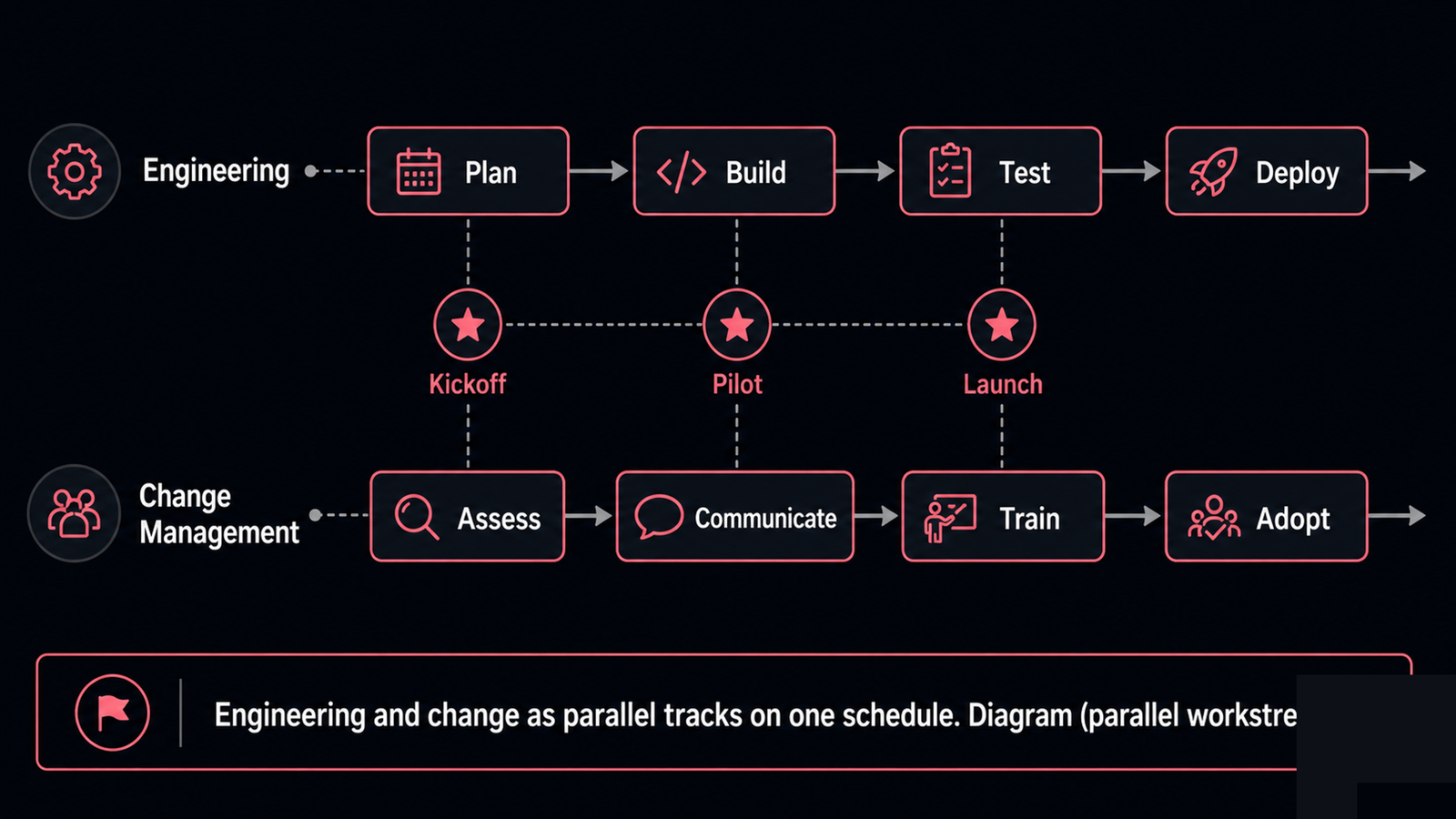
When change management sits at the bottom of the engineering plan, it gets the attention a line at the bottom gets. None. Launch week arrives and someone writes the announcement. By then the workflows haven't been redesigned, the people haven't been trained and the owners haven't been engaged. The agent ships into an organization that isn't ready to use it. Adoption is real work with its own dependencies and its own timeline. The only way it gets done is to fund it as a parallel workstream with a named owner accountable for it, the same as any other part of the project.
The Microsoft framing matters because it names the scale of what you're actually doing. Building human-agent teams reorganizes how work happens. An email doesn't accomplish that. The engineering side sets the tempo. MAKER's lesson is that reliability over long workflows comes from deliberate, continuous effort. The same thing holds on the human side. Both the agent and the organization around it become dependable through sustained work, not a launch-day push.
What does a real change workstream include?
| Element | Change as an add-on | Change as a workstream |
|---|---|---|
| Owner | Whoever has time | Named, accountable |
| Budget | Leftover | Funded alongside the build |
| Timeline | Launch week | Parallel from day one |
| Scope | An announcement | Workflow redesign and training |
Running change in parallel works best when the engineering side delivers something dependable for people to adopt. That's what VibeModel provides as the Pattern Intelligence Layer. When the agent handles its patterns the same correct way every time, the change workstream has a stable target to train people on and redesign work around, instead of chasing a system whose behavior keeps shifting under it.
Frequently asked questions
Who should own the change workstream?
A named person accountable for adoption, with budget and a seat in planning, not whoever has spare time near launch.
When does it start?
Day one, in parallel with the build. Workflow redesign and training need to be ready when the agent is, not scrambled together at launch.
Is this just more process?
It is the process that decides whether the engineering pays off. An unadopted agent delivers nothing, no matter how well built it is.