


Key facts.
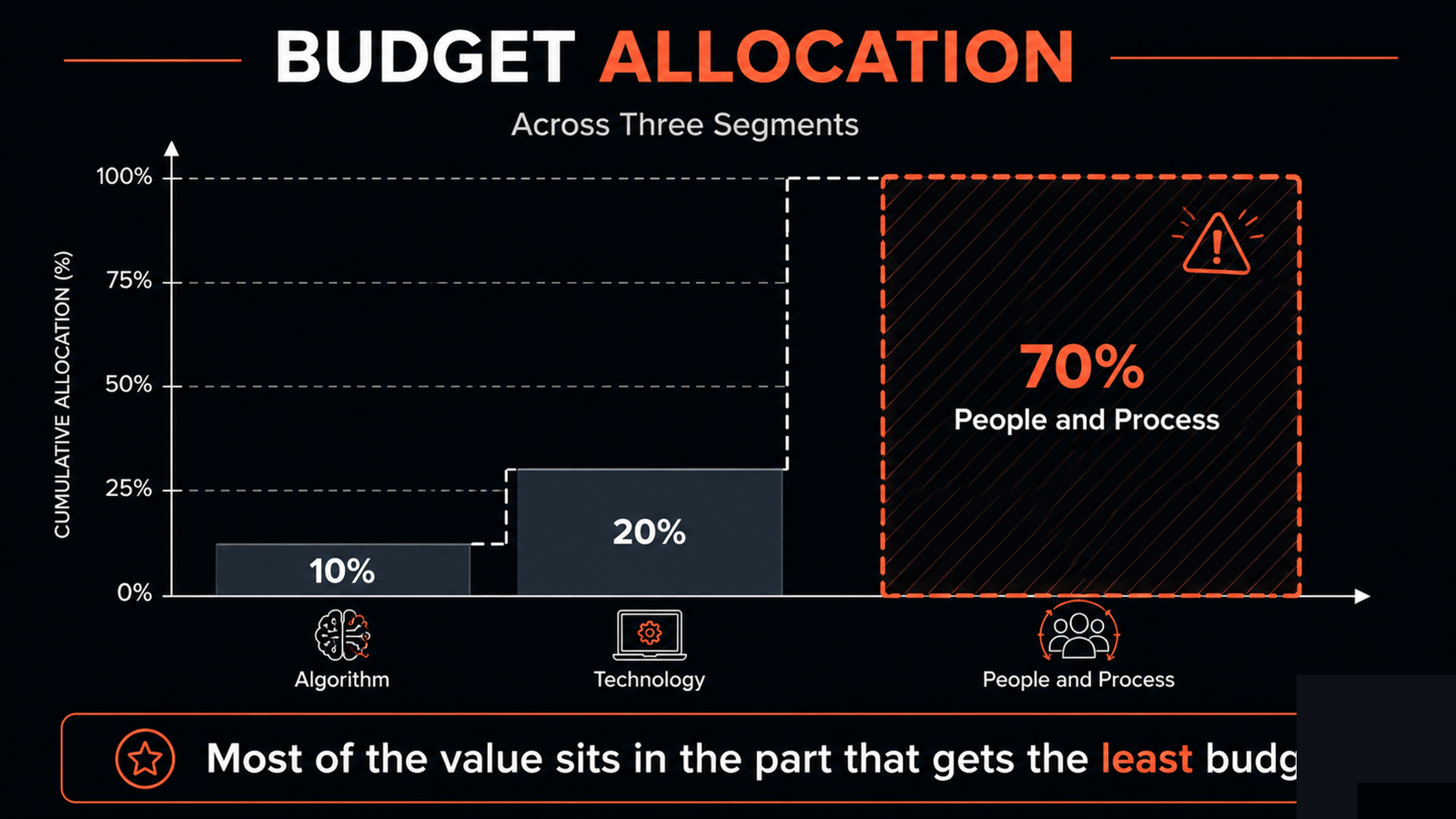
- BCG's 10-20-70 framing puts roughly 70% of the work and value of an AI transformation in people and process, 20% in technology and data, and 10% in the algorithms themselves. source
- EY's 2025 research found companies miss up to 40% of potential AI productivity gains because of gaps in talent and adoption strategy, not model quality. source
- WebArena reports the best agent finishing 14.4% of real web tasks versus 78.2% for humans, a reminder that the agent needs process scaffolding to be useful. source
- Funding the workflow redesign is where return lives; a stronger model will not save you (WebArena: 14.4%). (arXiv:2307.13854)
Where does the value actually go?
The instinct is to spend the budget where the excitement is: the model, the integration, the demo. BCG's framing says that is backwards. The algorithm is roughly a tenth of the work. The bulk is redesigning the workflow the agent sits in, training the people who run it and rebuilding the process around what the agent can and cannot do. Teams that fund the 10% generously and treat the 70% as a launch afterthought end up with a working model attached to a process that was never adjusted to use it. The model runs. The value does not show up.
This is why two companies can buy the same model and get opposite results. The one that did the process work gets the EY upside. The one that skipped it leaves up to 40% of the gains on the floor and cannot figure out why, because the dashboard says the model is fine. The model is fine. The change was the missing input.
What does funding the change look like?
| Investment area | Skip change management | Fund change management |
|---|---|---|
| Budget split | Most on model and tooling | Most on process and people |
| Workflow | Unchanged around the agent | Redesigned to use the agent |
| Training | A launch email | Role-specific, ongoing |
| Result | Up to 40% of gains lost | The return the model promised |
Reliability is the thread that ties this together. People only redesign their work around an agent they can trust to behave the same way twice. VibeModel is the Pattern Intelligence Layer because consistent behavior at the pattern level is what makes the process redesign safe to commit to. Get the reliability right and the change management has something solid to build on. Skip it and you are asking people to rebuild their work around a system they cannot predict.
Frequently asked questions
Is 10-20-70 a hard rule?
No, it is a rough split BCG uses to make a point: people and process dominate the work of getting value from AI and they are usually the underfunded part.
Why does skipped change management cost so much?
Because the model only produces value through a workflow. If the workflow is unchanged, the agent has nowhere to deliver and the gains EY measured never land.
Where should the first dollar go?
Into understanding and redesigning the target workflow, then training the people in it. The model can wait; the process cannot.