


Key facts.
- KPMG's 2025 Pulse Survey found 65% of leaders cite scaling use cases and 62% cite workforce skills gaps as their top challenges to ROI, pointing at execution rather than funding. source
- Veracode's 2025 GenAI Code Security Report found about 45% of AI-generated code samples contained security flaws, a downstream cost of skimping on the human and process side. source
Why does the change line item get skipped?
The technical cost of an agent is easy to estimate: model usage, integration, engineering time. The change cost is fuzzier, the training hours, the workflow redesign, the standing oversight, so it gets waved through as an afterthought or omitted entirely. The result is a business case that funds the build and starves the adoption, which is precisely the gap KPMG's leaders are pointing at when they name scaling and skills, not funding, as the barriers to ROI. The money went to the part that was easy to price and the project stalled in the part that was not.
Quantifying the change work is unglamorous but decisive. Estimate the training the team needs, the process redesign hours and the ongoing oversight cost and put them in the case as real numbers. The Veracode finding is a useful argument for the oversight line specifically: nearly half of AI-generated code carried flaws, so the review and verification you did not budget for is not optional, it is a cost you will pay either deliberately up front or expensively after an incident. A funded change line is the difference between a project that delivers and one that demos.
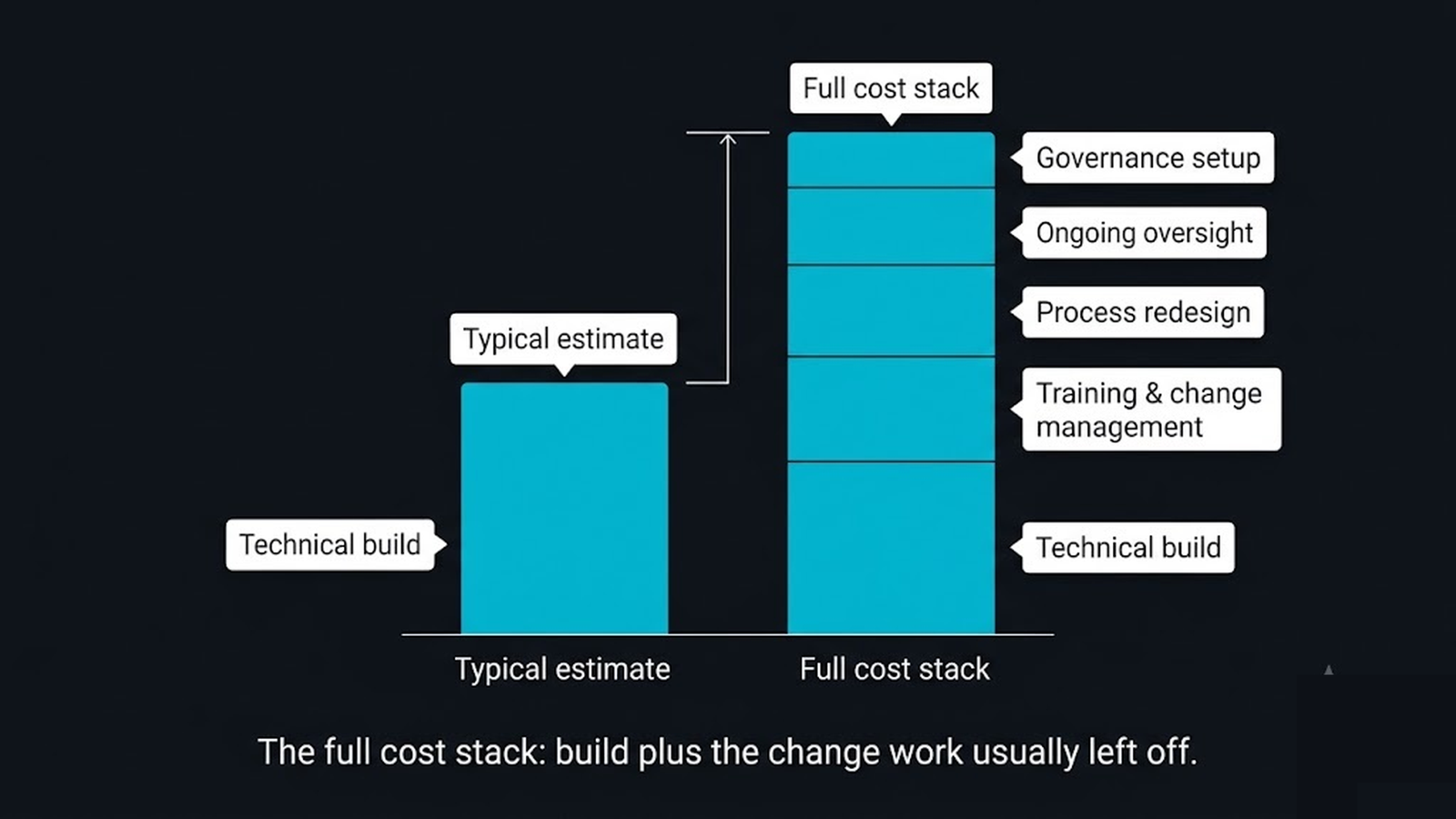
What goes in the change line item?
| Cost | Usually budgeted | Often omitted |
|---|---|---|
| Technical build | Yes | (covered) |
| Training | Rarely sized | Role-specific hours |
| Process redesign | Assumed free | Real workflow work |
| Ongoing oversight | Skipped | Verification and review |
Sizing the oversight line is easier when you can see where the agent actually needs checking, which is what the Pattern Intelligence Layer makes visible. VibeModel surfaces reliability at the pattern level, so you can estimate oversight cost from where the agent is and is not reliable rather than guessing and the business case reflects what it truly takes to make the agent pay off instead of funding only the half that was easy to price.
Frequently asked questions
Why not just fund the technical build first?
Because the model alone does not deliver value; the change work does. KPMG's data shows execution and skills, not funding the model, are what block ROI.
How do you size the oversight cost?
From where the agent needs checking. Findings like Veracode's ~45% flawed code show review is a real, recurring cost, not a one-time pass.
What happens if you skip the change line?
You fund half a project. The build ships, adoption stalls and the saved change cost reappears as incidents and rework.