

Key facts.
- DORA finds even elite teams have a non-zero change failure rate, kept low (strong teams ~0-15%) through gating and fast recovery. source
- Reliable rollback and recovery, with high performers recovering quickly, is what makes a failed change survivable. source
- An agent's diagnosis and action accuracy on real incidents is low, so its changes fail at least as often as a human's and need the same controls. source
Why are approval and rollback non-negotiable for agent changes?
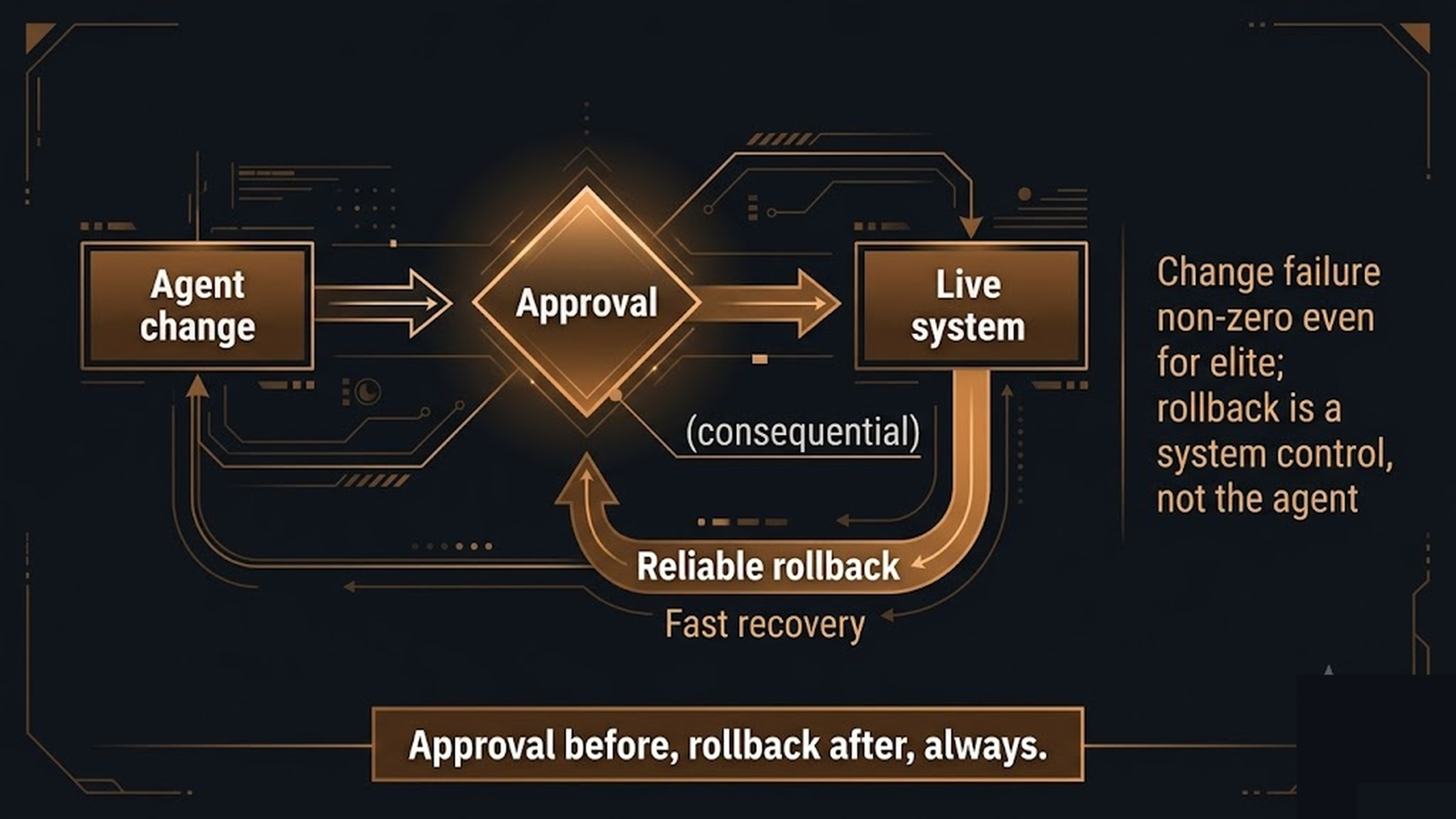
Because change failure is a fact of operations, not a sign of incompetence and the controls are what make it survivable. DORA's research is clear that even the best teams fail some changes, keeping the rate low only through disciplined gating and recovering fast when a change does break, which means the question is never whether a change will fail but whether you can catch or reverse it when it does. An agent acting on production inherits this reality and arguably worsens it, since its accuracy on real incidents is low, so its changes are at least as likely to be wrong as a skilled human's and it applies them faster. Without approval, a consequential change the agent got wrong, from a misdiagnosis or a brittle action, goes straight to live systems with no second look; without reliable rollback, that bad change cannot be quickly reversed and becomes a prolonged outage. So the approval gate and the rollback are not optional safety extras, they are the same discipline that keeps even elite human change failure rates low and recoverable and an agent that skips them is operating with a higher failure rate and no net. The agent's speed makes the controls more important, because it can apply a bad change before any human notices and only a pre-approval gate and a fast rollback bound the damage.
The recovery dimension matters as much as the failure rate. High performers are defined not only by failing less but by recovering fast and an agent acting on production needs that fast, reliable rollback so the change that does break is a brief incident rather than a long one, especially since the agent cannot be relied on to correctly diagnose and reverse its own bad change.
What controls does every agent change need?
Approval for consequential changes and reliable, fast rollback. Require explicit human approval before the agent applies a change with real blast radius, so a misdiagnosed or brittle change gets a second look rather than going straight to production. Keep rollback reliable and fast, so the change that fails and some will, is reversed in minutes rather than debugged under a live outage. Do not rely on the agent to recognize or reverse its own bad change, since its diagnostic accuracy is low; make the rollback a system control that works regardless. These are the controls DORA shows keep human change failure recoverable and an agent acting on live systems needs them as a hard requirement, not a recommendation, because its inevitable bad change must land as a caught or reversed mistake, not an outage.
| Change handling | When a change fails |
|---|---|
| Agent applies directly, no rollback | Bad change becomes a prolonged outage |
| Approval gate plus reliable rollback | Caught before or reversed in minutes |
DORA finds elite teams fail changes 0% to 15%, surviving by gating; a more capable agent without approval turns a bad change into an outage. (arXiv:2502.05352)
Building those controls is part of what VibeModel does as the Pattern Intelligence Layer. We model the patterns of a consequential change that needs approval and the rollback that makes failure survivable, so an agent's changes to production carry the discipline that keeps change failure recoverable rather than removing it.
Frequently asked questions
Why require approval if the agent is usually right?
Because changes fail at a non-zero rate even for elite teams and the agent's incident accuracy is low. Approval catches the consequential bad change before it ships.
Can the agent roll back its own change?
Do not rely on it. Its diagnostic accuracy is low, so rollback must be a system control that works regardless of the agent.
Why does the agent need this more than a human?
Because it applies changes faster and reasons about consequences no better, so a bad change can reach production before a human notices.