


Key facts.
- DORA research finds elite teams keep change failure rates low, with strong teams generally in the roughly 0 to 15% range, achieved through gating and staged rollout. source
- Infrastructure changes, scaling, restarts, config edits, have consequences across dependent systems that are easy to under-reason. source
- The controls that keep change failure low, approval, staged rollout, rollback, are exactly what an unguarded agent skips. source
Why are infrastructure changes so dangerous for an agent?
Because infrastructure is highly connected and a change to it propagates in ways that are hard to fully reason about even for humans, which is why mature teams wrap changes in discipline. An agent scaling a service, restarting a node or editing a configuration is making a change whose effects ripple across dependent systems and the agent, like a human, cannot perfectly predict those effects, but unlike a disciplined human process, an unguarded agent applies the change directly without the approval, staging and rollback that catch a bad change before it becomes an outage. The DORA finding is the relevant benchmark: even elite human teams have a non-zero change failure rate, kept low only through gating and staged rollout, which means changes fail sometimes no matter how skilled the operator and the controls are what keep the failure rate low and recoverable. An agent that applies infrastructure changes without those controls is operating with a higher effective failure rate and no safety net, so the change it did not fully reason about and there will be such changes, lands directly on production as an outage rather than being caught in staging or rolled back. The danger is not that the agent is reckless; it is that infrastructure changes are inherently risky and the agent is removing the discipline that manages that risk.
The connectedness is what makes the consequences unintended. A config change that looks local touches a shared dependency; a restart that seems safe drops in-flight work; a scaling action that should help triggers a cascade. These are exactly the effects that staged rollout surfaces before full deployment and that an agent applying changes directly does not.
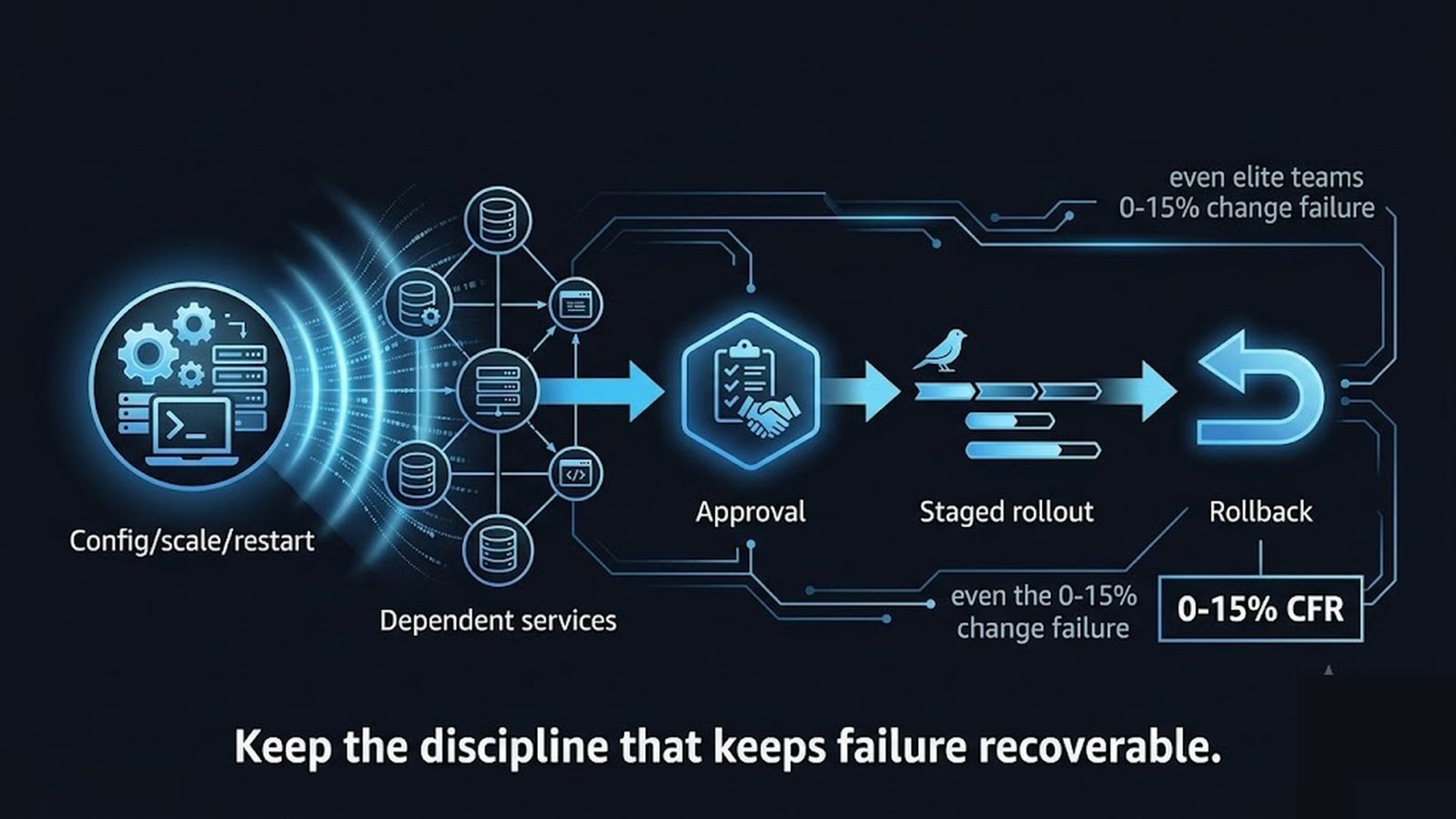
What controls make agent changes safe?
The same controls that keep human change failure rates low: approval, staged rollout and reliable rollback. Require human approval for consequential infrastructure changes, so a change the agent did not fully reason about gets a second look. Apply changes through staged rollout, canary first, so an unintended consequence surfaces on a small slice before it hits all of production. Keep reliable rollback so a bad change is reversed in minutes. These are not bureaucracy; they are the discipline that gives even elite human teams their low change failure rate and an agent making infrastructure changes needs them more, not less, because it reasons about the consequences no better than a human and applies changes faster.
| Change handling | Outcome |
|---|---|
| Agent applies changes directly | Unintended consequences become outages |
| Approval, staged rollout, rollback | Bad changes caught and recoverable |
Gating those changes is part of what VibeModel does as the Pattern Intelligence Layer. We model the patterns of a consequential infrastructure change and where the approval, staging and rollback gates belong, so an agent's changes carry the discipline that keeps change failure rates low instead of removing it.
Frequently asked questions
Why gate an agent's changes more than a human's?
Because the agent reasons about consequences no better than a human but applies changes faster, so it needs the discipline more, not less.
What controls matter most?
Approval for consequential changes, staged rollout to surface unintended effects on a small slice and reliable rollback to recover quickly.
Why is staged rollout important?
Because infrastructure changes ripple unpredictably; staging surfaces the unintended consequence on a canary before it hits all of production.