


Key facts.
- The Amazon Q extension incident (CVE-2025-8217) showed a single shared component, the build pipeline, propagating injected code to a widely-distributed extension.source
- The injected code was intended to wipe systems and would have hit every machine that updated, a system-wide blast radius from one compromised shared piece.source
- Shared configuration and infrastructure are high-fan-out dependencies, so an error there propagates not staying contained.source
Why does a shared-component change cascade?
Amazon Q's wipe hit every machine through one pipeline; whether a more capable agent edits config or the tool is hijacked, the radius is total. (source)
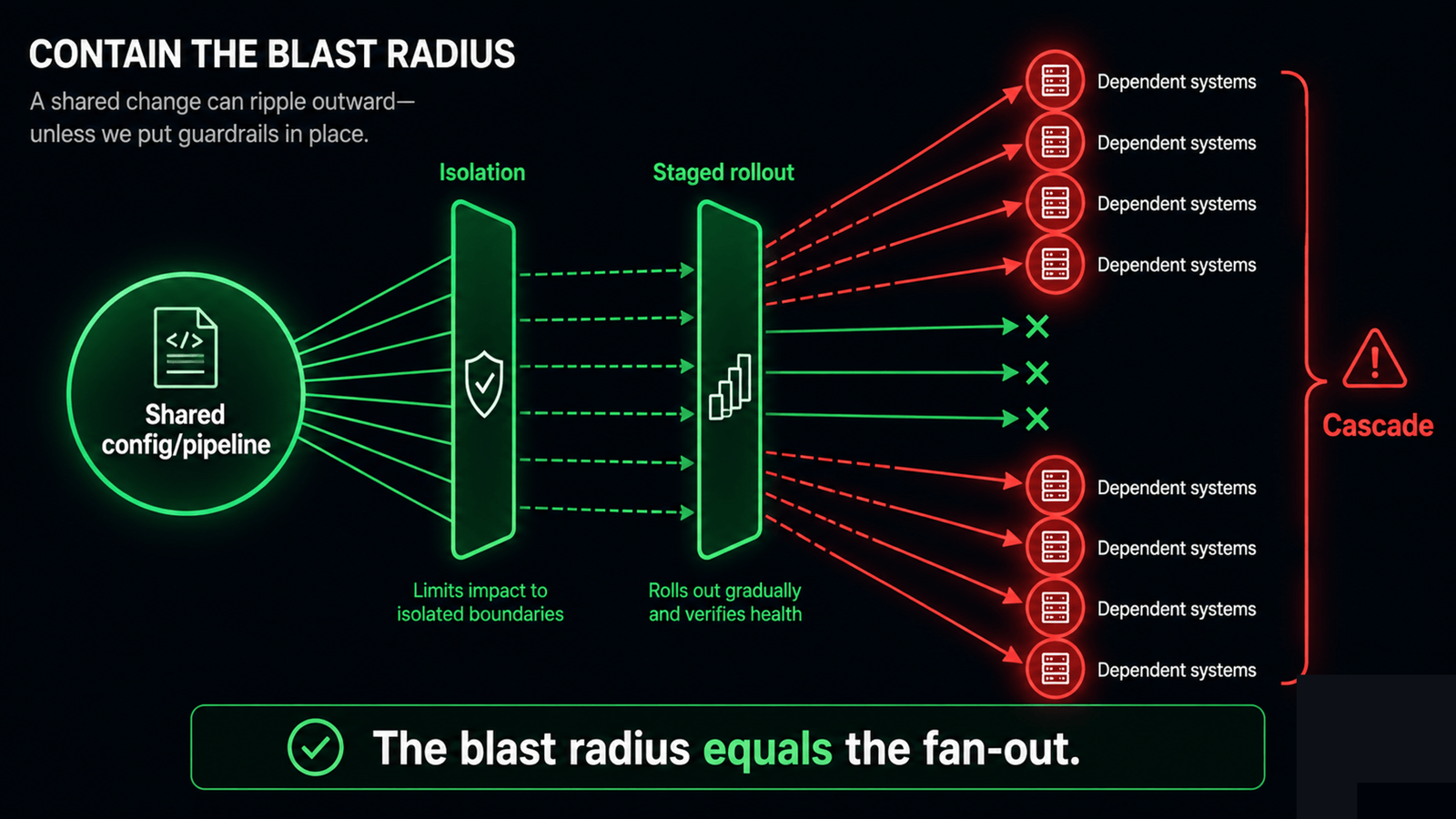
Shared infrastructure is what many systems depend on. Change it, and everyone downstream is affected. That's the geometry. An edit to a feature flag, a deployment manifest, a network rule, it doesn't stay local. It propagates. Amazon Q was the supply-chain version: the build pipeline was a shared component. The malicious payload it carried would have reached every machine that ran the update. The direction doesn't matter. Agent making a careless edit or tooling being subverted, same result. The blast radius equals the fan-out of the shared thing that changed. High fan-out is precisely where you can't afford an unguarded change.
A coding agent touching shared infrastructure is categorically riskier than one touching an isolated service. Error in an isolated component, one service fails. Error in a shared component, everything that depends on it fails. The agent usually has no idea how wide the dependency reaches. It treats a shared-config edit exactly like a local file change. The control has to supply the caution the agent doesn't have.
What contains the cascade?
Isolation and approval, calibrated to fan-out. Any change to shared infrastructure is high-consequence by default. It needs explicit approval. It needs staged rollout, not direct application. That way a bad change gets caught before it reaches everything. Keep agents in scopes where their changes have bounded surfaces. Gate anything that touches a shared dependency. The Amazon Q and Replit incidents both show the same thing: the unguarded change to the shared, central component is the one that becomes an outage.
| Change target | Failure if unguarded |
|---|---|
| Isolated component | One service fails |
| Shared config or infrastructure | Everything downstream fails |
Scaling controls to fan-out is part of what VibeModel does as the Pattern Intelligence Layer. We model the patterns of a high-fan-out change to shared infrastructure and where the isolation and approval gates belong. A coding agent cannot turn one config edit into a system-wide outage.
Frequently asked questions
What counts as shared infrastructure?
Anything many systems depend on: shared configs, feature flags, deployment manifests, network rules, build pipelines. A change there has system-wide reach.
Why is the agent careless with high-fan-out changes?
It often has no model of how wide a dependency reaches, so it treats a shared-config edit like a local one. The control has to enforce the caution.
Does staged rollout help?
Yes. It limits how far a bad shared change propagates before it is caught, turning a cascade into a contained incident.