


Key facts.
- MicroRemed requires models to generate executable remediation playbooks that actually run and restore the system, testing end-to-end execution, not just reasoning. source
- The gap between proposing a fix and executing it correctly through real tools is where the automation becomes brittle. source
- Agents fail at tool boundaries on parameter and call correctness even when their higher-level reasoning is sound. source
Why does the tool boundary break the automation?
MicroRemed shows the gap is turning a diagnosis into a fix that runs; a more capable model reasons well and still must execute correctly through real tools. (arXiv:2511.01166)
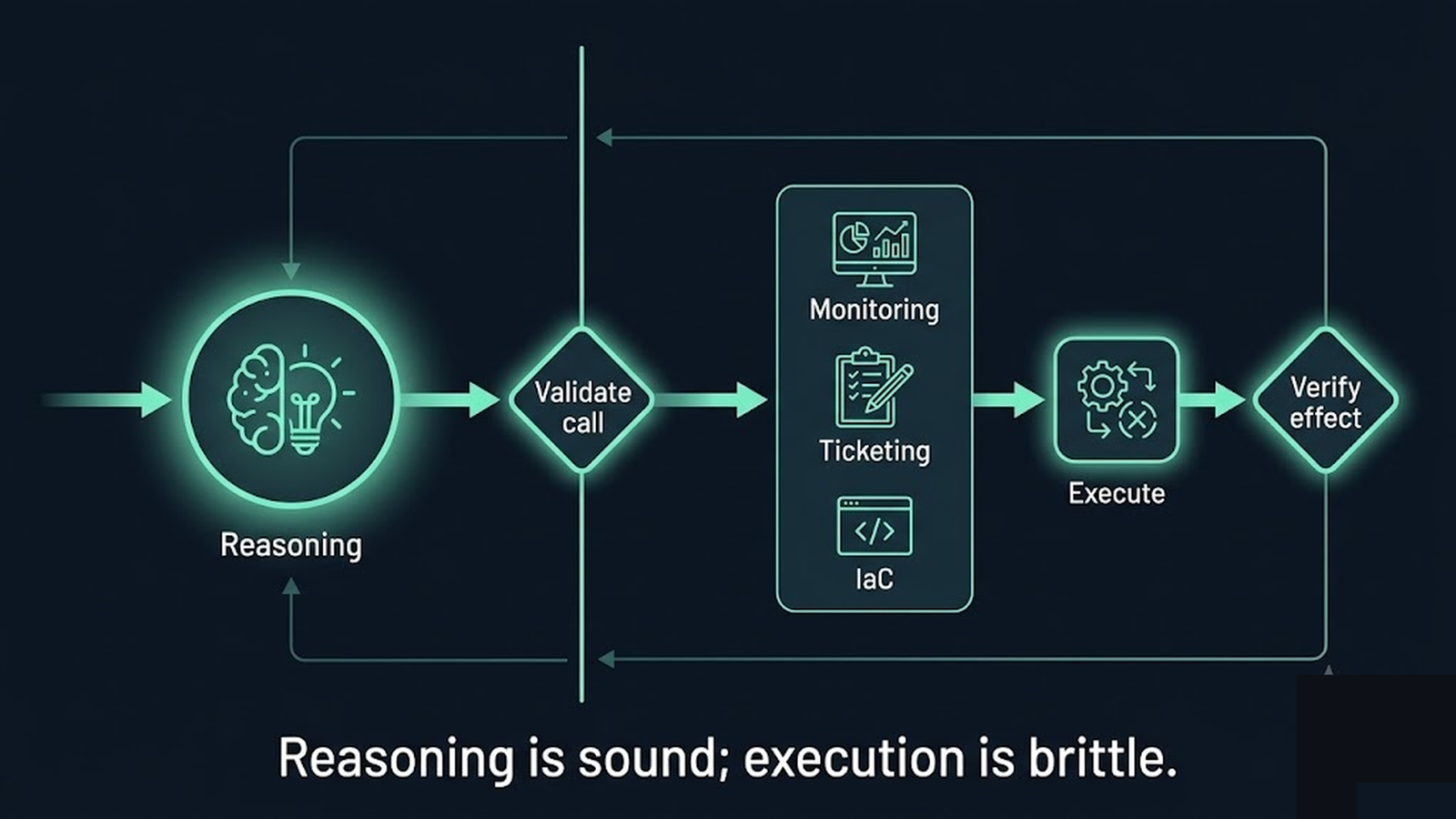
Because reasoning about an incident and executing an action through real operational tools are different skills and the execution is where the brittleness lives. The agent can analyze logs and metrics and arrive at a sensible plan, restart this service, update that config, open this ticket, but then it has to actually carry that out through your monitoring system, your ticketing system and your infrastructure-as-code tooling, producing the exact API calls, the correct parameters, the right playbook and that is where it fails. MicroRemed makes this concrete by requiring the model to generate an executable playbook that actually runs and restores the system, not just to describe a fix and the difficulty of that end-to-end execution is the point: a plan that reads well is not an action that runs correctly. An agent that gets the incident reasoning right and then generates a malformed infrastructure command, a wrong ticket field or a playbook that errors on execution has not remediated anything and in IT ops a brittle execution against live systems can leave the incident unresolved or, worse, partially apply a change that creates a new problem. The integration with the real tools is the load-bearing part and it is exactly the part that proves fragile.
This is why a sound diagnosis is necessary but not sufficient. The automation has to survive contact with the actual tools and those tools have strict, unforgiving interfaces where a small error in a parameter or a call breaks the action, which is the same boundary-failure pattern that defeats agents in other domains, now against monitoring and infrastructure systems where a broken action has operational consequences.
What hardens the integration?
Validation before execution and verification after, at every tool boundary. Before the agent's action runs against monitoring, ticketing or infrastructure, validate that the call and its parameters are well-formed and target the intended system, catching a malformed command or wrong field before it executes. After execution, verify that the action actually took effect, the ticket created correctly, the config applied, the service restored, rather than trusting the agent's report. Treat the boundary with the operational tools as the fragile part, because MicroRemed shows end-to-end execution is where the difficulty concentrates and build the checks there. The agent's reasoning can be sound; the action through the tools is what has to be validated and verified to make the automation reliable rather than brittle.
| Integration handling | Result |
|---|---|
| Trust the agent's action through tools | Brittle execution, broken or partial actions |
| Validate before, verify after | Malformed actions caught, effects confirmed |
Hardening that boundary is part of what VibeModel does as the Pattern Intelligence Layer. We model the patterns of a correct action through monitoring, ticketing and infrastructure tools and verify the effect, so IT ops automation holds at the tool boundary where end-to-end execution otherwise proves brittle.
Frequently asked questions
Why does sound reasoning not guarantee a working action?
Because executing through real tools is a separate skill. MicroRemed shows end-to-end execution, generating a playbook that actually runs, is where the difficulty concentrates.
What makes the tool boundary fragile?
Strict, unforgiving interfaces where a small parameter or call error breaks the action, against systems where a broken action has operational consequences.
How do I harden it?
Validate the call and parameters before execution and verify the effect after, treating the boundary with operational tools as the load-bearing, fragile part.