


Key facts.
- MicroRemed tests end-to-end remediation, from diagnosis to an executable fix that restores the system, which is hard even within a single agent. source
- Chaining specialized agents adds coordination surface to incident-response work that is unreliable within each stage. source
- Agent diagnosis accuracy on real incidents is low, so a wrong diagnosis handed to remediation drives a wrong fix under time pressure. source
Why does the chain break under pressure?
Because incident response is a chain where each stage hands its output to the next and a live incident is the worst possible time for a handoff to fail. The detection agent flags an issue, the diagnosis agent identifies a cause, the remediation agent applies a fix, the notification agent informs the team and each boundary is a place where the previous agent's output can be dropped, misread or acted on wrongly. The work is already unreliable within each stage, diagnosis accuracy on real incidents is low and end-to-end remediation is hard enough to warrant its own benchmark, so the handoffs are stacking coordination risk on top of stage-level unreliability. Under the time pressure of a live outage, the failure modes compound: a low-confidence diagnosis is handed to remediation as if it were certain, the remediation agent acts on it fast because the incident is urgent and a wrong fix is applied to a misdiagnosed cause while the clock is running, which can extend the outage rather than resolve it. The notification stage then reports a resolution that did not happen, so the team stands down while the incident continues. The chain that looked like an automated SRE team behaves, under pressure, like a relay where each runner might drop the baton and dropping it during an incident means a longer outage.
The urgency is what makes the coordination failures expensive. In a calm setting a handoff error might be caught; during a live incident, the pressure to act fast means a misread or dropped handoff is acted on immediately, so the coordination failure converts directly into prolonged downtime, which is the outcome incident response exists to prevent.
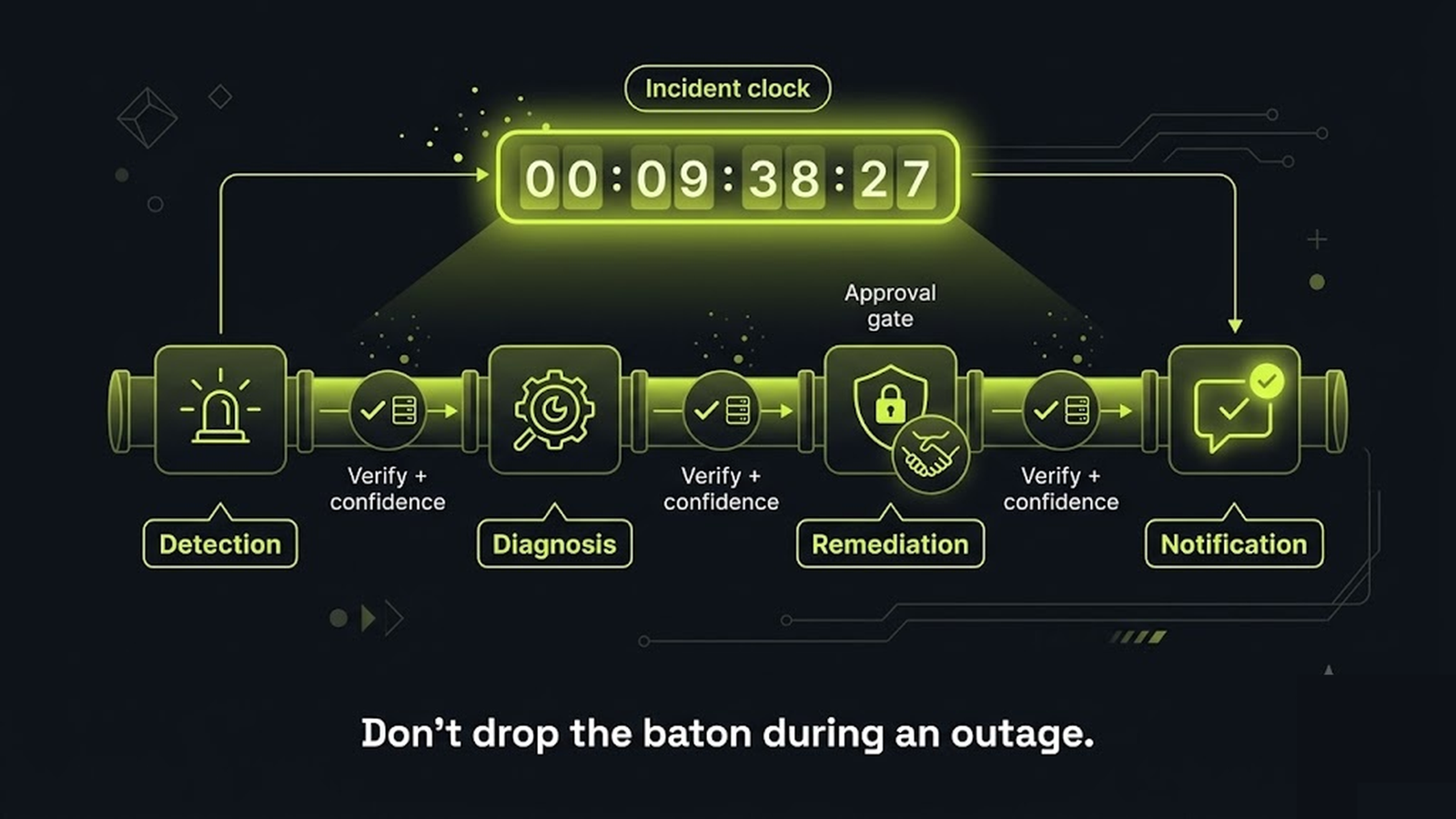
What makes the chain hold?
Verified handoffs and honest confidence, with human gates at the consequential stages. Verify each handoff so the remediation agent confirms it understood the diagnosis before acting and the notification agent confirms the remediation actually resolved the incident before reporting it. Pass confidence along the chain, so a low-confidence diagnosis is flagged as uncertain rather than handed on as fact and the remediation stage treats it accordingly. Gate the consequential action, remediation on a live system, behind a check or human approval given the low diagnostic accuracy, so a wrong diagnosis does not drive a fast wrong fix under pressure. The chain holds when the handoffs are verified and the urgency does not override the checks, not when it merely has a box for each incident-response role.
| Chain design | Behavior under incident pressure |
|---|---|
| Unverified handoffs, act fast | Wrong fix on a misdiagnosis, prolonged outage |
| Verified handoffs, gated remediation | Coordination errors caught before they extend the incident |
Securing those handoffs is part of what VibeModel does as the Pattern Intelligence Layer. We model the patterns of a verified handoff between incident-response stages and where the remediation gate belongs, so a multi-agent incident-response chain holds under pressure instead of dropping the baton during an outage.
Frequently asked questions
Won't a stronger model make the incident-response chain hold together?
End-to-end remediation is hard within one stage (MicroRemed); a more capable agent at diagnosis does not fix a handoff that drops its output. (arXiv:2511.01166)
Should I chain specialized incident agents?
Only with verified handoffs and gated remediation. The stage-level work is unreliable, so unverified handoffs compound the risk under pressure.
Why is incident pressure the problem?
Because the urgency pushes the chain to act on a misread or dropped handoff immediately, converting a coordination error directly into prolonged downtime.
What must the notification stage verify?
That the remediation actually resolved the incident before reporting it, so the team does not stand down while the incident continues.