


Key facts.
- Visible symptoms are often many steps downstream of the cause, MAKER error-corrects every atomic step because compounding across the chain causes total failure (MAKER, 2025).
- Interaction channels grow combinatorially: n agents create n(n-1)/2 pairwise channels, so the search space expands far faster than the agent count.
- Failures are hard to reproduce: 1,000 temperature-0 runs of one prompt diverged into 80 distinct outputs (Thinking Machines, 2025). You can't fix what you can't reliably trigger.
What makes the search so slow?
Separated cause and symptom inflate MTTR as a class; an upgrade inherits the compounding chain, and the rework runs long. (arXiv:2511.09030)
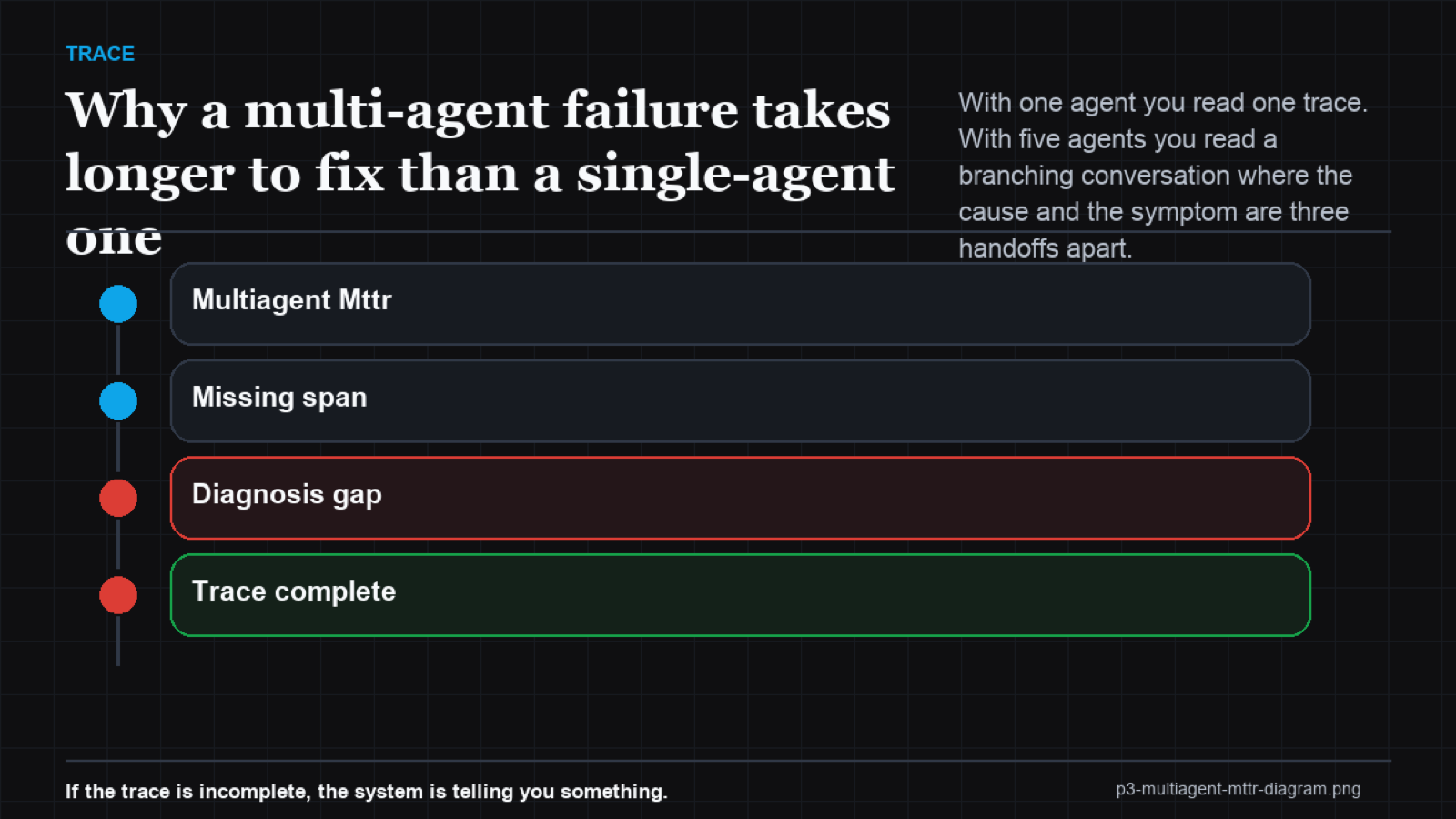
Three things compound. The cause propagates: a bad output at step one gets consumed, transformed, and re-emitted before it surfaces as a wrong answer at step four. The trace branches: parallel subagents produce parallel histories you must reconcile. And re-running the system may not reproduce the path that failed. A single agent gives you one linear trace and one bug. A multi-agent system gives you a graph, and the bug is a property of the graph, not any single node.
What shortens MTTR here
Interaction-level tracing with stable correlation IDs across handoffs, recorded inputs and accepted outputs at every boundary, and pattern detection that flags misalignment before it propagates four steps downstream. The goal is to move the alarm from the symptom back to the cause.
This is where VibeModel's Pattern Intelligence Layer earns its place. By recognizing the failure pattern at the boundary where it starts, we collapse the distance between cause and symptom, your team reads the right handoff instead of the whole graph. Faster localization is lower MTTR. Lower MTTR is a healthier system.
Frequently asked questions
Can better logging alone fix MTTR?
It helps, but raw logs of a branching non-deterministic system are a haystack. You need pattern-level signals that point at the boundary that failed.
Does reducing agent count lower MTTR?
Often, yes. Fewer agents means fewer channels and a smaller search space. Start small for reliability, not just cost.