


When every agent thinks it might own the task, none of them do.
Key facts.
- Role allocation failure is formally defined as a condition where the agents' assigned or emergent role configuration is misaligned with task requirements — it does not require the agents to be individually broken (MAST, arXiv:2503.13657, 2025).
- Gartner projects 30% of agentic AI projects will be abandoned after proof of concept by end of 2025, with coordination failures — not model capability gaps — cited as a primary driver (Gartner, 2025).
- Coordination failures produce emergent behaviors that cannot be predicted from individual agent testing, so pre-deployment testing of each agent in isolation gives false confidence (Galileo AI, 2025).
- Nature's 2025 paper on decentralized adaptive task allocation confirms that behavior-based role assignment in dynamic systems is an active research problem, not a solved one (Nature Scientific Reports, 2025).
How dynamic allocation creates the conditions for role conflict
Static role assignment is predictable: Agent A always handles data retrieval, Agent B always handles transformation. Each agent's prompt encodes its role boundary. Dynamic allocation breaks this by assigning roles at runtime based on task context. The orchestrator sees a task, judges which agent is best suited, and routes accordingly.
The failure case appears when two closely related sub-tasks arrive simultaneously. The orchestrator routes both to agents that share a partial capability, both agents begin, and their execution paths overlap. Neither agent knows the other has started. The task gets done twice with different outputs, or both agents reach the same blocking condition and stall waiting for the other to proceed first.
This is not a bug in any one agent. It is a gap in the allocation logic. The orchestrator had no exclusivity mechanism — no way to claim a sub-task as in-flight before routing it. Adding more agents doesn't solve this. It adds more potential overlaps.
Why role confusion compounds at scale
In a two-agent system, there are two possible role assignments to get wrong. In a ten-agent system, there are 90 ordered pairs. Every additional agent multiplies the combinations the allocation logic must handle correctly. Dynamic systems that do fine at three agents break at seven because the allocation algorithm was never tested against the combinatorial space that scale creates.
The failure mode researchers call "ping-pong" captures this: Agent A passes the task to Agent B, which passes it back to Agent A, because each agent's role definition includes enough overlap that neither considers the task fully outside their scope. The orchestrator watches the loop without intervening because each individual pass looks like a legitimate delegation.
Penn State and Duke research in 2025 confirmed that failures in complex multi-agent systems are "not only common but incredibly difficult to diagnose" precisely because the failure pattern requires observing multiple agents' state simultaneously (Galileo AI, 2025).
What explicit ownership boundaries look like in practice
An ownership boundary is a non-overlapping mapping from task class to agent. Not "Agent A is good at data tasks" but "Agent A is the exclusive owner of tasks tagged data_retrieval. No other agent may start a task with that tag." The tag is set at task creation, not at routing time.
This converts the dynamic allocation problem into a static lookup. The orchestrator doesn't decide which agent is best — it reads the tag and routes deterministically. When two tasks with the same tag arrive, the second queues behind the first rather than spawning a concurrent conflict.
The NeurIPS 2024 DEPART framework formalizes this as the Divide step: complex tasks are decomposed into sub-tasks with explicitly assigned types before any routing occurs. Routing happens after decomposition, not in place of it. That ordering eliminates the race condition.
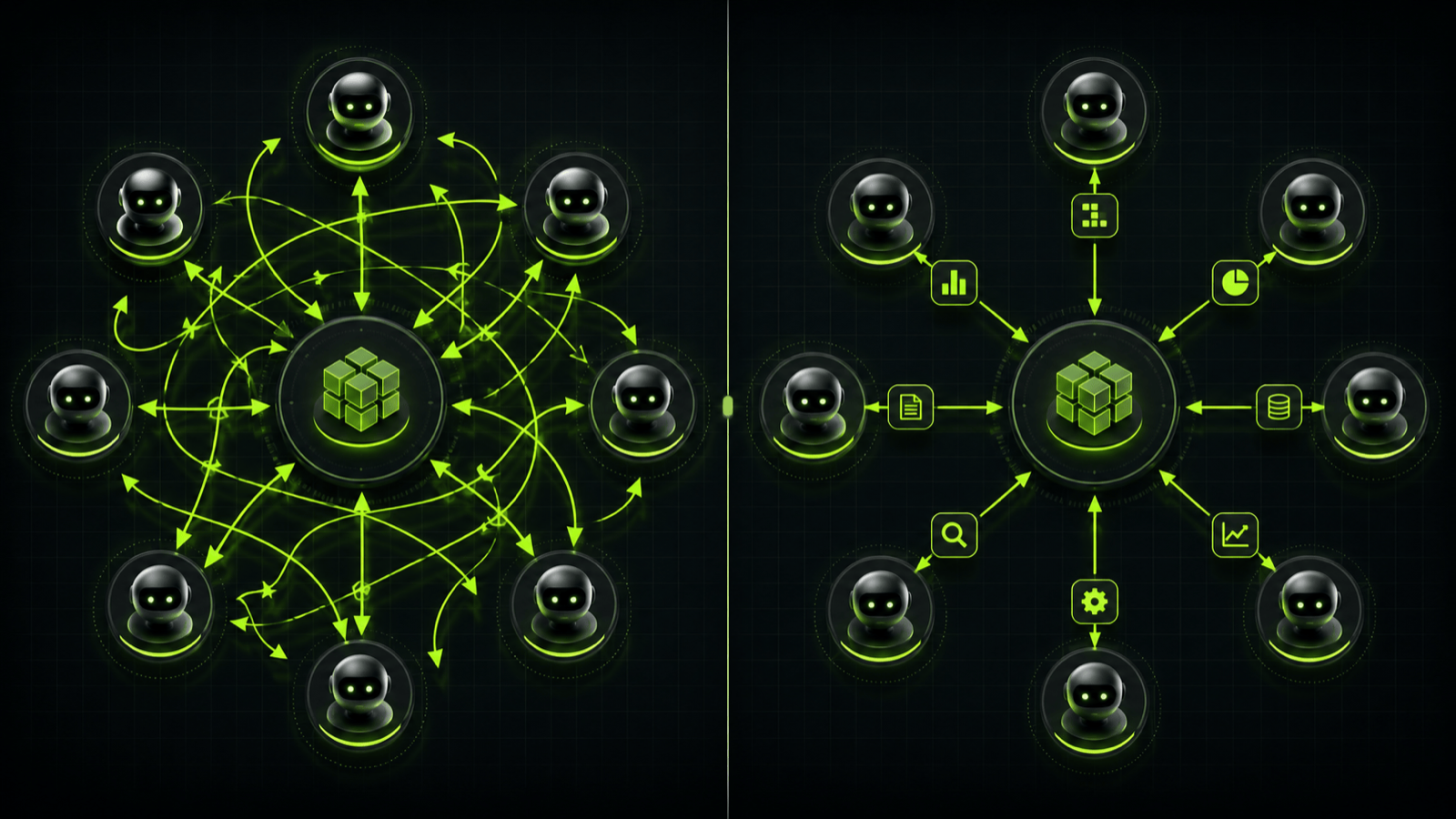
Dynamic allocation (left) allows overlapping assignments. Static ownership tags (right) eliminate the ambiguity before routing.
| Agent count | Role conflict surface | Common failure mode | Mitigation |
|---|---|---|---|
| 2 | 1 pair | Duplicate execution on shared capability | Clear non-overlapping role definitions |
| 5 | 20 pairs | Ping-pong loops on borderline tasks | Task-type tagging before routing |
| 10 | 90 pairs | Allocation collisions, stalls, orphaned tasks | Exclusive ownership registry + queue |
| 20+ | 380+ pairs | Emergent behavior unpredictable from unit tests | Decomposition before routing (DEPART pattern) |
Role confusion at scale is a pattern matching problem: the system needs to match each task to exactly one owner before execution begins. VibeModel's Pattern Intelligence Layer models which task-type to agent-role mappings in your specific workflow produce the allocation conflicts, so you can tighten boundaries on the exact combinations that fail rather than rebuilding the entire allocation design.
Frequently asked questions
Why does my two-agent system work fine but my five-agent system breaks?
Because the number of possible role conflict pairs scales as n×(n-1). Two agents have one pair to handle correctly. Five have twenty. The allocation logic that was sufficient at two agents hits untested combinations at five, and some of those combinations produce duplicate execution or ping-pong loops.
Is dynamic task allocation inherently unreliable?
Not inherently. The reliability problem comes from combining dynamic allocation with overlapping role definitions. If each task type maps to exactly one agent regardless of how routing decisions are made at runtime, dynamic allocation can be reliable. The danger is using capability as a routing signal when multiple agents share that capability.
What is the ping-pong failure mode in multi-agent systems?
Ping-pong is when Agent A passes a task to Agent B, which passes it back to Agent A, indefinitely. It happens when both agents' role definitions include enough overlap that each agent treats the task as partially outside its exclusive scope and delegates rather than completing.
How do I observe role confusion in production traces?
Look for task IDs that appear in more than one agent's in-progress log simultaneously, or task IDs that pass between two agents more than once. Either pattern signals a role overlap. An exclusive ownership registry where each task is claimed by one agent before execution begins eliminates both signals.